
- Catalogs
- 3B Scientific
- Hemorrhage Control Leg Trainer P103


Hemorrhage Control Leg Trainer P103

Hemorrhage Control Leg Trainer P103
The Hemorrhage Control Leg Trainer P103 and P103D is designed for realistic training in hemorrhage control on the lower extremity. It simulates realistic wound and bleeding scenarios to train students in using tourniquets, wound packing, and managing traumatic thigh injuries. It is particularly useful for Tactical Combat Casualty Care (TCCC) and Civilian Casualty Care training.
Delivery Content
The package includes the Hemorrhage Control Leg Trainer, two wound covers made of 3B SKINlike™ silicone, a 2-liter canister, a hand blood pump system, a canister blood pump system cap, a multiple bleeding connector, 100 grams of blood powder, a carry bag with straps, and a sand bag.
Prepare Simulated Blood
To prepare the simulated blood, mix 20 grams of blood powder with 2 liters of water, stir until smooth, and fill the canister.
How to Fix the Leg to the Sand Bag
Fill the sand bag, attach the leg to it, and secure it with the buckle for stability during training.
Blood Pump System: Setting a Bleeding Scenario
For different scenarios, connect the appropriate bleeding ports to the hand blood pump system. Adjust the black valve to start or stop the training.
Scenarios
- Scenario 1: Single Bleeding Wound - Connect the pump to the selected wound port.
- Scenario 2: Simultaneous 3 Wounds - Connect all three ports to the pump system.
- Scenario 3: Simultaneous Two Bleeding Wounds - Block the unnecessary wound and connect the pump to the selected ports.
Hand Blood Pump and Wound Cover
Use the hand blood pump carefully to simulate realistic blood pressure. Install wound covers for realism and remove them for cleaning.
How to Make the Leg Wearable
Attach the carry bag strap to the leg and secure it around a simulated casualty for realistic training.
Cleaning and Care
Flush the leg blood vessel system with clean water after training to remove any simulated blood residues.
Technical Data
Weight: 5.1 kg
Dimensions: 56 cm length, 58 cm thigh circumference
Operating Temperature: 0°C to +30°C
Storage Temperature: -10°C to +40°C
Contact Information
3B Scientific GmbH, Ludwig-Erhard-Straße 20, 20459 Hamburg, Germany. Phone: +49 (0)40-73966-0, Email: [email protected]
Catalog excerpts

HEMORRHAGE CONTROL LEG TRAINER P103, P103D USER MANUAL
Open the catalog to page 1
HEMORRHAGE CONTROL LEG TRAINER P103, P103D | Contents
Open the catalog to page 2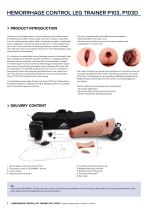
Trainer for hemorrhage control on lower extremity with realistic wound and bleeding simulation. Hemorrhage is the loss of blood components from the cardiovascular system. When the blood loss leads to inadequate tissue oxygenation in the whole body or parts of it, a hemorrhagic shock can occur. It is the ideal tool for improving training in preclinical patient care with instructions and practical exercises in controlling bleeding using wound packs and tourniquets. It is a solution for realistically training bleeding control and traumatic thigh injury management. Students will gain confidence in...
Open the catalog to page 3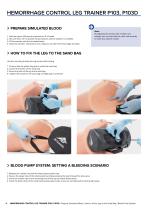
1. Add two spoon (20 grams) of powder to 2L of water 2. Stir until there are no powder lumps/residues and the solution is complete 3. Fill the canister with the simulated blood 4. Close the canister. The blood is now ready for use with the hemorrhage simulator > PREPARE SIMULATED BLOOD o By adjusting the mixing ratio of water and powder, you can fine-tune the color and viscosity to meet your specific needs. Use the sand bag to keep the leg sturdy while training 1. Fill sand into the plastic bag that is inside the sand bag 2. Loosen the buckle on the sand bag 3. Screw the back of the leg to the...
Open the catalog to page 4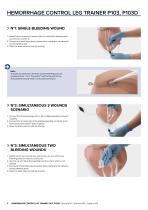
> N°1: SINGLE BLEEDING WOUND 1. Identify which wound you want to train on, and which bleeding port you need to connect to 2. Connect the hand blood pump system tube coupling to the selected wound bleeding port 3. Open the black valve to start the training To avoid any confusion, the three wound bleeding ports are numbered from 1 to 3. The port N°1 will be the port for the most proximal wound which is the junctional wound. 1. Connect the three bleeding ports to the multiple bleeding connector coupling 2. Connect the last extremity of the multiple bleeding connector to the hand blood pump system...
Open the catalog to page 5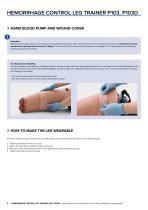
With the hand blood pump you can build up a simulated high pressure, which can be higher than the normal blood pressure. Therefore, the pump should not be operated with more than 3 fingers. This ensures that the required blood pressure is displayed in the leg blood vessel and during tourniquet application training Tip: Wound Cover Handling for more realism and to avoid any confusion during a training scenario with one single bleeding wound, do not forget to install the dedicated wound cover(s). Those wound covers will enable flexibility in scenarios. After the utilization of the leg, all the...
Open the catalog to page 6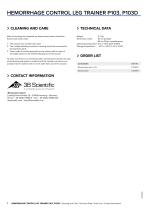
> CLEANING AND CARE > TECHNICAL DATA After the training, the complete leg blood vessel system should be flushed with clean water. 1. The canister can be filled with water 2. The multiple bleeding connector coupling should be connected to the leg blood ports 3. Clean water should be pumped into the system until no trace of simulated blood can be detected flowing out of the wound To make sure there is no remaining water into the blood vessels, the tube of the blood pump system is pulled out of the canister and some air is pumped into the system until no more water flows out of the wounds Dimension...
Open the catalog to page 7All 3B Scientific catalogs and technical brochures
 QuickLung Breather
12 Pages
 SAM4 - Auscultation Manikin
9 Pages
 Quick Start Guide Atlas Baby
4 Pages
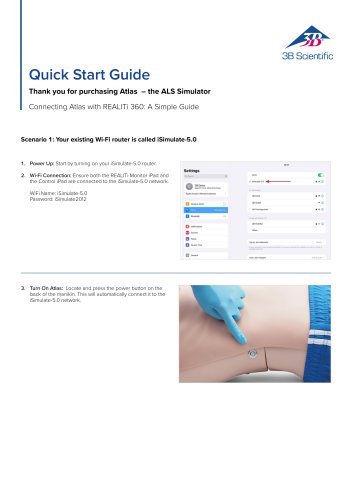 Quick Start Guide Atlas
4 Pages
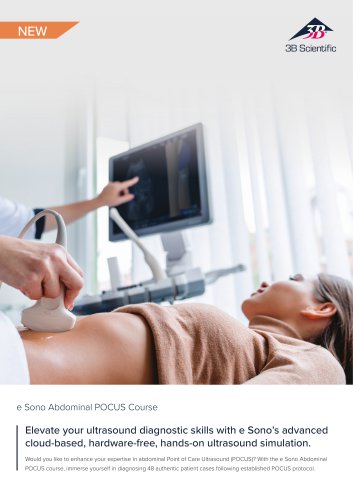 Sellsheet eSono Abdominal
3 Pages
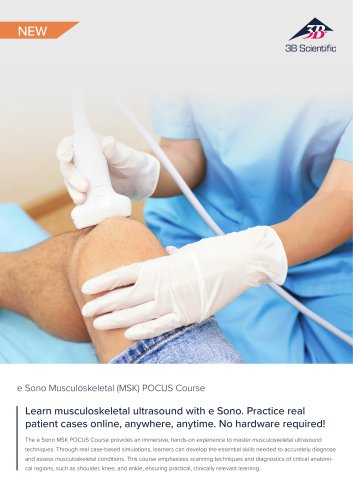 Sellsheet eSono MSK
3 Pages
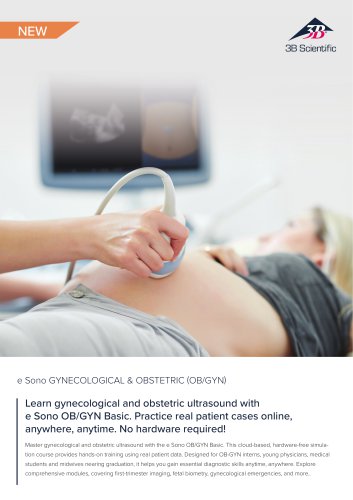 Sellsheet eSono OBGYN
3 Pages
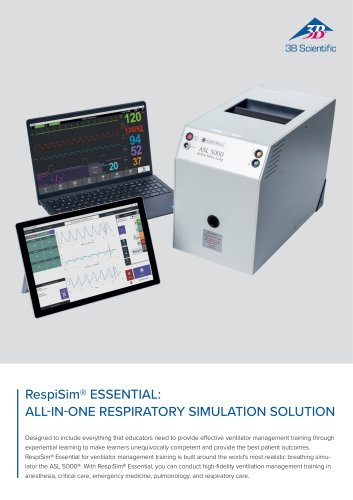 Sellsheet IngMar RespiSim
2 Pages
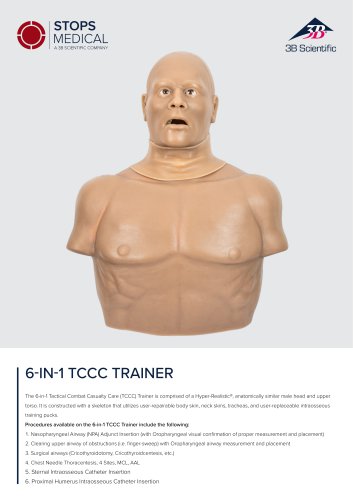 Sellsheet Stops 6N1 Trainer
2 Pages
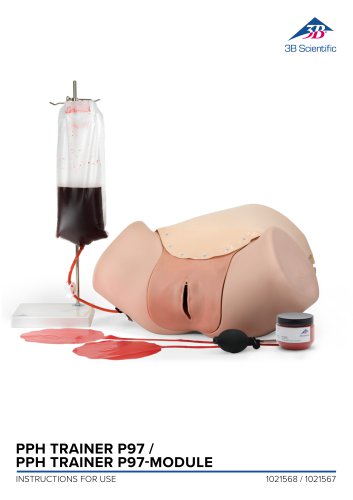 PPH Trainer P97
14 Pages
 Sellsheet Lifecast Neonatal
3 Pages
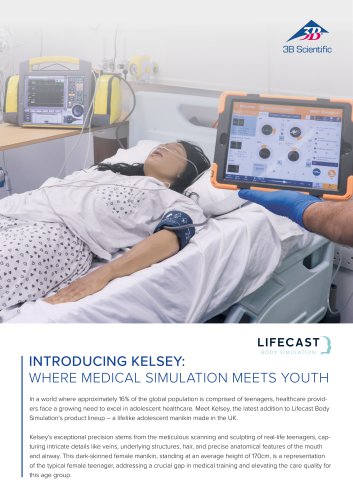 Sellsheet Lifecast Teenager
2 Pages
 Sellsheet Lifecast Baby V
2 Pages
 Product Manual Atlas Baby
16 Pages
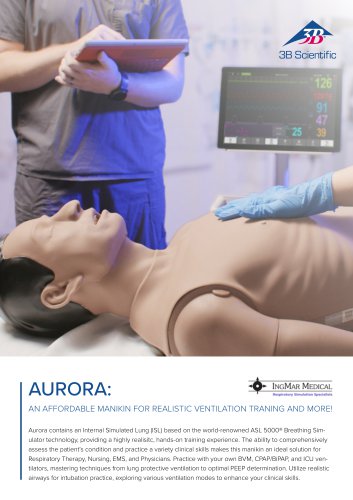 IngMar Sellsheet Aurora
2 Pages
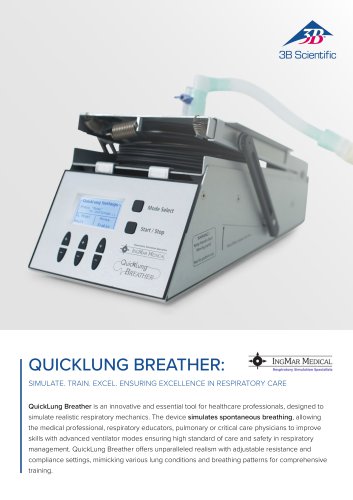 IngMar Sellsheet QuickLung
2 Pages
 Sellsheet VSI 1025586
2 Pages
 Sellsheet VSI 1025528
2 Pages
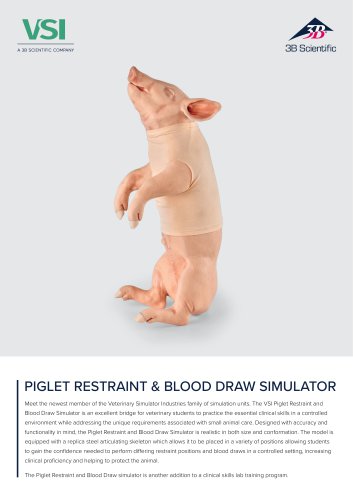 Sellsheet VSI 1025662
2 Pages
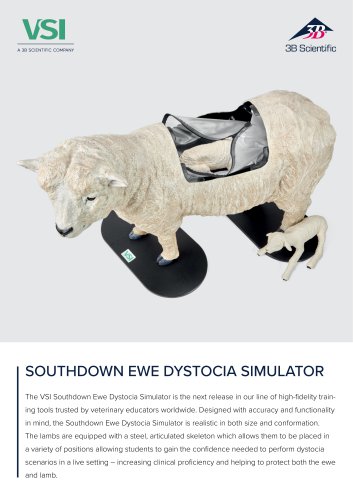 Sellsheet VSI 1025616
2 Pages
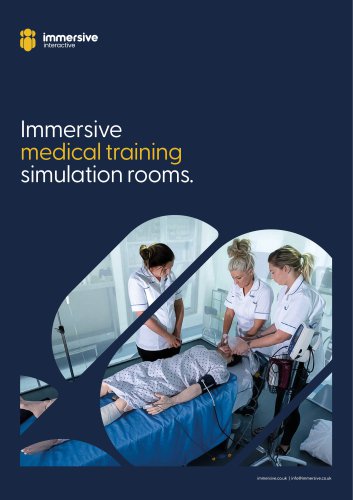 Immersive Brochure
13 Pages
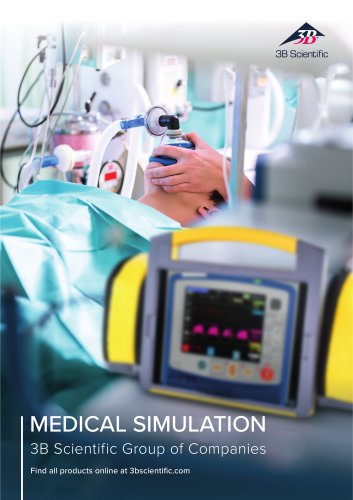 Medical Simulation
51 Pages
 Lifecast Brochure
16 Pages
 Atlas Product Manual
18 Pages
 Cardionics Brochure Simulation
23 Pages
 Acupuncture
35 Pages
 Best of Therapy
12 Pages
 Manual P120/P121/P122/P124/P125
60 Pages
 P10/1,P11/1 product manual
11 Pages
 P16 Product brochure
2 Pages
 Medical Simulation EMS TCCC
9 Pages
 Catalog Natural Sciences
196 Pages
 K17
K1716 Pages
 D25 Half Lower Jaw
13 Pages
 D20 Dentition Development
12 Pages
 D10
D1012 Pages
 L56
L5630 Pages
 L50, L51, L55
36 Pages
 C15, C16, C17, C18, C20
12 Pages
 P80 SIMone Product Manual
52 Pages
 P57 Quick instructions
16 Pages
 N30 / N31 Product Manual
12 Pages
 N15 Acupuncture Ears
2 Pages
 Female Breast
30 Pages







![Product Manual - I.v. Injection Arm P50/1 - P50/1 [1021418]](https://img.medicalexpo.com/pdf/repository_me/67454/product-manual-iv-injection-arm-p50-1-p50-1-1021418-249392_1mg.jpg)

![Product Manual - Hemorrhage Control Arm Trainer P102 - P102 [1022652]](https://img.medicalexpo.com/pdf/repository_me/67454/product-manual-hemorrhage-control-arm-trainer-p102-p102-1022652-249356_1mg.jpg)
![Product Manual - Trainer for wound care and bandaging techniques - P100 [1020592]](https://img.medicalexpo.com/pdf/repository_me/67454/product-manual-trainer-wound-care-bandaging-techniques-p100-1020592-249350_1mg.jpg)
![Product Manual - Postpartum Hemorrhage Trainer - PPH Trainer P97 - P97 [1021568]](https://img.medicalexpo.com/pdf/repository_me/67454/product-manual-postpartum-hemorrhage-trainer-pph-trainer-p97-p97-1021568-249337_1mg.jpg)


Archived catalogs
 P72+light Product manual
28 Pages
 P72+light Product brochure
2 Pages
 P10CCD product manual
16 Pages
 P10CCD product brochure
2 Pages
 P16 Product manual
8 Pages
 C41
C4116 Pages
 C18
C189 Pages
 G01
G0124 Pages
 3B Smart Anatomy
3 Pages
 M10
M1016 Pages
 A291
A29120 Pages
 F11
F1113 Pages
 P72
P7248 Pages
 B60
B6016 Pages
 A05/2 ,A11, A13
18 Pages
 A290 A291
20 Pages
 G21, G22
9 Pages
 K25
K2512 Pages
 K20, K21
12 Pages


- 3B Scientific anatomical model
- 3B Scientific training anatomical model
- 3B Scientific teaching anatomical model
- 3B Scientific training simulator
- 3B Scientific general care simulator
- 3B Scientific tooth model
- 3B Scientific upper body simulator
- Dental care model
- 3B Scientific training manikin
- 3B Scientific bone model
- 3B Scientific skull model
- 3B Scientific flexible anatomical model
- 3B Scientific surgery simulator
- 3B Scientific plastic anatomical model
- Stethoscope
- Transparent anatomical model
- 3B Scientific mouth anatomical model
- White anatomical model
- Vascular model
- Patient simulation unit