
- Catalogs
- aap Implantate
- Elbow Plates 2.7/3.5 Surgical Technique


- Products
- Catalogs
- News & Trends
- Exhibitions
Elbow Plates 2.7/3.5 Surgical Technique
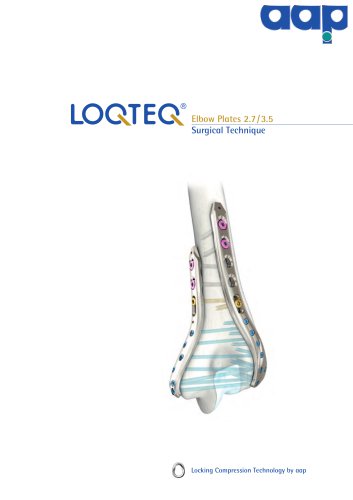
Elbow Plates 2.7/3.5 Surgical Technique
The LOQTEQ® Elbow Plates 2.7/3.5 system is designed for the fixation of fractures in the distal humerus and proximal ulna. Made from titanium alloy, the system supports various fracture patterns and allows for early patient mobilization.
Material
The implants are made from high-quality titanium alloy, ensuring biocompatibility and mechanical strength, compliant with national and international standards.
Intended Use
The system is intended for temporary fixation, correction, or stabilization of the distal humerus and olecranon, designed for single use in human bones.
Indications/Contraindications
Indications: Includes intra-articular and supracondylar fractures of the distal humerus, osteotomies, and non-unions. The olecranon plate is used for fractures and pseudarthrosis of the olecranon.
Contraindications: Includes infection, allergies to implant material, osteomyelitis, high anesthesia risk, and insufficient soft tissue coverage.
Processing (Sterilization & Cleaning)
Products are unsterilized and must be processed before use. Damaged implants or packaging should not be used.
MRI Safety Information
The system is MR Conditional, with further details provided in the product instructions.
Features & Benefits
The anatomical design supports fracture reduction. Plates accept both locking and non-locking screws, and features like flattened ends and K-wire holes facilitate insertion and fixation. Double plating techniques provide stable fixation, and the system allows for early mobilization.
Surgical Technique for Distal Humerus Plates
Preoperative Planning: Evaluate fracture with X-ray and CT, select appropriate plate size, and consider independent lag screws.
Patient Positioning: Position patient laterally or prone with arm supported. A tourniquet may be used.
Approach: Typically involves posterior access with a longitudinal incision. Protect the ulnar and radial nerves.
Surgical Technique for Olecranon Plate
Similar preoperative planning and patient positioning as for humerus plates. The approach depends on fracture type and surgeon preference.
Explantation
Details on explantation procedures are provided, ensuring safe removal of implants.
Assembly Instructions
Instructions for assembling the system components are included.
Implants and Instruments
Detailed descriptions of available implants and instruments are provided, ensuring proper selection and use.
Clinical Cases
Examples of clinical cases demonstrate the application and effectiveness of the system.
Specifications and Instruments
The document specifies the use of anatomically pre-contoured plates to minimize intra-operative bending. It lists various instruments such as the aiming arm, K-wire, twist drills, and screwdrivers, along with their respective article numbers for reference.
Procedures
- Reduction and Primary Fixation: The procedure begins with the reduction of the medial column and securing the fracture temporarily. The medial plate is positioned and fixed using K-wires and cortical screws.
- Insertion of Cortical Screws: Non-locking screws must be inserted first. The document details the insertion of cortical screws in both oblong and metaphyseal plate sections, emphasizing the importance of proper alignment and fluoroscopic confirmation.
- Insertion of Locking Screws: Locking screws are inserted using a drill guide, with specific instructions on screw length determination and the use of a torque limiter for optimal locking.
- Insertion of Locking Compression Screws: The document describes the use of LOQTEQ® gliding holes for fracture compression and subsequent locking fixation, with caution against over-compression.
Recommendations and Cautions
- Use the aiming arm in combination with the matching aiming device to avoid perforating articular surfaces.
- Care should be taken to avoid perforating gloves when positioning the aiming arm pointer.
- Contouring of plates should be avoided where possible, and if necessary, should be done carefully to prevent implant failure.
- Ensure no screws penetrate the articular surfaces, and confirm all screw heads are flush with the plate surface using fluoroscopy.
Conclusion
The document provides a comprehensive guide for the surgical technique of distal humerus plates, emphasizing the importance of proper instrument use, careful positioning, and verification through fluoroscopy to ensure successful outcomes.
Clinical Case Overview
The document presents a clinical case involving a proximal ulna fracture with luxation and a radius head fracture, classified as AO 21-A1. Preoperative and postoperative images are included to illustrate the surgical outcomes.
Contact Information
For further inquiries, aap Implantate AG can be contacted via phone, fax, or email. Their contact details are provided for customer service and technical support.
Disclaimer
The document concludes with a disclaimer noting that the information is subject to technical modifications, errors, and misprints.
Catalog excerpts

Elbow Plates 2.7 /3.5 Surgical Technique Locking Compression Technology by aap
Open the catalog to page 1
Disclaimer This surgical technique is exclusively intended for medical professionals, especially physicians, and therefore may not be regarded as a source of information for non-medical persons. The description of this surgical technique does not constitute medical advice or medical recommendations nor does it convey any diagnostic or therapeutic information on individual cases. Therefore, the attending physician is fully responsible for providing medical advice to the patient and obtaining the informed consent of the patient which this surgical technique does not supersede. The description of...
Open the catalog to page 2
Content Introduction . . . . . . . . . . . . . . . . . . . . . . . . . . . . . . . . . . . . . . . . . . . . . . . . . . . . . . . . . . . . . . . . . . . . . . . . . . . . . . . . . . . . . . . . . . . . . . . . . . . . . . . . .2 • Material . . . . . . . . . . . . . . . . . . . . . . . . . . . . . . . . . . . . . . . . . . . . . . . . . . . . . . . . . . . . . . . . . . . . . . . . . . . . . . . . . . . . . . . . . . . . . . . . . . . . . . . . . . . . . . . .2 • Intended Use . . . . . . . . . . . . . . . . . . . . . . . . . . . . . . . . . . . . . . . . . . . . . . . . . . . . . . . . . ....
Open the catalog to page 3
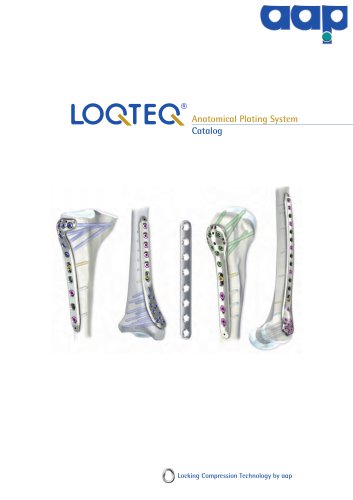
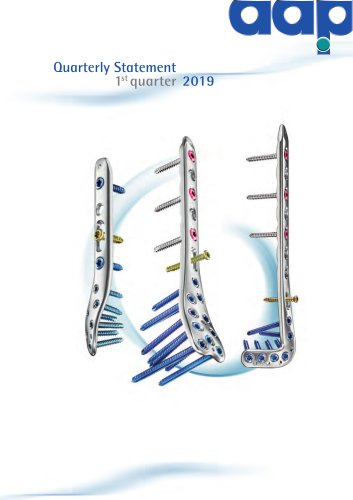
Introduction The system LOQTEQ® Elbow Plates 2.7/3.5 comprises bone plates and screws for application at the distal Humerus and the proximal ulna as well as the necessary accessories for insertion. The flexibility of the system allows for safe reduction and stable fixation of various fracture patterns with respect to the indications mentioned in this technical guide. The design features of the implants in combination with standard surgical techniques and proven stability result in reliable constructs to support the bone during the healing process and allow for early mobilization of the patient....
Open the catalog to page 4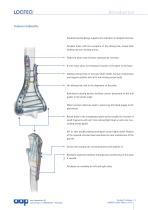
Introduction Features & Benefits Anatomical plate design supports the reduction of complex fractures. All plate holes, with the exception of the oblong hole, accept both locking and non-locking screws. • Flattened plate ends facilitate submuscular insertion. • K-wire holes allow for temporary fixation of the plate to the bone. • Gliding locking holes in the plate shaft enable fracture compression and angular stability with ø3.5 mm locking screws (red). • The oblong hole aids in the alignment of the plate. Radiolucent aiming devices facilitate correct placement of the drill guides in the preset...
Open the catalog to page 5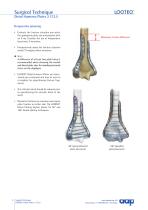
Surgical Technique Distal Humerus Plates 2.7 / 3.5 Preoperative planning • Evaluate the fracture situation and select the appropriate plate size and position with an X-ray. Consider the use of independent lag screws, if necessary. Minimum 2 holes difference • Preoperatively assess the fracture situation using CT imaging where necessary. NOTE: A difference of at least two plate holes is recommended when choosing the medial and lateral plate sizes for avoiding increased stress on the diaphysis. • LOQTEQ® Distal Humerus Plates are anatomically pre-contoured and may be used as a template for repositioning...
Open the catalog to page 6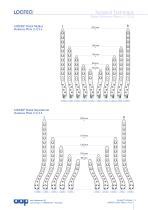
Surgical Technique Distal Humerus Plates 2.7/3.5 L LOQTEQ® Distal Medial Humerus Plate 2.7 /3.5 LOQTEQ® Distal Dorsolateral Humerus Plate 2.7 /3.5 aap Implantate AG Lorenzweg 5 • 12099 Berlin • Germany Surgical Technique LOQTEQ®
Open the catalog to page 7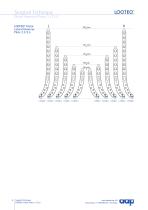
Surgical Technique Distal Humerus Plates 2.7 / 3.5 L LOQTEQ® Distal Lateral Humerus Plate 2.7 / 3.5 Surgical Technique LOQTEQ® Elbow Plates 2.7 /3.5 aap Implantate AG Lorenzweg 5 • 12099 Berlin • Germany
Open the catalog to page 8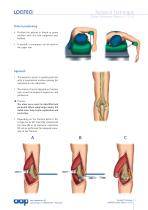
Surgical Technique Distal Humerus Plates 2.7/3.5 Patient positioning • Position the patient in lateral or prone position with the arm supported over bolsters. • If needed, a tourniquet can be used on the upper arm. Approach • The posterior access is usually preferred, with a longitudinal incision passing the olecranon on the radial side. • The choice of access depends on fracture type as well as surgeon’s experience and preference. CAUTION: The ulnar nerve must be identified and protected. When using longer plates, the radial nerve may require exploration and protection. • Depending on the...
Open the catalog to page 9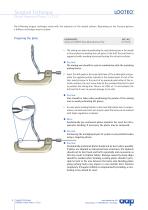
Surgical Technique Distal Humerus Plates 2.7 / 3.5 The following surgery technique starts with the reduction of the medial column. Depending on the fracture pattern, a different technique may be chosen. Aiming arm LOQTEQ® Distal Medial Humerus Plate • The aiming arm assits in positioning the most distal screws in the medial or lateral plate by marking the exit point of the drill. The joint block is supported while avoiding screws perforating the articular surfaces. C AUTION : The aiming arm should be used in combination with the matching aiming device. • Insert the drill guide in the most distal...
Open the catalog to page 10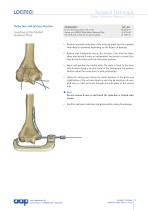
Surgical Technique Distal Humerus Plates 2.7/3.5 Reduction and primary fixation Insertion of the Medial Humerus Plate K-wire with trocar point, ø1.6, L 150 Aiming arm LOQTEQ® Distal Medial Humerus Plate Twist drill ø2.0, L 180, coil 25, quick coupling • Perform anatomic reduction of the articular block and the condyles from distal to proximal, depending on the degree of damage. • Reduce and temporarily secure the fracture. Care must be taken when positioning K-wires or independent lag screws to ensure that they do not interfere with the later plate position. • Insert and position the medial plate....
Open the catalog to page 11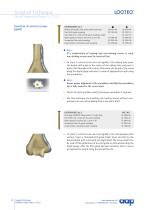
Surgical Technique Distal Humerus Plates 2.7 / 3.5 Insertion of cortical screws (gold) INSTRUMENTS ø3.5 Double drill guide, with spring aided centering Twist Drill, quick coupling Twist drill ø2.7, L 150, coil 50, quick coupling, scaled Depth gauge for screws, ø3.5-4.0, up to L 90 Screwdriver Duo, quick coupling Large handle, cannulated, quick coupling N OTE : If a combination of locking and non-locking screws is used, non-locking screws must be inserted first. • To insert a cortical screw ø3.5 mm (gold) in the oblong hole, place the double drill guide in the center of the oblong hole and press...
Open the catalog to page 12All Aap Implantate catalogs and technical brochures

- Compression plate
- Metallic compression plate
- Locking compression plate
- Distal compression plate
- Compression bone screw
- Metallic compression bone screw
- Proximal compression plate
- Forearm compression plate
- Lateral compression plate
- Medial compression plate
- Tibia compression plate
- General purpose compression bone screw
- Humerus compression plate
- Radius compression plate
- Cannulated compression bone screw
- Osteotomy plate
- Femur compression plate
- General purpose compression plate
- Metallic osteotomy plate