
- Catalogs
- AB Analitica
- GENEQUALITY DDK-G17

GENEQUALITY DDK-G17

GENEQUALITY DDK-G17
Duchenne and Becker muscular dystrophies (DMD, BMD) are genetic neuromuscular disorders caused by mutations in the dystrophin gene located at Xp21. These disorders lead to progressive and irreversible muscle fiber degeneration, with incidences of 1.5 per 10,000 and 1.5 per 100,000 live births, respectively. The dystrophin gene is notably large, comprising over 2.5Mb and 82 exons, with common mutations being intragenic deletions (65%) or duplications (5-8%). The DDK/G17 kit is designed to detect deletions in specific exons of the dystrophin gene using multiplex PCR, offering a rapid analysis method that requires only small or suboptimal DNA samples. This kit is valuable for confirming diagnoses and conducting prenatal genetic consultations.
Technical Description
The kit is available in formats for 25 or 50 tests, with a shelf life of 6 months. It uses peripheral whole blood as the starting material and targets exons 3, 4, 6, 8, 13, 17, 19, 43, 44, 45, 47, 48, 49, 50, 51, 52, and 60 for amplification via multiplex PCR. An internal control is included, and results are visualized through agarose gel electrophoresis.
Procedure
The procedure involves multiplex PCR amplification of the targeted exons, followed by visualization on a 4% agarose gel. The gel electrophoresis setup includes a molecular weight marker and three multiplex PCR products.
Ordering Information
The kit can be ordered under the codes 04-44A for 25 tests and 04-44R for amplification reagents for 50 tests.
Bibliographic References
Key references include works by Muntoni F. et al. (2003) and Navarro-Fdez Balbuena C. et al. (2003), which provide further insights into the genetic and clinical aspects of DMD and BMD.
Catalog excerpts
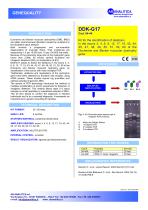
DANALITICA LU UlOMifJlCUB www.-abBnjlitioB.il MULTIPLEX AMPLIFICATION INTRODUCTION Duchenne and Becker muscular dystrophies (DMD, BMD) are allelic neuromuscular disorders caused by mutations to the dystrophin gene atbXp21. Both involves a progressive and not-reversible degeneration of muscular fibers. Their incidences are respectively 1.5 per 10.000 and 1.5 per 100.000 live births. Because of the extremely large size of the dystrophin gene (more than 2.5Mb, 82 exons) several mutations are intragenic deletions (65%) or duplications (5-8%). DDK/G17 allows to detect the deletions in the exons 3, 4, 6, 8, 13, 17, 19, 43, 44, 45, 47, 48, 49, 50, 51, 52, 60 of the Duchenne and Becker muscular dystrophy gene, by amplification of this exons with three multiplex PCR. Traditionally, deletions and duplications of the dystrophin gene have been detected by Southern blot analysis using cDNA probes. These studies require big quantities and optimal samples of genomic DNA. The advent of PCR technology introduced the method of multiplex amplification of exonic sequences for detection of intragenic deletions. This method allows rapid (1-2 days) analysis on small quantities or suboptimal samples of DNA. This kit also allows to confirm the diagnosis in infected individuals and to do a prenatal diagnosis: it represents an important aid in genetic consulting for families. SHELF LIFE: 6 months. STARTING MATERIAL: peripheral whole blood. AMPLIFIED REGIONS: exons 3, 4, 6, 8, 13, 17, 19, 43, 44, 45, 47, 48, 49, 50, 51,52, 60. AMPLIFICATION: MULTIPLEX PCR. INTERNAL CONTROL: included. RESULT VISUALIZATION: agarose gel electrophoresis. Muntoni F. et al., Lancet Neurol. 2003 Dec;2(12):731-40. Navarro-Fdez Balbuena C. et al., Rev Neurol. 2003 Oct 1631 ;37(8):766-9 AB ANALITICA srl Via Svizzera 16 - 35127 PADOVA - ITALY Tel. +39 049 761698 - Fax +39 049 8709510 e-mail: [email protected] www.abanalitica.it
Open the catalog to page 1All AB Analitica catalogs and technical brochures
 Catalogue 2023
36 Pages
 EQA PROGRAMME CATALOGUE
77 Pages
 AB 13C Breath test
4 Pages
 PRODUCT CATALOG 2018
16 Pages
 HP UREASI TEST
2 Pages
 RS-FACTOR V LEIDEN
1 Page
 HPV-TYPE EXPRESS
2 Pages
 PRODUCT LIST 2017
20 Pages
 Product list 2016
24 Pages


- Detection kit
- Solvent reagent
- Blood detection kit
- Molecular biology reagent
- Laboratory reagent
- Infectious disease detection kit
- Molecular detection kit
- Rapid infectious disease test
- Optical test kit
- Clinical chemistry reagent kit
- Fluorescence detection kit
- Real-time PCR assay kit
- Rapid bacteria test
- Strip assay kit
- Oncology detection kit
- Urine detection kit
- PCR system
- DNA extraction reagent
- PCR detection kit
- Genetic detection kit