
- Catalogs
- Abaxis Europe
- Piccolo xpress

- Products
- Catalogs
- News & Trends
- Exhibitions
Piccolo xpress

Piccolo xpress
The Piccolo Xpress™ is a portable device for on-site testing of blood, serum, or plasma using single-use reagent discs. It features an Intelligent Quality Control (IQC™) system that ensures accurate results by automatically checking the analyzer, reagent disc, and sample during each run.
IQC™ performs automatic checks on the analyzer's chemistry, optics, and electronics to ensure accurate results, regardless of the operator's skill level. Key checks include:
- Bar Code: Verifies reagent calibration data and expiration date.
- Chemistry: Confirms reagent viability and monitors reactions.
- Fluidics: Ensures sufficient sample and diluent presence.
- Sample: Quantifies physical interferents and suppresses results if limits are exceeded.
- Signal Adjustment: Monitors and adjusts flash intensity for optimal performance.
- Software/Memory: Optimizes real-time performance and detects errors.
The QC report includes run-specific information and system checks. Level 1 IQC checks ensure all components are within allowable values, while Level 2 checks focus on precision. Results are stored in the analyzer's memory and can be recalled and printed as needed.
The Piccolo Xpress™ uses a small sample volume introduced into a reagent disc, where all reactions occur. It measures absorption at multiple wavelengths to ensure accurate results. IQC verifies the composition and delivery of substances, validates light components, and audits digital conversions.
Bar Code: Encodes test panel type, expiration date, and calibration factors. Fluidics: Controls fluid movement and verifies sample volume. IQC Reactions: Uses system cuvettes for reagent and system testing, aborting runs if degradation is detected.
IQC evaluates sample quality for physical interferents, suppressing results for analytes exceeding sensitivity limits.
IQC monitors reactions to ensure they are within defined ranges and have reached completion.
The optical system uses a xenon arc lamp and photodetectors to measure light intensity. IQC adjusts for lamp intensity changes and measures background noise to detect problems.
Light leakage can affect accuracy and precision, especially at higher absorbencies. If background noise exceeds limits, the IQC system aborts the run and displays an error message. A reference wavelength is used to minimize variability.
The instrument includes two microprocessors: a real-time controller for monitoring and controlling measurements, and an I/O controller for memory management, calculations, and data storage. These processors ensure data integrity and reliability. The analyzer can store up to 5000 results and system QC data.
The analyzer software consists of two programs: one controls the measurement engine, and the other reports analyte concentrations and stores run-related data.
Absorbance is calculated from 10 flashes through the cuvette, verified by algorithms to detect errors. Errors result in suppression of results for specific analytes or entire panels.
The Piccolo reagent disc integrates with the analyzer's functions. It includes a bar code ring with ID code, lot number, expiration date, and calibration data. The disc works with the analyzer for signal calibration and system checks, employing fluidics for precise sample and diluent delivery.
- Minimum-absorbance cuvette for signal adjustments
- Maximum-absorbance cuvette for noise performance quantification
- Cuvette with reagent beads for chemistry QC
- Two cuvettes with dye beads for instrument QC
- "Empty" cuvette for system control
- 21 cuvettes with test-specific lyophilized reagent beads
- Two cuvettes verify sample and diluent presence
- One cuvette verifies diluted sample delivery to reaction cuvettes
Catalog excerpts

Fast, easy, accurate on-site chemistry testing Run-specific information is found at the top of the QC Report Instrument QC data are arranged in two columns below the run-specific information. Level 1 iQC 1 through 8 refers to the eight different system checks that the analyzer carries out at the beginning of each run. The allowable values for all components are normalized, with 90% equaling the minimum allowed value and 110% equaling the maximum allowed value. For the run to pass iQC, the values obtained by flashing through the minimum- and maximum-absorbance cuvettes at the beginning of the run must be within these limits for all components. Level 2 QC data concerns precision. Two system cuvettes contain 1 dye bead and 2 dye beads, respectively. At the beginning of the run, the analyzer calculates the ratio of the absorbances in the 1-bead and the 2-bead cuvettes at all wavelengths. It then averages the ratios and determines the precision of the measurements. The precision is reported to the right of “LEVEL 2.” The values to the right of each specified wavelength indicate the mathematical relationship between the normalized ratio obtained at that wavelength and the average for all wavelengths. For the run to pass iQC, the precision must be between 95 and 105% overall and for each specific wavelength. The results obtained in the chemistry iQC testing are given at the bottom of the card, along with the minimum acceptable value for this test. Any value above the minimum indicates that the disc was stored correctly and all chemistries in the disc were viable at the time of testing. ___________________________________________________________________ O How to recall and print the QC Report System QC data are compiled for each run and stored in the analyzer memory with the run results. For any run that remains in memory, these data can be recalled and a copy of the QC Report can be printed. Refer to the Piccolo Operator’s Manual for instructions on recalling and printing system QC data. Intelligent Quality Control (iQC ) on the Piccolo Xpress Point-of-Care Chemistry Analyzer ™ • Verifies current dating • Cyclic redundancy check verifies accurate transfer of the reagent calibration data to the analyzer software The Piccolo Xpress™ Point-of-Care Chemistry Analyzer is a lightweight portable instrument that processes whole blood, serum, or plasma samples in self-contained, single-use reagent discs. Along with fully automated processing and onboard data handling, the Piccolo Xpress™ incorporates a unique process called iQC (“intelligent Quality Control”). Transparent to the operator, iQC checks the analyzer, the reagent disc, and the sample during each run to verify correct electronic and chemistry performance. iQC automatically suppresses a single chemistry or the entire panel if it detects uncharacteristic performance, and immediately alerts the operator to any problems. From the self-test at power-up to the recording and printing of patient results, the Piccolo Xpress™ conducts multiple QC checks automatically with each run. iQC ensures that the operator reports only accurate and reliable results. • Confirms the viability of the analyte-specific reagents • Monitors all reactions in process • Verifies the presence of sufficient sample and diluent • Verifies the presence of diluted sample in all reagent cuvettes • Quantifies physical interferents (hemolysis, lipemia, icterus) • Suppresses results for any reaction where the limits of sensitivity to an interferent have been exceeded Signal adjustment • Monitors changes in flash intensity and adjusts for maximum dynamic range • Monitors the noise associated with the lamp intensity at all wavelengths • Measures the background noise to detect electrical and other problems • Uses a reference wavelength to minimize the effect of flash-to-flash intensity variation Software / memory • The architecture of the two microprocessors optimizes real time performance • Synchronizes the flashing of the lamp with the position of specific cuvettes • Detects errors in absorbance data and errors in the calculations 3240 Whipple Road, Union City, CA 94587 | 1-800-822-2947 | www.abaxis.com ©2010 Abaxis, Inc., Piccolo Xpress™ is a trademark of Abaxis, Inc. 888-9659 Rev. D Demands for improved patient care and greater cost control are driving profound changes in the structure of health care delivery. Within and outside of traditional hospital environments, evolving technology is permitting some types of diagnostic testing and patient monitoring to move from the clinical laboratory to the near-patient environment. Many health care professionals whose roles have traditionally involved hands-on patient care are now being asked to take a role in clinical chemistry testing as well. Laboratorians, with their training and experience, know that rigorous quality control (QC) is an absolute necessity for accurate test results on which treatment decisions can confidently be based. The Piccolo Xpress™ Point-of-Care Chemistry Analyzer incorporates a process called iQC (“intelligent Quality Control”) that meets established QC standards independently of the operator’s skill level. iQC is a series of sophisticated automatic checks that verify the chemistry, optics, and electronics functions of the analyzer during each run, and ensures that operators in a wide range of environments report only accurate and reliable results.
Open the catalog to page 1
When spinning stops, capillary forces pull precise quantities of sample and diluent into a mixing chamber. A spin cycle that alternately accelerates and decelerates the disc ensures complete mixing. At the end of this cycle, the aliquot (diluted sample) flows through the exit siphon and along the distribution channel to the reaction cuvettes. The design of the cuvettes permits air to outflow and aliquot to inflow, preventing the formation of air bubbles inside the cuvette and ensuring the correct concentration of the reaction solution. If iQC detects no aliquot in a reservoir beyond the last...
Open the catalog to page 2All Abaxis Europe catalogs and technical brochures
 Product Overview Brochure
16 Pages
 xpress flyer
2 Pages
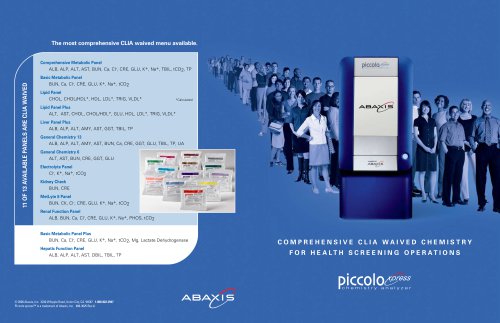 health screening brochure
2 Pages
 urgent care centers
2 Pages
 internal medicine clinical
2 Pages
 Waived CMP
2 Pages
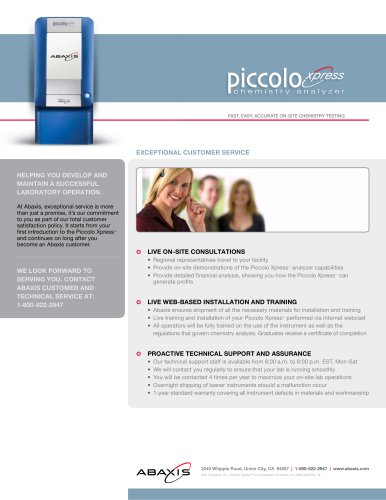 Service Plus
1 Page
 Med Imaging Centers
1 Page
 Oncology Centers
1 Page
 Urgent Care Clinical
2 Pages
 Financial Impact
2 Pages
 VetScan HM5
6 Pages
 VetScan VS2
2 Pages

