

SoToxa™

SoToxa™
The SoToxa™ Mobile Test System, formerly known as the DDS®2 Mobile Test System, is a handheld analyzer for rapid drug detection using oral fluid samples. It is particularly beneficial for roadside testing by law enforcement due to its ease of use and quick results.
The system detects common drugs within 5 minutes and includes an onboard heater for optimal testing conditions. It can store over 10,000 results, which can be printed or downloaded for data management.
- Wisconsin Pilot Study: Demonstrated the system's ability to identify drug use where blood alcohol tests might fail, showing high consistency with blood test results.
- Michigan Pilot Program: Showed high sensitivity and specificity, with accuracy between 88.3% and 100% across drug categories.
- VIFM Laboratory Evaluation: Confirmed high specificity and a 100% detection rate for positive samples.
- Spanish Roadside Survey: Found a 16.4% prevalence of drug use among drivers, with THC being the most detected.
- Canadian Device Assessment: Compared favorably with other devices, offering shorter analysis time and high sensitivity and specificity.
The SoToxa™ system is effective for roadside drug testing, providing quick, reliable results with minimal risk of sample adulteration, especially where traditional specimen collection is impractical.
The SoToxa™ system offers a robust solution for detecting drug use in drivers, aiding law enforcement in managing drug-impaired driving.
In Brazil, traffic collisions result in approximately 43,000 deaths annually, some linked to psychoactive substances. While Brazil uses breathalyzers for alcohol, no approved roadside drug testing devices exist. This document evaluates the user experience of traffic agents with four devices, including the DDS®2 system, at checkpoints in Porte Alegre.
- 164 samples were collected, with 33 screening positive for at least one drug and 44 positive results overall.
- Cocaine and cannabis were the most prevalent drugs detected.
- Devices were evaluated on simplicity, operational success, and hygiene, with the DDS®2 system scoring highest for operational feasibility and user experience.
The study assessed the DDS®2 system (now SoToxa™) for detecting drugs in drivers. Oral fluid samples were screened for six drug classes and confirmed in a lab using ELISA and LC-MS-MS.
- No significant differences were found between DDS®2 onsite screens and laboratory screens.
- The DDS®2 system showed 100% accuracy for AMP, MAMP, OPI, and 85.71% for BZO, COC, THC.
- Oral fluid is a viable option for roadside testing and laboratory confirmation.
Performance metrics for the DDS®2 system include sensitivity, specificity, PPV, NPV, and accuracy for each drug class, demonstrating high operational success and user satisfaction among traffic agents.
Catalog excerpts

SoToxa Mobile Test System ™
Open the catalog to page 1
GLOSSARY ABBREVIATION Positive Predictive Value Negative Predictive Value Enzyme Linked Immunosorbent Assay Victorian Institute of Forensic Medicine Oral Fluid Liquid Chromatography Driving Under the Influence of Drugs Mass Spectrometry Drug Recognition Experts
Open the catalog to page 2
A popular method Oral fluid testing has become a popular method for detecting the presence of drugs and its metabolites due to the speed of sample collection and ease of use. This is especially the case when testing in challenging environments such as the roadside, where collecting urine and other traditional specimens for preliminary screening is not practical. THE SOTOXA™ MOBILE TEST SYSTEM WA S P R E V I O U S LY K N O W N A S T H E D D S ®2 M O B I L E T E S T S Y S T E M The system is referred to as the DDS®2 Mobile Test System throughout the publications within this brochure. The performance...
Open the catalog to page 3
Drugged driving in Wisconsin: Oral fluid versus blood OVERVIEW Dane County, Wisconsin launched a pilot project in order to evaluate the frequency of individuals driving under the influence of drugs. In the state of Wisconsin, drug testing is often cancelled if the blood alcohol concentration is above the specified limit set by the state. This resulted in around 3,600 drug samples being cancelled between December 2015 and July 2016. • Around 68 % of those samples that tested positive for drugs in this pilot study, would have previously been excluded as alcohol was above the specified limit. Therefore,...
Open the catalog to page 4
Oral fluid roadside analysis pilot program Michigan law states that a person cannot operate a vehicle while under the influence of alcoholic liquor, a controlled substance, other intoxicating substance or a combination of these elements (Legislature Service Bureau, 2019). Over the last ten years in Michigan, drug-impaired driving has become more prevalent, and traffic fatalities have increased. • Out of all the tests conducted, 21 returned positive results for the presence of two or more drugs. During an evaluation of oral fluid as matrix for drug detection, the Oral Fluid Roadside Analysis Pilot...
Open the catalog to page 5
Roadside drug testing: An evaluation of the DDS®2 Mobile Test System OVERVIEW Driving under the influence of drugs has increased over recent years and with the legalisation of cannabis in several US states, it is vital to monitor drug use whilst driving. • Out of 528 tests via the DDS®2 Mobile Analyser that were performed, only four tests were shown to be invalid by the DDS®2 system, which could be caused by factors such as insufficient sample volume. Oral fluid screening tests have become increasingly popular as a means of testing drivers for drugs at the roadside. Samples can be easily collected,...
Open the catalog to page 6
DDS®2 Mobile Analyser assessment In 2015 Victorian Institute of Forensic Medicine (VIFM) evaluated the DDS®2 Mobile Test System (now renamed the SoToxa™ Mobile Test System) in a laboratory environment. • During testing of negative samples, it was found that no false positive results occurred for any of the six drug groups being evaluated. The study was set out to evaluate the performance of the DDS®2 system for the 6-panel offering which included AMP, BZO, COC, MAMP, THC, OPI. • Testing at -50% of the manufacturer’s cutoff yielded no false positive results for AMP, BZO, THC or OPI. However, one...
Open the catalog to page 7
Prevalence of drug use among drivers based on mandatory, random tests in a roadside survey OVERVIEW Several studies have described the increase of drivers driving under the influence of drugs. In Spain, legislation prohibits driving under the influence of narcotic and psychotropic, stimulants, and other substances. In addition to those mentioned above, this also includes medicines which can impair the physical or mental skills of drivers. • The prevalence of driving under the influence of drugs in this study was around 16.4%. The authors in this study set out to evaluate the prevalence of drivers...
Open the catalog to page 8
An assessment of oral fluid drug screening devices OVERVIEW Since 2008, Canadian police have been authorised to perform a mandatory field sobriety test, evaluate individuals by a DRE, and request blood samples from drivers. • The length of time for the analysis of the test once the sample was collected: However, with limited availability of DREs and lengthy delays during the examinations, requests were made for an onsite screening device for use at the roadside. As such the authors of this study evaluated the performance of three of the most prevalent on-screen drug testing devices on the market....
Open the catalog to page 9
Evaluation of oral fluid as a specimen for driving under the influence of drugs Due to the legalisation of cannabis in some states of the United States, the number of drivers driving under the influence of drugs has increased. • The authors did not report any significant differences between the onsite screen using the DDS®2 system and the laboratory screen using ELISA. This study was set out to evaluate the effectiveness of oral fluid as a sample type for the use of drug detection in DUID cases. • The accuracy of the DDS®2 system was reported as: Drivers suspected of driving under the influence...
Open the catalog to page 10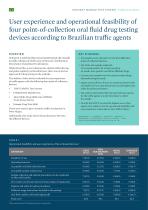
User experience and operational feasibility of four point-of-collection oral fluid drug testing devices according to Brazilian traffic agents OVERVIEW In Brazil it is estimated that around 43,000 people die annually in traffic collisions of which some of these are contributed to the presence of psychoactive substances. • 164 samples were collected over the four difference point-of-collection devices. Whilst Brazil has a zero tolerance for alcohol whilst driving and police regularly use breathalysers, there are no devices approved for drug testing on the roadside. The authors of this article evaluated...
Open the catalog to page 11
© 2019 Abbott. All rights reserved. All trademarks referenced are trademarks of either the Abbott group of companies or their respective owners. Any photos displayed are for illustrative purposes only. Any person depicted in such photos is a model. APOC0693 Ed.3a 11/19
Open the catalog to page 12All Abbott catalogs and technical brochures
 HIV-1/2 Ag/Ab COMBO
2 Pages
 HIV-1/2 TEST
6 Pages
 Alere hCG Easy
6 Pages
 Alere AfinionTM CRP
2 Pages
 Alere™ q HIV-1/2 Detect
2 Pages
 Strep A Package Insert
24 Pages
Archived catalogs
 Alere Determine HB sAg
6 Pages
 Binax NOW G6PD
4 Pages
 Alere™ DDS® 2
2 Pages
 Alere Afinion Lipid Panel
2 Pages
 Alere i Influenza A & B
2 Pages
 Alere hCG Portfolio Brochure
6 Pages
 Alere Actim Partus
6 Pages
 Alere Actim PROM Brochure
6 Pages
 Alere ICU Product Brochure
6 Pages
 epoc
epoc2 Pages
 Alere Triage System
4 Pages
 Alere? TestPack hCG
4 Pages
 Alere Pima CD4 Analyser
20 Pages
 Alere Cardio Combo
4 Pages
 Alere hCG Portfolio
2 Pages
 Alere Cholestech LDX System
2 Pages
 Alere HemoPoint® H2 Meter
2 Pages
 Alere Cholestech LDX® System
2 Pages
 Alere INRatio®/INRatio®2
2 Pages
 Alere™
2 Pages
 AIMS®
AIMS®4 Pages
 epoc®
epoc®2 Pages
 epoc® Blood Analysis System
2 Pages


- Detection kit
- Blood detection kit
- Abbott rapid immunochromatographic test
- Abbott rapid blood test
- Abbott cassette rapid test
- Abbott rapid immunoassay test
- Rapid serum test
- Rapid plasma test
- Abbott rapid virus test
- Rapid whole blood test
- Whole blood detection kit
- Abbott rapid infectious disease test
- Cassette detection kit
- Abbott rapid respiratory disease test
- Laboratory testing system
- Abbott rapid urine test
- Rapid bacteria test
- Abbott strip rapid test
- COVID-19 rapid test
- Abused drug rapid screening test