
- Catalogs
- ACON DIABETES CARE
- Ketone Testing in Dairy Cows

Ketone Testing in Dairy Cows

Ketone Testing in Dairy Cows
The document discusses the critical period between calving and the end of lactation in dairy cows, highlighting the risk of ketosis, a metabolic disease that can lead to decreased milk yield, impaired reproductive performance, and economic loss.
Ketosis occurs due to a negative energy balance during lactation when energy demand exceeds intake. It is identified as the most important metabolic disease in US dairy herds. Monitoring blood Beta-Hydroxybutyrate (BHBA) levels is crucial for early detection and prevention.
The gold standard for ketosis testing is blood BHBA. Subclinical ketosis is identified at BHBA levels between 1.2 – 1.4 mmol/L, which is critical for predicting health risks during early lactation.
- Most clinical ketosis cases occur 2-3 weeks post-calving.
- Subclinical ketosis can reduce milk yield by up to 4.6 lb/day in the first week of lactation.
- Cows with subclinical ketosis are three times more likely to be removed from the herd.
Regular monitoring of BHBA levels and providing nutritional support are recommended to prevent ketosis from becoming a clinical issue.
Catalog excerpts
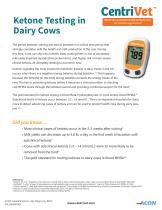
Ketone Testing in Dairy Cows Blood Glucose & Ketone Monitoring System for Small & Large Animals The period between calving and end of lactation is a critical time period that strongly correlates with the health and milk production of the cow. During this time, cows can slip into a ketotic state, putting them in risk of decreased milk yield, impaired reproductive performance, and higher risk of more severe clinical ketosis, all ultimately leading to economic loss.1 Ketosis, arguably the most important metabolic disease in dairy herds in the US, occurs when there is a negative energy balance during lactation.2,3 This happens because the demand on the body during lactation exceeds the energy intake of the cow. The key to preventing ketosis before it becomes a clinical problem is checking cow BHBA levels through the lactation period and providing nutritional support for the herd.3 The gold standard for ketosis testing is blood Beta-Hydroxybutyrate or more simply, blood BHBA.1,2 Subclinical levels of ketosis occur between 1.2 – 1.4 mmol/L. This is an important threshold for dairy cows to detect advancing cases of ketosis and can be used to predict health risks during early lacation.2,3,4 • Most clinical cases of ketosis occur in the 2-3 weeks after calving5 • Milk yields can decrease up to 4.6 lb. a day in the first week of lactation with subclinical ketosis5 • Cows with subclinical ketosis (1.2 – 1.4 mmol/L) were 3x more likely to be removed from the herd5 • The gold standard for testing ketones in dairy cows is blood BHBA1,2 References: 1 Iwersen, M., et al. “Evaluation of an electronic cowside test to detect subclinical ketosis in dairy cows.” Journal of Dairy Science 92.6 (2009): 2618-2624. 2 Duffield, T. F., et al. “Impact of hyperketonemia in early lactation dairy cows on health and production.” Journal of Dairy Science 92.2 (2009): 571-580. 3 Oetzel, Garrett R. “Herd-level ketosis–diagnosis and risk factors.” Proceedings of the 40th annual conference of bovine practitioners, Vancouver, Canada. 2007. 4 Ketosis in Cattle: Introduction (Acetonemia Ketonemia). (2013). The Merck Veterinary Manual. 5 Oetzel, G. R. “Understanding the impact of subclinical ketosis.” (2015). ACON Laboratories Inc., San Diego, CA, 92121 PN 216
Open the catalog to page 1All ACON DIABETES CARE catalogs and technical brochures
 On Call Express Family
2 Pages
 Cholesterol
4 Pages
 OCR_Distributor
2 Pages
 OCR_OTC
2 Pages
 OCPL_HCP
2 Pages
 OCPL_OTC
2 Pages
 On Call® GK Dual
6 Pages
 On Call® EZ II
2 Pages
 OCC HCP
2 Pages
 OCC OTC
2 Pages
 On Call® Plus II
2 Pages
 On Call® Sharp
2 Pages
 On Call® extra
4 Pages


- Detection kit
- Solvent reagent
- Blood detection kit
- Molecular biology reagent
- Serum detection kit
- Plasma detection kit
- Rapid chromatographic immunoassay test
- Blood rapid screening test
- Cassette rapid test
- Infectious disease detection kit
- Rapid serum test
- Rapid plasma test
- Rapid virus test
- Rapid whole blood test
- Respiratory disease assay kit
- Rapid respiratory disease test
- COVID-19 assay kit
- Blood glucose meter
- Strip assay kit
- IgG assay kit