


- Company
- Products
- Catalogs
- News & Trends
- Exhibitions
3D
3D
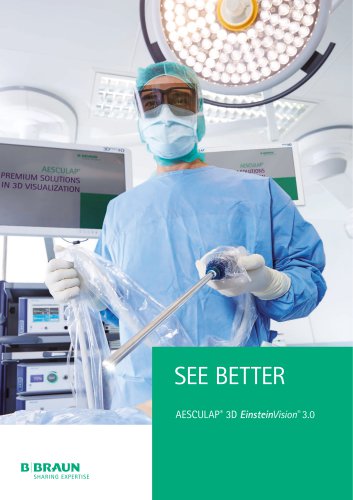
3D, or three-dimensional viewing, leverages stereoscopic vision, which is the ability to perceive depth due to the slightly different images seen by each eye. The Aesculap EinsteinVision® 2.0 camera system mimics this by capturing two images from different viewpoints, processed and displayed on a 3D monitor, requiring 3D glasses for depth perception.
Active 3D glasses use liquid crystal lenses to alternately block each eye in sync with the monitor, requiring batteries and being more expensive. Passive 3D glasses use polarized filters to show different images to each eye simultaneously, are battery-free, and preferred in medical settings for ease of switching between 2D and 3D.
Traditional sterilization methods include autoclaving, which can damage components due to high temperatures, and Sterrad, a low-temperature gas plasma sterilizer. Aesculap offers a sterile single camera drape for the EinsteinVision® system, providing a cost-effective, ready-to-use solution that reduces cross-contamination risks.
Chip-on-the-tip cameras integrate sensors at the endoscope tip, reducing weight but often providing lower resolution and depth perception. Conventional systems like the Aesculap EinsteinVision® use larger sensors in the camera head, offering better image quality and depth perception without the need for upscaling.
Autostereoscopic displays, which do not require glasses, are being developed but are not yet suitable for surgical environments due to quality and safety requirements.
Catalog excerpts
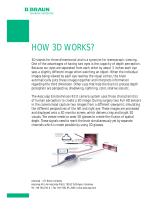
HOW 3D WORKS? 3D stands for three dimensional and is a synonym for stereoscopic viewing. One of the advantages of having two eyes is the capacity of depth perception. Because our eyes are separated from each other by about 3 inches each eye sees a slightly different image when watching an object. When the individual images being viewed by each eye reaches the visual cortex, the brain automatically puts these images together and interprets information regarding the third dimension. Other cues that help the brain to process depth perception are perspective, shadowing, lightning, color, relative size etc. The Aesculap EinsteinVision® 2.0 camera system uses those characteristics of human perception to create a 3D image. During surgery two Full HD sensors in the camera head capture two images from a different viewpoint, simulating the different perspectives of the left and right eye. These images are processed and displayed onto a 3D monitor screen, which delivers crisp and bright 3D visuals. The viewer needs to wear 3D glasses to create the illusion of spatial depth. These signals need to reach the brain simultaneously yet by separate channels which is made possible by using 3D glasses. Aesculap – a B. Braun company Aesculap AG | Am Aesculap-Platz | 78532 Tuttlingen | Germany Tel. +49 7461 95-0 | Fax +49 7461 95-2600 | www.aesculap.com
Open the catalog to page 1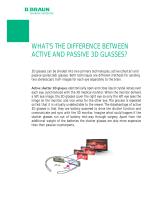
WHAT’S THE DIFFERENCE BETWEEN ACTIVE AND PASSIVE 3D GLASSES? 3D glasses can be divided into two primary technologies, active (shutter) and passive (polarized) glasses. Both techniques are different methods for sending two stereoscopic half-images for each eye separately to the brain. Active shutter 3D glasses electronically open and close liquid crystal lenses over each eye, synchronized with the 3D medical monitor. When the monitor delivers a left eye image, the 3D glasses cover the right eye so only the left eye sees the image on the monitor, and vice versa for the other eye. The process is...
Open the catalog to page 2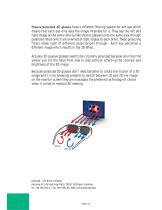
Passive polarized 3D glasses have a different filtering system for ach eye which means that each eye only sees the image intended for it. They see the left and right image at the same time (unlike shutter glasses) onto the same area through polarized filters which are oriented at right angles to each other. These polarizing filters allow light of different polarizations through. Each eye perceives a different image which results in the 3D effect. Actually 3D passive glasses need to be circularly polarized because only then the viewer can tilt the head from side to side without affecting the contrast...
Open the catalog to page 3
WHICH STERILITY PROCESS IS THE BEST FOR 3D VISUAL COMPONENTS? Until recently there were two options available for the sterile product supply of a camera system. The first option is autoclaving. This usually includes the endoscope and sometimes also the camera head if it is not draped with a sterile cover. The disadvantage of autoclaving is the thermal stress on the product due to high temperature (134°C). This often results in a shorter product lifetime and increased investment cost as additional camera heads need to be bought in a defined time period. Another disadvantage is that due to the...
Open the catalog to page 4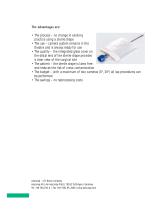
• The process - no change in existing practice using a sterile drape • The use - camera system remains in the theatre and is always ready for use • The quality - the integrated glass cover on the distal end of the sterile drape provides a clear view of the surgical site • The patient - the sterile drape is latex free and reduces the risk of cross-contamination • The budget - with a maximum of two cameras (0°, 30°) all lap procedures can be performed • The savings - no reprocessing costs Aesculap - a B. Braun company Aesculap AG | Am Aesculap-Platz | 78532 Tuttlingen | Germany Tel. +49 7461 95-0...
Open the catalog to page 5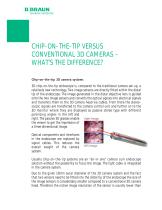
CHIP-ON-THE-TIP VERSUS CONVENTIONAL 3D CAMERAS – WHAT’S THE DIFFERENCE? Chip-on-the-tip 3D camera systems 3D chip-on-the-tip endoscope is, compared to the traditional camera set-up, a relatively new technology. Two image sensors are directly fitted within the distal tip of the endoscope. The image generated in the distal objective lens is guided onto the two image sensors and converts the optical signals into electrical signals and transmits them to the 3D camera head via cables. From there the stereoscopic signals are transferred to the camera control unit and further on to the 3D monitor where...
Open the catalog to page 6
Full HD (1080 lines of horizontal resolution) and needs to be upscaled to Full HD quality. Depth perception is a key feature for stereoscopic viewing. Only a good depth perception provides the impression of a natural 3D image. Chip-on-the-tip camera system by its technological nature only provide a limited depth of field which usually results in a less impressive 3D impression. Smaller sensors have a reduced pixel size which usually results in a higher level of disturbing image noise. Therefore it is beneficial to have bigger sensors in the camera.
Open the catalog to page 7
Conventional 3D camera ystems A "conventional" system like the Aesculap EinsteinVision® 3D camera system consists of a rigid stereo endoscope containing glass rod lenses and objectives to transport the image from the distal tip of the endoscope to the two image sensors which are located in the camera head. From here the flow of 3D information is similar as described in the chip-in-the-tip camera. The main differences to chip- on-the-tip system are: • The two image sensors which are placed in the camera head are substantially bigger in size. This is very beneficial for a low image noise • The...
Open the catalog to page 8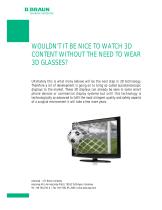
WOULDN’T IT BE NICE TO WATCH 3D CONTENT WITHOUT THE NEED TO WEAR 3D GLASSES? Ultimately this is what many believe will be the next step in 3D technology. Therefore a lot of development is going on to bring so-called autostereoscopic displays to the market. These 3D displays can already be seen in some smart phone devices or commercial display systems but until this technology is technologically so advanced to fulfil the most stringent quality and safety aspects of a surgical environment it will take a few more years. Aesculap – a B. Braun company Aesculap AG | Am Aesculap-Platz | 78532 Tuttlingen...
Open the catalog to page 9All Aesculap® catalogs and technical brochures
 AESCULAP® EQUIPMENT CARTS
6 Pages
 AESCULAP® NEUROENDOSCOPY
128 Pages
 AESCULAP® AdTec® single use
8 Pages
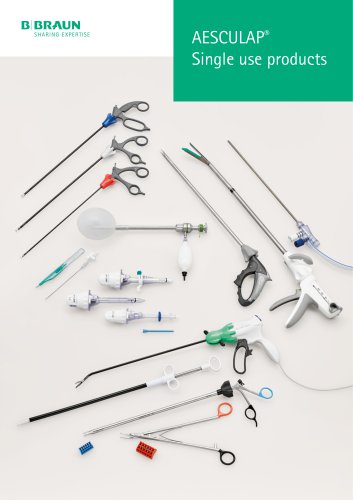 AESCULAP® Single use products
92 Pages
 Aesculap® AdTec® comBi
4 Pages
 Aesculap® AdTec®single use
4 Pages
 AESCULAP® AdTec® single use
6 Pages
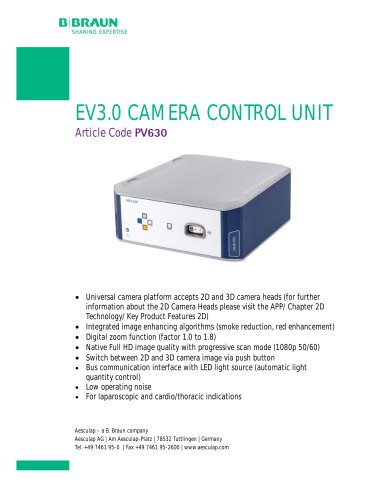 EV3.0 CAMERA CONTROL UNIT
12 Pages
 AESCULAP® EinsteinVision® 3.0 FI
62 Pages
 OMNI
635 Pages
 AESCULAP® NEUROENDOSCOPY
128 Pages
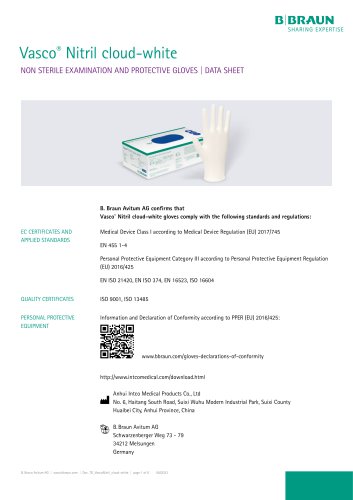 Vasco® Nitril cloud-white
6 Pages
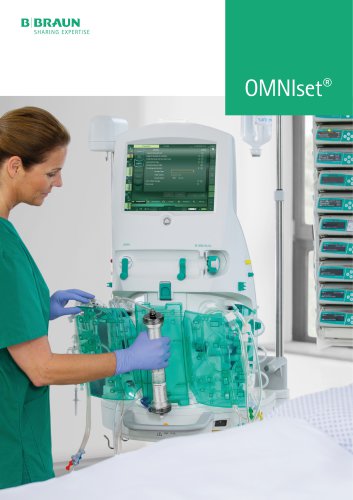 OMNIset®
4 Pages
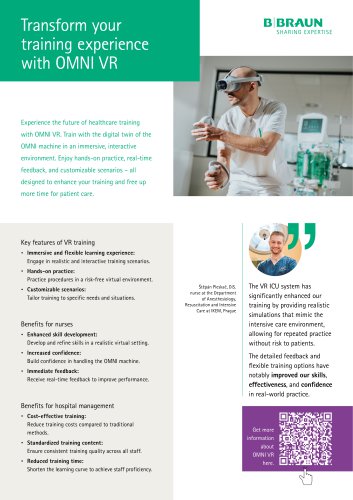 OMNI VR
2 Pages
 OMNI® plus
9 Pages
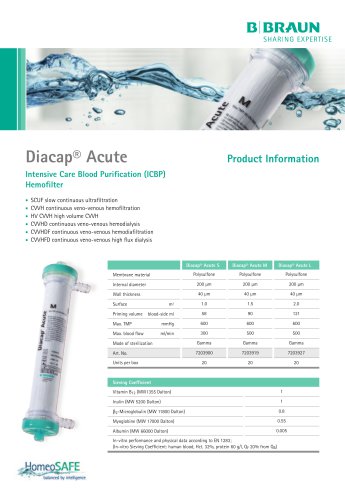 Diacap® Acute
2 Pages
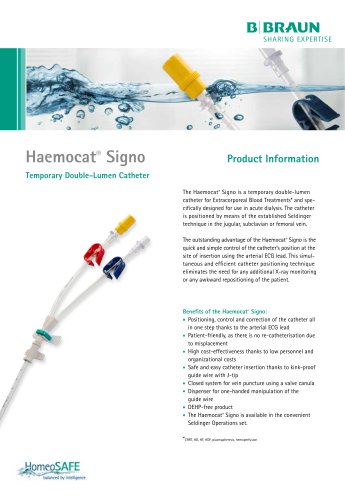 Haemocat® Signo
2 Pages
Archived catalogs
 Premilene® Mesh Plug
8 Pages
 AESCULAP® Excia® 12/14
18 Pages
 Aesculap®
16 Pages
 VascuFlex®
12 Pages
 MONOMAX®
16 Pages
 Quintex®
8 Pages
 AESCULAP® BULLDOG CLIPS
8 Pages
 AESCULAP® Metha®
28 Pages
 AESCULAP® NEUROENDOSCOPY
128 Pages
 Targon® FN
36 Pages
 proGAV ® 2.0
36 Pages
 TrendHip®
16 Pages
 Aesculap® OrthoPilot®
52 Pages
 Aesculap® Targon® RF
28 Pages
 CARDIOLOGY
44 Pages
 Nelson® deluxe
8 Pages
 M.blue®
44 Pages
 LC – LINEAR CUTTER STAPLER
6 Pages
 Aesculap Aeos®
16 Pages
 EV3.0 CAMERA CONTROL UNIT
12 Pages
 Aesculap Surgical Instruments
64 Pages
 AdTec® bipolar
8 Pages
 AESCULAP® CoreHip® SYSTEM
36 Pages
 AESCULAP® SINGLE USE PRODUCTS
88 Pages
 proSA®
30 Pages
 activ L®
44 Pages


- Bone plate
- Logistics trolley
- Compression plate
- Metallic compression plate
- AESCULAP® catheter
- Locking compression plate
- Surgery forceps
- Medical device trolley
- Grasping forceps
- Syringe
- Surgery electrode
- Cannula
- Electrosurgical electrode
- Human scissors
- Endoscope
- AESCULAP® retractor
- Surgical system
- Container
- Orthopedic surgery instrument kit
- Reusable forceps