


- Company
- Products
- Catalogs
- News & Trends
- Exhibitions
Aesculap® OrthoPilot®

Aesculap® OrthoPilot®
- The OrthoPilot® system integrates seamlessly into surgical workflows with minimal extension of operation time.
- It is user-friendly, ergonomic, and provides intraoperative documentation.
- Used by over 600 hospitals, supported by international studies confirming improved alignment.
- Preoperative Planning: Involves radiographic imaging to assess axis deviation, implant alignment, and joint gap, considering soft tissue condition, extensor mechanism functionality, and bone preservation.
- Patient Preparation: Standard positioning and draping procedures are recommended, using a leg holder for leg control.
- OrthoPilot® Setup: Instructions on positioning the system, including femoral and tibial transmitter placement and camera adjustment for visibility.
- Data Entry: Enter patient and hospital information, including implant and tool set specifications.
- Includes general instruments, standard and MIOS® instruments, and IQ instruments, with components like drills, sawing guides, and alignment blocks.
- Ensure optimal positioning of the camera and transmitters for continuous visibility.
- Utilize system features for precise alignment and documentation during surgery.
- Medial and Lateral Cutting Height Indicators: Reference points recorded using landmarks like the deepest points of defects or joint surfaces.
- Optional Software Configuration: Allows recording of one reference point if needed.
- Anterior Cruciate Ligament Reference: If absent, use the middle of the medial-lateral diametral line of the tibial head.
- Anterior Ankle Joint Point: Located at the anterior edge of the distal tibia, near the ankle joint gap.
- Medial and Lateral Malleolus: Recorded using a pointer at their centers.
- Procedure: Performed with the leg stationary, moving the femur in a circular motion to register data.
- Precautions: Ensure visibility of the femur transmitter and avoid pelvic movement.
- Procedure: Movement of the femur transmitter is tracked relative to the tibia transmitter to determine the knee joint centre.
- Dynamic Display: Shows the relationship between the mechanical tibial and femoral axes.
- Procedure: Tibial cutting block is attached and adjusted for desired varus/valgus and slope values.
- Precautions: Avoid contamination of marker spheres on transmitters.
- Procedure: Use tibia control plate to reassess and record the resection surface orientation.
- Procedure: Distal and posterior condyles are recorded using an orientation block.
- Importance: Ensures accurate femur component size proposal and gap value display.
- Procedure: Optimize anterior points on the femur using a pointer to ensure correct implant size.
- Procedure: Use distractor to measure medial and lateral gap distances in both extension and flexion positions.
- In Extension: Displays cutting height, remaining extension gap, and varus/valgus alignment.
- In Flexion: Displays posterior cutting height, remaining flexion gaps, and rotation.
- Registration of lateral malleolus and anterior ankle joint point.
- Hip and knee center registration, followed by mechanical axis registration.
- Planning and registration of tibia cut, including lateral and medial tibia references.
- Selection of operating field and instruments, and input of patient data.
- Registration of distal and posterior condyles, and optimization of anterior cortex.
- Planning and registration of femoral cut, with setting of 4-in-1 femoral cutting guide.
- Registration of joint gaps in extension and flexion, followed by femoral planning.
- Selection of operating field and instruments, and input of patient data.
- Procedures involve multiple registrations and planning steps to ensure accurate alignment and cuts.
- Use of OrthoPilot® TKA system for guidance in total knee arthroplasty.
- All procedures are subject to technical changes and are protected under registered trademarks of Aesculap AG.
Catalog excerpts

Aesculap® OrthoPilot® OrthoPilot® KneeSuite – TKA Total Knee Arthroplasty e.motion®, e.motion® Pro System, Columbus®, VEGA System® Aesculap Orthop
Open the catalog to page 1
OrthoPilot ® TKA – Total Knee Arthroplasty THA Cup only THA Cup & Stem THA Stem only THA Dysplasia Jenny JY, Clemens U, Kohler S, Kiefer H, Konermann W, Miehlke RK. Consistency of implantation of a total knee arthroplasty with a non-image-based navigation system: a case-control study of 235 cases compared with 235 conventionally implanted prostheses. J Arthroplasty. 2005 Oct;20(7):832-9. Jenny JY, Miehlke RK, Giurea A. Learning curve in navigated total knee replacement. A multi-centre study comparing experienced and beginner centres. Knee. 2008 Mar;15(2):80-4. Epub 2008 Feb 11. Bäthis H, Shafizadeh...
Open the catalog to page 2
OrthoPilot® The OrthoPilot® system assists in the precise implantation of knee and hip endoprostheses.1 Integration in the surgical workflow as well as minimal prolongation of operation time were essential criteria in the development of the OrthoPilot® system2. At the same time, we focussed on a navigation system that is non-traumatic for the patient. From the beginning, a method was developed that dispenses with CTs and MRIs exposure or expenses that these entail, and requires only very little extra operation time. CT Scan not required Ergonomic instruments precisely aligned to the surgery n...
Open the catalog to page 3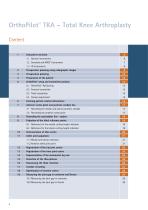
OrthoPilot ® TKA – Total Knee Arthroplasty Content 1 Instrument overview 1.2 Standard and MIOS Instruments Preoperative planning using radiographic images Preoperative planning 5 OrthoPilot setup and transmitter position ® Entering patient-related information Anterior cortex point and posterior condyle line 7.1 Recording the medial and lateral posterior condyle 7.2 Recording the anterior cortex point Recording the epicondylar line - option Palpation of the tibial reference points 9.1 Reference for the medial cutting height indicator 9.2 Reference for the lateral cutting height indicator Determination...
Open the catalog to page 4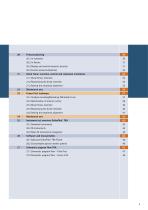
Femoral planning 20.3 Display and control elements (centre) 20.4 Control elements (bottom) Distal femur resection, control and rotational orientation 21.1 Distal femur resection 21.2 Reassessing the distal resection 21.3 Setting the rotational alignment Mechanical axis Femur First technique 23.1 Condyle recording/Recording Whiteside’s Line 23.2 Optimization of anterior cortex 23.3 Distal femur resection 23.4 Reassessing the distal resection 23.5 Setting the rotational alignment Mechanical axis Instrument set overview OrthoPilot TKA 25.3 Reset IQ instruments navigation 26.2 Consumeable passive...
Open the catalog to page 5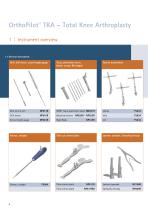
OrthoPilot ® TKA – Total Knee Arthroplasty 1 Instrument overview 1.1 General instruments Drill, drill sleeve, screw length gauge Tissue protection sleeve, bicort. screws, RB adapter Passive transmitters MIOS® tissue protection sleeve NQ941R Drill sleeve Screw length gauge Rigid Body Pointer, straight Tibia cut control plate Laminar spreader, spreading forceps Tibia control plate Laminar spreader Tibia control plate Pointer, straight Spreading forceps
Open the catalog to page 6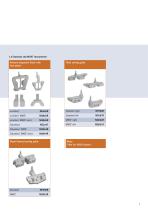
1.2 Standard and MIOS® Instruments* Femoral alignment block with foot plates Tibial sawing guide Standard right e.motion MIOS Standard left e.motion® MIOS® short MIOS® right MIOS left Columbus® MIOS® Columbus MIOS short Distal femoral sawing guide Note: * Not for VEGA System®.
Open the catalog to page 7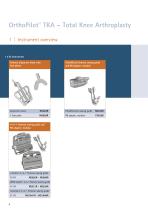
OrthoPilot ® TKA – Total Knee Arthroplasty 1 Instrument overview 1.3 IQ Instruments Femoral alignment block with foot plates Tibial/Distal femoral sawing guide and RB adapter, modular Alignment block Tibial/femoral sawing guide NS334R 4-in-1 Femoral sawing guide and RB adapter, modular e.motion® 4-in-1 Femoral sawing guide F2-F8 VEGA System® 4-in-1 Femoral sawing guide F1-F8 Columbus® 4-in-1 Femoral sawing guide F1-F8 8
Open the catalog to page 8
Preoperative planning using radiographic images The OrthoPilot® system and the TKA software can be used in all cases where total knee arthroplasty with a total knee endoprosthesis is indicated. There must be sufficient bone quality and hip joint mobility. Note: The corresponding notes in the respective surgical technique description, instruction for use and package inserts, in particular in the instruction for use for the OrthoPilot® application software TKA TA013595 must be observed.
Open the catalog to page 9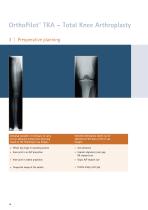
OrthoPilot ® TKA – Total Knee Arthroplasty 3 Preoperative planning Aesculap considers it necessary to carry out an adequate preoperative planning based on the following X-ray images: Selected information which can be obtained on the basis of the X-ray images: Whole leg image in standing position Knee joint in an A/P projection Knee joint in lateral projection Slope, A/P implant size Tangential image of the patella Patella shape, joint gap Axis deviation Implant alignment, joint gap, ML implant size
Open the catalog to page 10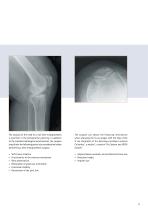
The analysis of the need for a full knee endoprosthesis is essential in the preoperative planning. In addition to the standard radiological examinations, the surgeon should take the following points into consideration before performing a knee endoprosthesis surgery: Soft tissue situation Functionality of the extensor mechanism n Bone preservation n Restoration of good axis orientation n Functional stability n Restoration of the joint line The surgeon can obtain the following information when analysing the X-ray images with the help of the X-ray templates of the Aesculap prosthesis systems Columbus®,...
Open the catalog to page 11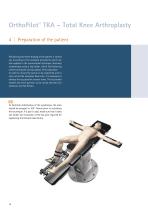
OrthoPilot ® TKA – Total Knee Arthroplasty 4 Positioning and sterile draping of the patient is carried out according to the standard procedures which are also applied in the conventional technique. Aesculap recommends using a leg holder, which facilitates leg control during the various phases of the operation. In order to record the points to be registered and to carry out all the necessary bone cuts, it is necessary to change the leg position several times. The leg holder enables the knee position to be varied between full extension and full flexion. TIP To facilitate mobilisation of the quadriceps,...
Open the catalog to page 12All Aesculap® catalogs and technical brochures
 AESCULAP® EQUIPMENT CARTS
6 Pages
 AESCULAP® NEUROENDOSCOPY
128 Pages
 AESCULAP® AdTec® single use
8 Pages
 AESCULAP® Single use products
92 Pages
 Aesculap® AdTec® comBi
4 Pages
 Aesculap® AdTec®single use
4 Pages
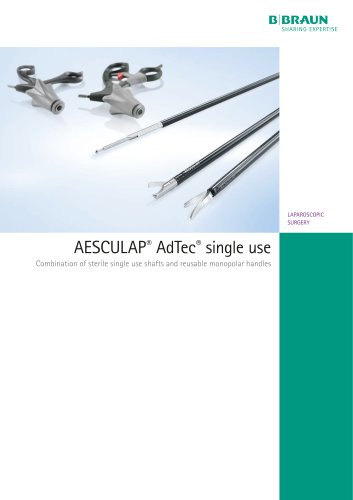 AESCULAP® AdTec® single use
6 Pages
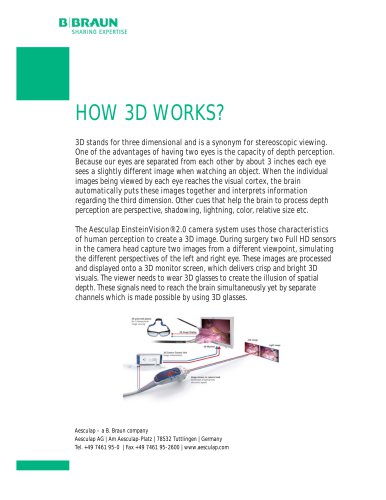 3D
3D9 Pages
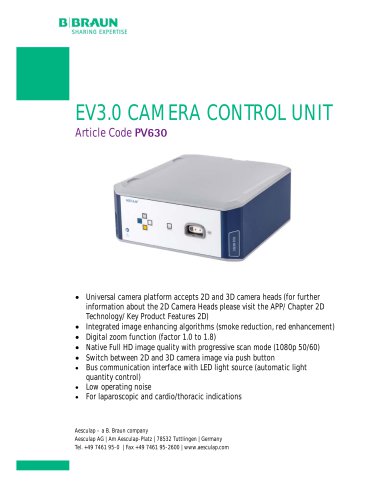 EV3.0 CAMERA CONTROL UNIT
12 Pages
 AESCULAP® EinsteinVision® 3.0 FI
62 Pages
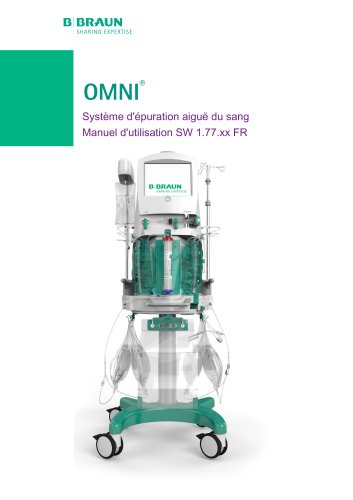 OMNI
OMNI635 Pages
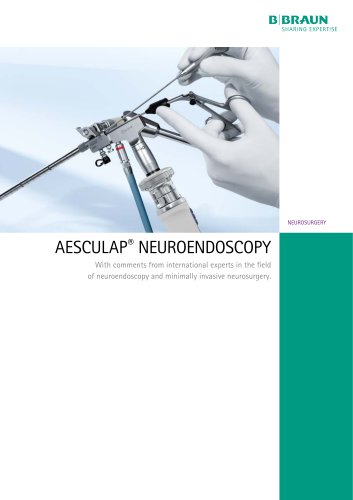 AESCULAP® NEUROENDOSCOPY
128 Pages
 Vasco® Nitril cloud-white
6 Pages
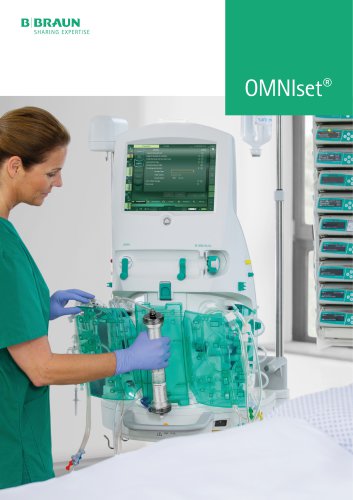 OMNIset®
4 Pages
 OMNI VR
2 Pages
 OMNI® plus
9 Pages
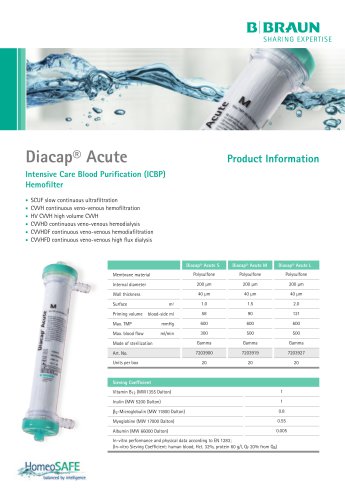 Diacap® Acute
2 Pages
 Haemocat® Signo
2 Pages
Archived catalogs
 Premilene® Mesh Plug
8 Pages
 AESCULAP® Excia® 12/14
18 Pages
 Aesculap®
16 Pages
 VascuFlex®
12 Pages
 MONOMAX®
16 Pages
 Quintex®
8 Pages
 AESCULAP® BULLDOG CLIPS
8 Pages
 AESCULAP® Metha®
28 Pages
 AESCULAP® NEUROENDOSCOPY
128 Pages
 Targon® FN
36 Pages
 proGAV ® 2.0
36 Pages
 TrendHip®
16 Pages
 Aesculap® Targon® RF
28 Pages
 CARDIOLOGY
44 Pages
 Nelson® deluxe
8 Pages
 M.blue®
44 Pages
 LC – LINEAR CUTTER STAPLER
6 Pages
 Aesculap Aeos®
16 Pages
 EV3.0 CAMERA CONTROL UNIT
12 Pages
 Aesculap Surgical Instruments
64 Pages
 AdTec® bipolar
8 Pages
 AESCULAP® CoreHip® SYSTEM
36 Pages
 AESCULAP® SINGLE USE PRODUCTS
88 Pages
 proSA®
30 Pages
 activ L®
44 Pages


- Bone plate
- Logistics trolley
- Compression plate
- Metallic compression plate
- AESCULAP® catheter
- Locking compression plate
- Medical device trolley
- Surgery forceps
- Grasping forceps
- Syringe
- Surgery electrode
- Cannula
- Electrosurgical electrode
- Human scissors
- Surgical system
- Endoscope
- Container
- Orthopedic surgery instrument kit
- Cutting electrosurgical system
- AESCULAP® retractor