
- Catalogs
- Airon Corporation
- pNeuton Bi-level Pressure Ventilation

pNeuton Bi-level Pressure Ventilation

pNeuton Bi-level Pressure Ventilation
- Set Peak Pressure control to desired IPAP (Inspiratory Positive Airway Pressure).
- Set PEEP/CPAP control to desired EPAP (Expiratory Positive Airway Pressure).
- Adjust Resp Rate control to match the patient's total rate.
- Set Tidal Volume control to meet the patient's inspiratory time demand, with 700 ml equating to a 1.2-second inspiratory time.
- Use a tight-fitting anesthesia or BVM style mask, as traditional BiPAP/CPAP masks are incompatible due to large expiratory ports.
- BiPAP devices adjust flow to meet patient demand during a breath, while pNeuton provides a fixed flow of 36 L/min, with up to 140 L/min available at CPAP pressure if needed.
- BiPAP breaths can be both patient and time-triggered, whereas pNeuton breaths are solely time-triggered based on the Resp Rate control.
Catalog excerpts
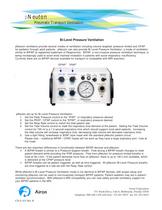
pNeuton Pneumatic Transport Ventilation Bi-Level Pressure Ventilation pNeuton ventilators provide several modes of ventilation including volume targeted, pressure limited and CPAP for pediatric through adult patients. pNeuton can also provide Bi-Level Pressure Ventilation, a mode of ventilation similar to BiPAP (a registered trademark of Respironics). BiPAP, a non-invasive pressure ventilation technique, is being increasingly used to avoid endo-tracheal intubation in patients with acute respiratory insufficiency. Currently there are no BiPAP devices available for transport or compatible with MRI scanners. “EPAP” “IPAP” pNeuton set up for Bi-Level Pressure Ventilation: 1. Set the Peak Pressure control to the “IPAP”, or inspiratory pressure desired. 2. Set the PEEP / CPAP control to the “EPAP”, or expiratory pressure desired. 3. Set the Resp Rate control to match the total patient rate. 4. Set the Tidal Volume control to meet the inspiratory time demand of the patient. Setting the Tidal Volume control for 700 ml is a 1.2 second inspiratory time which should support most adult patients. Increasing the tidal volume will increase inspiratory time, decreasing tidal volume will decrease inspiratory time. 5. Use a tight fitting “anesthesia or BVM” style mask with the standard pNeuton patient circuit. Please note – traditional BiPAP / CPAP masks will not work as they have a large expiratory port / hole at the mask. There are two important differences in functionality between BiPAP devices and pNeuton. Ø A BiPAP breath is similar to a Pressure Support breath. Flow during a BiPAP breath changes to meet patient demand while providing the IPAP pressure. Flow from pNeuton for pressure limited breaths is fixed at 36 L/min. If the patient demands more flow on pNeuton, there is up to 140 L/min available, which is delivered at the CPAP pressure level. Ø BiPAP breaths can be patient triggered, as well as time triggered. All pNeuton Bi-Level Pressure breaths are time triggered at a rate set with the Resp Rate control. While pNeuton’s Bi-Level Pressure Ventilation mode is not identical to BiPAP devices, with proper setup and monitoring pNeuton can be used to non-invasively transport BiPAP patients. Patient sedation may aid in patient / ventilator synchronization. With pNeuton’s MRI compatibility you can now safely provide ventilatory support for your BiPAP patients in the MRI. Airon Corporation 751 North Drive, Unit 6, Melbourne, Florida 32934 telephone 888-448-1238 (toll free) 321-821-9433 fax 321-821-9443 CD-A-015 Rev B
Open the catalog to page 1All Airon Corporation catalogs and technical brochures
 pNeuton model A
2 Pages
 Respiratory Care Test Comparison
13 Pages
 MACS
MACS2 Pages
 pNeuton model S
2 Pages
 pNeuton mini
2 Pages
 Airon_Brochure
12 Pages

- Non-invasive ventilator
- Anesthesia circuit
- Emergency ventilator
- CPAP ventilator
- Transport ventilator
- Resuscitation ventilator
- Infant ventilator
- Ventilator with adjustable PEEP
- Pediatric ventilator
- Pneumatic ventilator
- Pediatric ventilation circuit
- Semi-open breathing circuit
- Test lung
- Artificial ventilation test lung
- Infant breathing circuit