
- Catalogs
- Airon Corporation
- Respiratory Care Test Comparison

Respiratory Care Test Comparison

Respiratory Care Test Comparison
The document evaluates the performance of the pNeuton pneumatic transport ventilator, comparing it to other transport ventilators based on a study published in the June 2007 issue of Respiratory Care. The pNeuton ventilator was tested by Massachusetts General Hospital and met the study's protocol targets.
The pNeuton ventilator was tested using laboratory bench test procedures under different conditions of resistance and compliance with tidal volumes of 500 ml and 1000 ml. It performed within the required 10% accuracy, effectively ventilating under both normal and injured lung conditions.
The pNeuton ventilator performed as well or better than sophisticated ventilators. In contrast, other ventilators like Pneupac, Oceanic (Maxtec), and Carevent showed significant inaccuracies in tidal volumes during testing.
The pNeuton ventilator met all trial targets in bench tests. Although animal tests were not conducted, there is confidence that it would meet those targets. The document emphasizes the importance of spontaneous breathing performance, supported by the pNeuton ventilator.
The original study evaluated 15 transport ventilators for operational capabilities, including gas consumption, battery life, ease of use, and ability to deliver set ventilation parameters. Only two ventilators met all trial targets in both bench and animal tests.
Transport ventilators must be portable, easy to operate, and capable of delivering high FIO2. They should operate on internal batteries and without compressed gas. Only a few ventilators could maintain ventilation and oxygenation in both normal and lung-injured conditions.
The study used bench and animal models to evaluate ventilators. Bench tests assessed gas consumption, battery life, and the ability to deliver set parameters under different conditions. Animal tests involved ventilating healthy and lung-injured sheep to evaluate the ventilators' performance in maintaining normal arterial blood gas values and hemodynamics.
The study concluded that many transport ventilators have inaccuracies in delivering set parameters, and their physical characteristics and high gas consumption may limit their desirability for patient transport.
Miyoshi et al. assessed four ventilators with transport capabilities, noting variability in delivered tidal volume (VT) and issues with gas trapping due to high resistance. Zanetta et al. evaluated five transport ventilators and three ICU ventilators, finding similar issues.
The study's primary limitation is the lack of patient testing, relying instead on bench and animal models. The evaluations were more consistent with pediatric settings, limiting adult assessments. Spontaneous breathing performance was not evaluated, and only one ventilator per company was tested, which may not represent all models.
The document cites various studies and evaluations of transport ventilators, highlighting ongoing research and development in this field.
Catalog excerpts
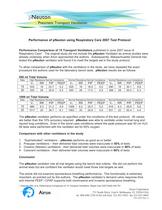
pNeuton Pneumatic Transport Ventilation Performance of pNeuton using Respiratory Care 2007 Test Protocol Performance Comparison of 15 Transport Ventilators published in June 2007 issue of Respiratory Care*. The original study did not include the pNeuton Ventilator as animal studies were already underway when Airon approached the authors. Subsequently, Massachusetts General has tested the pNeuton ventilator and found it to meet the targets set in the study protocol. To allow comparison of pNeuton with the ventilators in the study, we have repeated the exact procedure the authors used for the laboratory bench tests. pNeuton results are as follows: 500 ml Tidal Volume Rate High Resistance Normal Compliance Normal Resistance Normal Compliance Normal Resistance Low Compliance 1000 ml Tidal Volume Rate High Resistance Normal Compliance Normal Resistance Normal Compliance Normal Resistance Low Compliance The pNeuton ventilator performs as specified under the conditions of the test protocol. All values are better than the 10% accuracy required. pNeuton was able to ventilate under normal lung and injured lung conditions. Even in the worst case conditions where the peak pressure was 50 cm H2O. All tests were performed with the ventilator set for 65% oxygen. Comparison with other ventilators in the study 1. 2. 3. 4. “Sophisticated” ventilators – pNeuton performs as good as or better Pneupac ventilators – their delivered tidal volumes were inaccurate in 50% of tests Oceanic (Maxtec) ventilators - their delivered tidal volumes were inaccurate in 90% of tests Carevent ventilators - their delivered tidal volumes were inaccurate in 80% of tests Conclusion The pNeuton ventilator met all trial targets using the bench test criteria. We did not perform the animal tests but are confident the ventilator would meet those trial targets as well. The article did not examine spontaneous breathing performance. This functionality is extremely important, as pointed out by the authors. The pNeuton ventilator’s demand valve response time and internal PEEP / CPAP supports both noninvasive and invasive spontaneous breathing. * Chipman DW, et al. Performance Comparison of 15 Transport Ventilators. Respir Care 2007;52(6):740-751 Airon Corporation 751 North Drive, Unit 6, Melbourne, FL 32934 USA tel 888-448-1238 (USA toll free) 321-821-9433 fax 321-821-9443 CD-A-037 Rev A
Open the catalog to page 1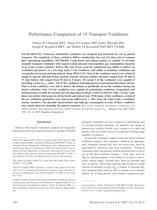
Performance Comparison of 15 Transport Ventilators Daniel W Chipman RRT, Maria P Caramez MD, Eriko Miyoshi MD, Joseph P Kratohvil RRT, and Robert M Kacmarek PhD RRT FAARC BACKGROUND: Numerous mechanical ventilators are designed and marketed for use in patient transport. The complexity of these ventilators differs considerably, but very few data exist to compare their operational capabilities. METHODS: Using bench and animal models, we studied 15 currently available transport ventilators with regard to their physical characteristics, gas consumption (duration of an E-size oxygen cylinder), battery...
Open the catalog to page 2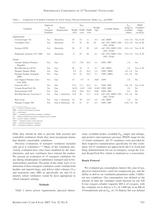
PERFORMANCE COMPARISON Table 1. Comparison of Evaluated Ventilators by Power Source, Physical Dimensions, Modes, FIO2, and PEEP Approved as Transport Ventilator Size Power Requirement Weight Height Width Depth (kg) (cm) (cm) (cm) Available Modes FIO2 (range or available values) PEEP Available? (range cm H2O) Sophisticated Univent Eagle 754 VersaMed iVent Electricity Electricity A/C, SIMV CMV, SIMV CMV, SIMV CMV, IMV CMV, IMV CMV, IMV A/C (VP), SIMV (VP), PSV, CPAP A/C, SIMV CMV, IMV Simple Oceanic Medical Products Magellan Bio-Med Devices IC2A Pneupac Parapac Medic Pneupac Parapac Transport 200D...
Open the catalog to page 3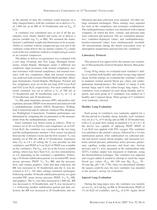
PERFORMANCE COMPARISON as the amount of time the ventilator could function on a fully charged battery with the ventilator set to deliver a VT of 1,000 mL at an RR of 10 breaths/min and an FIO2 of 0.21. A ventilator was considered easy to use if all the parameters were clearly labeled and easily set to deliver a precise variable (eg, VT or RR). We assumed the manufacturer’s published weight and dimensions to be accurate. Ability to ventilate without compressed gas was met if the ˙ ventilator could deliver the set minute volume (VE) under each of the test conditions without a compressed gas source...
Open the catalog to page 4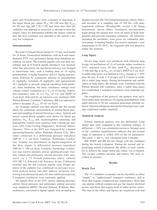
PERFORMANCE COMPARISON gases and hemodynamics were evaluated to determine if the target blood gas values (PaO2 60 –100 mm Hg, PaCO2 30 –50 mm Hg, pH 7.30 –7.50) had been met, then the ventilator was adjusted as necessary to attempt to meet the targets. Once we determined whether the targets could be met, the next ventilator was attached to the animal’s airway for evaluation. Instrumentation We used 12 female Dorset sheep (21–31 kg), each fasted for 24 hours. Orotracheal intubation, with an 8-mm innerdiameter ETT, was performed during deep halothane anesthesia via mask. The external jugular vein...
Open the catalog to page 5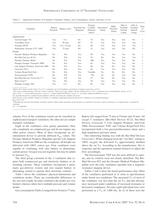
PERFORMANCE COMPARISON Table 2. Operational Features of Evaluated Ventilators: Battery, Gas Consumption, Alarms, and Ease of Use Sophisticated Univent Eagle 754 VersaMed iVent Newport HT50 Pulmonetic Systems LTV 1000 Simple Oceanic Medical Products Magellan Bio-Med Devices IC2A Pneupac Parapac Medic Pneupac Parapac Transport 200D Life Support Products AutoVent 2000 Carevent ATVϩ Vortran RespirTech Pro Percussionaire TXP Bio-Med Devices Crossvent 3** Bird Avian** Pneupac Compac 200 Battery Powered Battery Life* Oxygen Cylinder Duration (min)† Disconnect Alarm HighPressure Alarm Able to Ventilate...
Open the catalog to page 6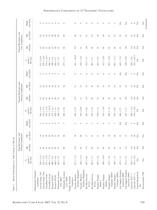
Normal Resistance and Normal Compliance Normal Resistance and Low Compliance High Resistance and Normal Compliance Bench Performance at a Tidal Volume of 500 mL Sophisticated Transport Ventilators Univent Eagle 754* Univent Eagle 754‡ VersaMed iVent* VersaMed iVent‡ Newport HT50* Newport HT50‡ Pulmonetic Systems LTV 1000* Pulmonetic Systems LTV 1000‡ Simple Transport Ventilators Oceanic Medical Products Magellan* Oceanic Medical Products Magellan‡ Bio-Med Devices IC2A* Bio-Med Devices IC2A‡ Pneupac Parapac Medic* Pneupac Parapac Medic‡ Pneupac Parapac Transport 200D* Pneupac Parapac Transport...
Open the catalog to page 7All Airon Corporation catalogs and technical brochures
 pNeuton model A
2 Pages
 MACS
MACS2 Pages
 pNeuton model S
2 Pages
 pNeuton mini
2 Pages
 Airon_Brochure
12 Pages


- Non-invasive ventilator
- Anesthesia circuit
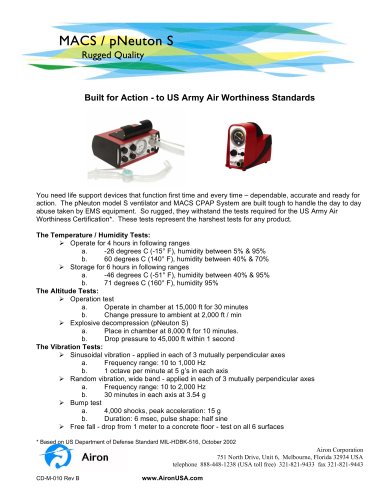
- Emergency ventilator
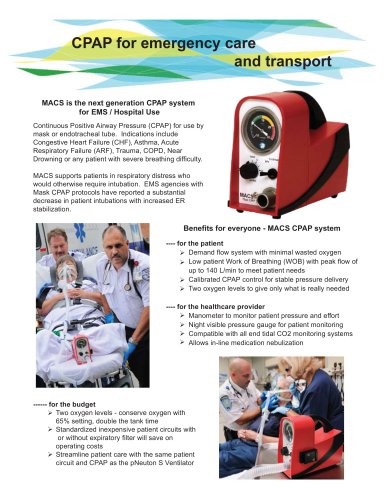
- CPAP ventilator
- Resuscitation ventilator
- Infant ventilator
- Ventilator with adjustable PEEP
- Pediatric ventilator
- Pneumatic ventilator
- Pediatric ventilation circuit
- Semi-open breathing circuit
- Test lung
- Artificial ventilation test lung
- Infant breathing circuit