
- Catalogs
- Alphatec Spine
- Minimally invasive lumbar spinal decompression in the elderly:

- Products
- Catalogs
- News & Trends
- Exhibitions
Minimally invasive lumbar spinal decompression in the elderly:

Minimally invasive lumbar spinal decompression in the elderly:
Objective: The study focuses on evaluating the safety and efficacy of minimally invasive lumbar spinal surgery in elderly patients, specifically those aged 75 and older, suffering from lumbar spinal stenosis and spondylosis. These conditions are significant causes of morbidity in the elderly, and traditional surgical options are often not considered due to age and comorbidities.
Methods: The research involved a review of demographic data and various health scores, including the Visual Analog Scale (VAS) for pain, Oswestry Disability Index, and Short-Form 36, from patients who underwent minimally invasive decompression for lumbar degenerative disease. The study included patients from two institutions, with data collected between January 2002 and December 2005. Statistical analyses such as paired t-tests and linear regression were employed.
Results: Out of 57 patients with a mean age of 81, 50 had sufficient data for analysis. The study reported no major complications or deaths. Significant improvements were observed in VAS pain scores, which decreased from 5.7 to 2.2 for back pain and from 5.7 to 2.3 for leg pain. The Oswestry Disability Index scores improved from 48 to 27, and the Short-Form 36 scores for Body Pain and Physical Function also showed significant enhancements post-surgery. The symptom relief was found to be durable over time.
Conclusion: The findings suggest that minimally invasive lumbar spine decompression is both safe and effective for elderly patients with spinal stenosis and spondylosis. The study recommends considering elderly patients as suitable candidates for this surgical approach.
Catalog excerpts
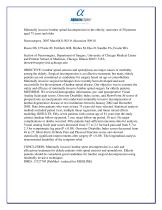
Minimally invasive lumbar spinal decompression in the elderly: outcomes of 50 patients aged 75 years and older Neurosurgery. 2007 Mar;60(3):503-9; discussion 509-10 Rosen DS, O'Toole JE, Eichholz KM, Hrubes M, Huo D, Sandhu FA, Fessler RG. Section of Neurosurgery, Department of Surgery, University of Chicago Medical Center and Pritzker School of Medicine, Chicago, Illinois 60637, USA. [email protected] OBJECTIVE: Lumbar spinal stenosis and spondylosis are major causes of morbidity among the elderly. Surgical decompression is an effective treatment, but many elderly patients are not considered as candidates for surgery based on age or comorbidities. Minimally invasive surgical techniques have recently been developed and used successfully for the treatment of lumbar spinal disease. Our objective was to examine the safety and efficacy of minimally invasive lumbar spinal surgery for elderly patients. METHODS: We reviewed demographic information, pre- and postoperative Visual Analog Scale pain scores, Oswestry Disability Index scores, and Short-Form 36 scores of prospectively accrued patients who underwent minimally invasive decompression of lumbar degenerative disease at two institutions between January 2002 and December 2005. Data from patients who were at least 75 years old were selected. Statistical analysis methods included paired t test, multiple linear regression, and linear mixed effects modeling. RESULTS: Fifty-seven patients with a mean age of 81 years met the study criteria (median follow-up period, 7 mo; mean follow-up period, 10 mo). No major complications or deaths occurred. Fifty patients had sufficient outcomes data for analysis. Visual Analog Scale pain scores decreased from 5.7 to 2.2 for back pain and from 5.7 to 2.3 for symptomatic leg pain (P < 0.05). Oswestry Disability Index scores decreased from 48 to 27; Short-Form 36 Body Pain and Physical Function scores also showed statistically significant improvements after surgery (P < 0.05). The longitudinal analysis demonstrated durability of the symptom relief. CONCLUSION: Minimally invasive lumbar spine decompression is a safe and efficacious treatment for elderly patients with spinal stenosis and spondylosis. Elderly patients should be considered good candidates for lumbar surgical decompression using minimally invasive techniques. PMID: 17327795 [PubMed - indexed for MEDLINE]
Open the catalog to page 1All Alphatec Spine catalogs and technical brochures
 Anterior cervical fusion
1 Page
 ALPHATEC SPINE
1 Page
 VELOSSITY
4 Pages

- Bone plate
- Retractor
- Interbody fusion cage
- Surgical retractor
- Bone substitute
- PEEK interbody fusion cage
- Anterior interbody fusion cage
- Lumbar interbody fusion cage
- Arthrodesis plate
- Orthopedic surgery bone substitute
- Spinal stabilization system
- Posterior spinal osteosynthesis unit
- Metallic arthrodesis plate
- Adult spinal osteosynthesis unit
- Cervical interbody fusion cage
- Titanium interbody fusion cage
- Locking arthrodesis plate
- Pedicle screw
- Posterior interbody fusion cage
- Metallic pedicle screw