

ALZET Research Application

ALZET Research Application
The document discusses the use of humanized mouse models, particularly focusing on immunodeficient strains like the NOD/SCID mouse, which are crucial for engrafting human cells and tissues. These models are instrumental in studying human biology and diseases, enhancing the translational value of preclinical studies.
ALZET pumps are highlighted for their role in continuous dosing in humanized mouse models. They offer a convenient alternative to repetitive injections, minimizing animal handling and stress. Key features include small size, various models for mice, and delivery rates ranging from 0.11 µl/hr to 8 µl/hr over durations from 1 day to 6 weeks.
- Gang et al. Study: Evaluated ICG-001 in combination with chemotherapy in NSG mice, showing prolonged survival and a promising strategy for eradicating drug-resistant leukemia cells.
- Klug et al. Study: Investigated low-dose irradiation in cancer immunotherapy, demonstrating the role of iNOS+ macrophages in enhancing T cell recruitment and tumor rejection.
- Suzuki et al. Study: Developed a system for generating hematopoietic stem cells from iPSCs, showing successful engraftment and differentiation in NOD/SCID mice.
- Chandramohan et al. Study: Assessed an anti-podoplanin immunotoxin in brain tumor models, indicating its efficacy in increasing survival rates.
- Krause et al. Study: Explored the modulation of the bone marrow microenvironment using PTH to target leukemia stem cells, suggesting a complementary approach to tumor therapy.
Various models like hCD34+ and hBLT mice are discussed, each with specific advantages for different research applications, such as longer lifespan or robust immune system development.
The document details several strains used in humanized models, including Nude, SCID, NRG, NOG, NOD SCID, and NSG mice, each with unique characteristics that make them suitable for specific types of research.
Humanized mouse models, supported by ALZET pumps, provide a versatile platform for studying human diseases and developing therapeutic strategies, with each model offering distinct benefits for various research needs.
Catalog excerpts
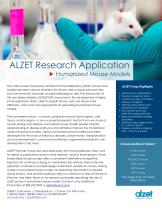
ALZET Research Application► Humanized Mouse Models The nude mouse and severe combined immunodeficiency (SCID) mouse have traditionally been used as recipients for human cells or tissues because they lack host immunity and easily accept heterologous cells. The introduction of the non-obese diabetic (NOD)/SCID mouse led to the development of highly immunodeficient strains, able to engraft human cells and tissues more efficiently, which are more appropriate for generating humanized mouse models. The humanized mouse - a mouse carrying functional human genes, cells, tissues, and/or organs - is now a powerful research tool for the in vivo study of human biology and disease. Humanized mouse models enable a better understanding of disease pathways and ultimately improve the translational value of preclinical studies. Various humanized mouse models have been developed for the study of infectious diseases, autoimmunity, transplantation, vaccine development, cancer immunotherapy, regenerative medicine, cell development, and more. ALZET Pump Highlights • Small size for implantation • 9 pump models for mice • Continuous and controlled delivery of agents • Minimize side effects and experimental variables • Convenient and cost-effective dosing method • Reduced animal handling and stress • Delivery rates ranging from 0.11 Ml/hr to 8 Ml/hr • Delivery durations ranging from 1 day to 6 weeks Immunodeficient Strains* ALZET® Osmotic Pumps are used extensively with immunodeficient mice, and hundreds of publications attest to their research value in these species. These implantable infusion pumps offer a convenient alternative to repetitive injections for continuous dosing of unrestrained lab animals. Their automatic operation, small size and simple design make them suitable for chronic dosing studies in humanized mouse models. No researcher intervention is required during infusion, and animal handling is kept to a minimum to reduce the risk of infection and stress. Read on for research summaries describing the use of ALZET pumps in humanized mouse models. Contact us for additional information at 800.692.2990 or [email protected]. Nude Mouse SCID Mouse NOD/SCID Mouse NSG Mouse NOG Mouse NRG Mouse *See page 4 for complete descriptions DURECT Corporation | 10260 Bubb Road | Cupertino CA, 95014-4166 T: 408.367.4036 F: 408.865.1406 Toll Free 800.692.2990 WWW.AIZFT.COM | [email protected] alzet OSMOTIC PUMPS
Open the catalog to page 1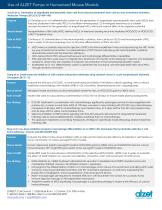
Use of ALZET Pumps in Humanized Mouse Models Suzuki et al. Generation of engraftable hematopoietic stem cells from induced pluripotent stem cells by way of teratoma formation. Molecular Therapy 2013;21(7):1424–1431 Purpose (1) Develop an in vivo differentiation system for the generation of engraftable hematopoietic stem cells (HSCs) from induced pluripotent stem cells (iPSCs) to facilitate hematopoiesis. (2) Investigate teratomas as a suitable microenvironment for the generation of engraftable HSCs with bone marrow (BM) niche migration potential. Mouse Model Transplantation of BM cells (hiPSC-derived...
Open the catalog to page 2
Purpose Mouse Model Role of ALZET Key Findings Evaluate the effect of human parathyroid hormone (PTH) for modulation of the bone marrow microenvironment to eliminate persistent and drug resistant leukemia stem cells (LSC) in chronic myelogenous leukemia (CML) and acute myeloid leukemia (AML). Xenograft model of chronic myelogenous leukemia in NOD/SCID IL-2 receptor y deficient (NSG) mice. 14-day ALZET pumps used for SC administration of human PTH (1-34) for 18 weeks (PTH treatment started 4 weeks prior to xenotransplantation and continued for 14 weeks thereafter, with pump replacement every two...
Open the catalog to page 3
Resources: • Ito et al. Cellular & Molecular Immunology 2012;9:208-214 • Shultz et al. Nature Reviews 2007;7:118-130 • www.jaxmice.jax.org • www.humouse.org DURECT Corporation | 10260 Bubb Road | Cupertino CA, 95014-4166 T: 408.367.4036 F: 408.865.1406 Toll Free 800.692.2990 WWW.ALZET.COM |
Open the catalog to page 4All ALZET catalogs and technical brochures
 PHARMACOLOGY FOCUS
8 Pages
 Research Application
2 Pages
 NEUROSCIENCE RESEARCH
4 Pages
 Special Delivery
8 Pages
 CANCER RESEARCH
4 Pages
 ALZET Research Application
2 Pages
 ALZET Technical Sheet 1.1
5 Pages
 INTRACEREBRAL CANNULATION
2 Pages
 INTRATHECAL CANNULATION
2 Pages
 INTRAVENOUS CANNULATION
2 Pages
 INTRAPERITONEAL IMPLANTATION
2 Pages
 SUBCUTANEOUS IMPLANTATION
2 Pages
 Colored Flow Moderators
1 Page
 IPRECIO
3 Pages
 Wound Closure Systems
1 Page
 Catheter Fact Sheet
2 Pages


