

CANCER RESEARCH

CANCER RESEARCH
Before selecting a cancer therapeutic for clinical development, it is crucial to understand its mechanism of action, antitumor activity, and safety profile through preclinical animal studies. ALZET® Osmotic Pumps have been used since 1977 for continuous delivery of experimental agents in cancer research, optimizing therapeutic efficacy while minimizing adverse effects.
Benefits of ALZET Pumps in Cancer Research
- Small size suitable for mice and larger animals.
- Continuous and controlled delivery of anti-cancer agents.
- Increased efficacy and improved bioavailability of drugs with short half-lives.
- Reduced drug toxicity and side effects.
- Reliable technology with over 15,000 publications.
- Simple design, easy to use, and cost-effective.
- Reduced animal handling and stress.
- Automatic dosing during nighttime and weekends.
Cancer Research Applications
Improve Efficacy and Lower Toxicity: ALZET pumps maintain drug levels within the therapeutic range, enhancing efficacy and minimizing adverse effects.
Use in Xenograft Models: Suitable for murine xenograft models, useful in studying various carcinomas, sarcomas, lymphomas, and leukemias.
Intratumoral Delivery: Direct delivery into tumors enhances efficacy and reduces systemic side effects.
Measurement of Cell Proliferation: Continuous labeling with BrdU for accurate measurement of cell proliferation.
In Vivo Imaging Applications: Used in bioluminescence imaging (BLI) for steady-state delivery of substrates.
Humanized Mouse Models: Ideal for chronic dosing studies in immunodeficient mouse strains.
Chronic Delivery: Maintains steady-state levels for up to six weeks, extendable through serial implantation.
Selecting an Optimum Vehicle
Consider solubility, tissue compatibility, pH, and sterility. A formulation with PEG 300, Cremophor ELP, glycofurol, ethanol, and propylene glycol is effective for poorly soluble compounds.
Conclusion
ALZET Osmotic Pumps provide a reliable method for continuous drug delivery in cancer research, improving therapeutic outcomes and reducing toxicity. They are adaptable for various research needs, offering a consistent and controlled delivery system.
Catalog excerpts
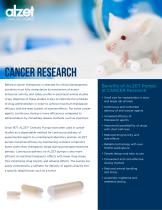
Before a cancer therapeutic is selected for clinical development, scientists must fully characterize its mechanism of action, antitumor activity, and safety profile in preclinical animal studies. A key objective of these studies is also to optimize the schedule of drug administration in order to achieve maximum therapeutic efficacy with the least burden of adverse effects. For some cancer agents, continuous dosing is more efficacious compared to administration by immediate release methods, such as injections. Since 1977, ALZET® Osmotic Pumps have been used in cancer studies as a dependable method for continuous delivery of experimental agents to unrestrained laboratory animals. ALZET pumps maximize efficacy by maintaining constant compound levels within their therapeutic range during prolonged treatment periods. Continuous delivery via ALZET pumps is also more efficient at reaching therapeutic effects with lower drug doses, thus minimizing drug toxicity and adverse effects. The pumps are easily connected to a catheter for delivery of agents directly into a specific target tissue, such as a tumor. Benefits of ALZET Pumps in CANCER Research • Small size for implantation in mice and larger lab animals • Continuous and controlled delivery of anti-cancer agents • Increased efficacy of therapeutic agents • Improved bioavailability of drugs with short half-lives • Reduced drug toxicity and side effects • Reliable technology with over 15,000 publications • Simple design and easy to use • Convenient and cost-effective dosing method • Reduced animal handling and stress • Automatic nighttime and weekend dosing
Open the catalog to page 1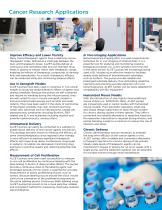
Improve Efficacy and Lower Toxicity Many chemotherapeutic agents have a relatively narrow therapeutic index, defined as a small gap between the toxic and therapeutic doses. ALZET pumps deliver at continuous and controlled rates and can maintain drug levels in plasma or tissues within their therapeutic range, enabling the effects of therapeutic compounds to develop fully and reproducibly. As a result, therapeutic efficacy can be enhanced while also minimizing adverse effects. Use in Xenograft Models ALZET pumps have been used in numerous in vivo cancer models to study the antiproliferative effects...
Open the catalog to page 2
Selecting an Optimum Vehicle The criteria for selecting a vehicle for ALZET pump infusion should include the solubility of the test compound, tissue compatibility, pH considerations for compound stability, and sterility. For many compounds soluble in aqueous media, Ringer’s solution is an appropriate vehicle since it is sterile, particle- and pyrogen-free, and non-irritating. Among various solvents investigated, a vehicle formulation containing 25% PEG 300, 25% Cremophor ELP, 25% glycofurol, 15% ethanol, and 10% propylene glycol was most effective at solubilizing two investigational compounds...
Open the catalog to page 3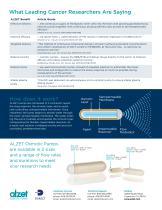
What Leading Cancer Researchers Are Saying ALZET Benefit Article Quote Effective delivery “...the continuous supply of therapeutic stem cells into the brain with growing glioblastoma by osmotic pumps together with continuous prodrug delivery also proved to be therapeutically efficient." Altaner et al. Int J Cancer 2014;134(6):1458-1465 Improve efficacy “.we report that i.c. administration of F10 results in dramatic regression of G48a tumors.” Gmeiner et al. J Neuro-oncol 2014;116(3):447-454 Targeted delivery “This method of continuous intracranial delivery will aid in achieving elevated concentrations...
Open the catalog to page 4All ALZET catalogs and technical brochures
 PHARMACOLOGY FOCUS
8 Pages
 Research Application
2 Pages
 NEUROSCIENCE RESEARCH
4 Pages
 Special Delivery
8 Pages
 ALZET Research Application
2 Pages
 ALZET Research Application
4 Pages
 ALZET Technical Sheet 1.1
5 Pages
 INTRACEREBRAL CANNULATION
2 Pages
 INTRATHECAL CANNULATION
2 Pages
 INTRAVENOUS CANNULATION
2 Pages
 INTRAPERITONEAL IMPLANTATION
2 Pages
 SUBCUTANEOUS IMPLANTATION
2 Pages
 Colored Flow Moderators
1 Page
 IPRECIO
3 Pages
 Wound Closure Systems
1 Page
 Catheter Fact Sheet
2 Pages


