

INTRAPERITONEAL IMPLANTATION

INTRAPERITONEAL IMPLANTATION
ALZET pumps are designed for intraperitoneal implantation in animals with sufficiently large peritoneal cavities. The document outlines the preparation, surgical procedure, and post-operative care for using ALZET osmotic pumps.
Substances administered intraperitoneally may be absorbed via the hepatic portal circulation, affecting plasma concentrations, especially for agents with a high first-pass effect. Such agents should be avoided for intraperitoneal administration.
1. Fill the ALZET pump with the drug solution using a syringe and filling tube as per the package insert instructions.
2. Insert the flow moderator into the pump.
3. Prime the pumps in sterile saline at 37°C, typically requiring an overnight period.
Anesthesia is necessary for surgical implantation. Recommended anesthetics include Isoflurane for inhalation or Xylazine® and Ketamine® for injection.
1. Apply ocular lubricant.
2. Shave and disinfect the incision site with 70% ethanol and iodine.
3. Repeat the disinfection process.
1. Make a midline skin incision in the lower abdomen.
2. Carefully incise the peritoneal wall.
3. Insert the filled pump into the peritoneal cavity.
4. Close the incision with wound clips or sutures.
1. Provide analgesics as needed under veterinary guidance.
2. Monitor animals daily post-surgery and check for adverse effects such as respiratory depression or infection.
3. Remove wound clips 7-10 days post-procedure.
Monitor the animal's health, especially the morning after surgery, to ensure recovery and address any complications promptly.
Catalog excerpts

GENERAL ITEMS - ALZET Osmotic Pumps* - Homeothermic pad - Sterile drape - Sterile gauze, cotton swabs - Hair clippers (#40 blade) - 70% ethanol - Betadine solution - Glass bead sterilizer - Ocular lubricant - Wound Clips (7mm for mice, 9mm for rats)* - Wound Clip Applier* - Wound Clip Remover* - Scalpel handle #3 - Scalpel blade #15 - Brown Adson forceps - Hemostat (straight tip) - Sutures (absorbable, 4.0) * Available from DURECT Corp. ([email protected]) _✓ ALZET pumps can be implanted intraperitoneally in animals with sufficiently large peritoneal cavities. With any substance administered intraperitoneally, whether by injection or by infusion, a majority of the dose may be absorbed via the hepatic portal circulation rather than by the capillaries. For substances that are extensively metabolized by the liver (i.e., have a high “first pass effect”), the intraperitoneal route of administration may produce highly variable concentrations of agent in plasma and consequently highly variable effects. Therefore, the intraperitoneal route should probably be avoided with agents that have a significant first-pass effect. Pump Preparation (refer to the package insert for complete filling instructions) - Fill the empty ALZET pump with your vehicle or drug solution using a syringe and filling tube according to the procedure listed in the package insert included in your box of pumps. - Insert the flow moderator into the filled ALZET pump until the cap or flange is flush with the top of the pump. - Prime the filled pumps in sterile saline at 37°C. - Refer to your package insert for the appropriate period of priming. Most pumps require at least an overnight priming period. Anesthesia Anesthesia is required for surgical implantation of ALZET pumps. - Anesthetize the animal using either an inhalable (i.e., Isoflurane) or injectable (i.e., Xylazine® and Ketamine®, or sodium pentobarbital) anesthetic. alzet OSMOTIC PUMPS SSIP-7.14 DURECT Corporation | 10260 Bubb road | Cupertino CA, 95014-4166 T: 408.367.4036 F: 408.865.1406 Toll Free 800.692.2990 WWW.ALZET.COM | [email protected]
Open the catalog to page 1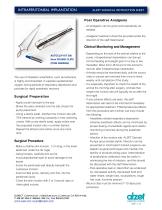
ALZET SURGICAL INSTRUCTION SHEET The use of inhalation anesthetics, such as Isoflurane, is highly recommended. It supplies supplemental oxygen during periods of respiratory depression and provides for rapid anesthetic recovery. Surgical Preparation - Apply ocular lubricant to the eye. - Shave the area centered over the site chosen for pump placement. - Using a sterile swab, disinfect the incision site with 70% ethanol by working outwardly in ever widening circles. With a new sterile swab, apply iodine over the proposed incision site in a similar fashion. Repeat the ethanol and iodine scrub one...
Open the catalog to page 2All ALZET catalogs and technical brochures
 PHARMACOLOGY FOCUS
8 Pages
 Research Application
2 Pages
 NEUROSCIENCE RESEARCH
4 Pages
 Special Delivery
8 Pages
 CANCER RESEARCH
4 Pages
 ALZET Research Application
2 Pages
 ALZET Research Application
4 Pages
 ALZET Technical Sheet 1.1
5 Pages
 INTRACEREBRAL CANNULATION
2 Pages
 INTRATHECAL CANNULATION
2 Pages
 INTRAVENOUS CANNULATION
2 Pages
 SUBCUTANEOUS IMPLANTATION
2 Pages
 Colored Flow Moderators
1 Page
 IPRECIO
3 Pages
 Wound Closure Systems
1 Page
 Catheter Fact Sheet
2 Pages


