

PHARMACOLOGY FOCUS

PHARMACOLOGY FOCUS
The document discusses the use of ALZET osmotic pumps for continuous drug administration in laboratory animals, emphasizing their advantages over traditional dosing methods.
ALZET pumps are small infusion devices designed for implantation in animals as small as mice. They provide continuous and automatic drug delivery for up to six weeks, ensuring constant exposure to drugs with short half-lives. This method is particularly beneficial for drugs that require frequent dosing due to rapid elimination rates.
- Increased drug efficacy and fewer side effects.
- Constant blood levels and reduced animal stress.
- Cost-effective due to reduced drug requirements.
ALZET pumps have been successfully used for continuous administration of various drugs, including Valproic acid (VPA), risperidone, GLP-1, and relaxin. Studies have shown that continuous administration can lead to significant drug savings and improved therapeutic outcomes compared to bolus dosing.
Pharmacokinetic profiles for drugs like risperidone, GLP-1, and relaxin demonstrate the benefits of continuous administration. For instance, continuous infusion of risperidone maintains steady-state levels with up to 48% drug savings compared to repeated bolus dosing.
Continuous administration is recommended for drugs with fast clearance rates to maintain effective steady-state concentrations. ALZET pumps are valuable for evaluating novel compounds in vivo, maximizing therapeutic benefits while minimizing drug use and study costs.
ALZET pumps offer a reliable and efficient method for chronic drug administration in preclinical studies, providing significant advantages in terms of drug efficacy, cost savings, and reduced animal stress.
Key features include a stainless steel stylet for easy insertion, leak-free catheter junctions, and markings for adaptation to smaller animals. They are suitable for cannulating small vessels and are adjustable for specific applications.
- RJC: Jugular vein in rats, made of silicone with a Dacron patch and bevel tip.
- RFC: Femoral vein in rats, made of polyurethane with retention beads.
- RFC-T: Femoral vein in rats, opaque polyurethane with tapered ID and radio-opaque features.
- RIC: Intrathecal access in rats, polyurethane with Teflon coated stylet.
- MJC: Small vessels in mice, polyurethane with retention beads and 28G PU catheter tip.
ALZET offers a surgical training video for pump implantation techniques. Publications on therapeutic agents delivered via ALZET pumps are available, covering a range of pharmacological studies.
UCSD offers a summer course in Systems Pharmacology and Translational Biology, supported by ALZET, focusing on CNS and cardiovascular systems, and in vivo imaging techniques. The course trains scientists in mini-pump implantation techniques.
Continuous drug delivery via ALZET pumps is highlighted, with a list of recently infused agents including selective serotonin agonists, enzyme inhibitors, and integrin antagonists.
Catalog excerpts

Effective Therapeutic Cannabinoid Analgesia Requires Targeted Delivery Dosing Methods for Antiepileptic Drugs Pharmacoeconomics of Continuous Drug Administration using ALZET Pumps Pharmacology Focus The primary objective of a pharmacology study is to optimize the conditions of drug administration in order to achieve maximum therapeutic efficacy with the least burden of adverse effects. Key parameters of drug action that are commonly investigated are the level and duration of drug exposure, as well as the spatial distribution of the drug. Rate-controlled drug delivery by ALZET Osmotic Pumps allows researchers to set drug concentration ® at a desired level and maintain it for a chosen duration. ALZET pumps also allow direct delivery of drugs into target tissues, thus enabling careful analysis of local versus systemic effects. By manipulating these variables, drug effects can be explored and optimized early in preclinical development, increasing the odds that a drug program graduates to the clinical phase. Since the mid-1970’s, ALZET pumps have been used as a powerful experimental tool to facilitate pharmacology research. ALZET pumps are commonly used in the pharmaceutical industry to optimize delivery of novel drugs and ignite product development. They are also used in academic institutions to educate the next generation of young scientists on the basic principles of pharmacology research. Described below are select applications of ALZET pumps in pharmacology research, drawn from more than 10,000 published ALZET studies. Please contact us if you would like references on any of the applications described below, or a custom reference list relevant to your research area. Pharmacokinetics of target-organ directed drug delivery –by Dr. H.A.J. Struijker-Boudier, Dept. of Pharmacology, University of Maastricht Ideal drug delivery limits drug distribution to its target site, thus avoiding systemic effects. Several drug delivery systems have been developed to facilitate target-organ directed drug delivery, including liposomes, antibodies, magnetic nanoparticles , and organ-specific pro-drugs. The most direct way of target-organ directed drug delivery is intra-arterial administration via infusion into the feeding artery. In experimental animals this approach is often used by means of osmotic minipumps. The aim of this review is to describe, from a pharmacokinetic perspective, some of the applications of target-organ directed drug administration. We focus on intra-arterial infusion as a method for target-organ directed drug delivery in view of the abundant application of this technique. 1 P.O. Box 530, Cupertino, CA 95015-0530 phone: 800.692.2990 email: [email protected] www.alzet.com
Open the catalog to page 1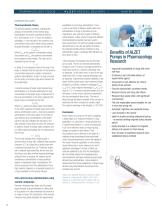
PHARMACOLOGY FOCUS (continued from cover) Pharmacokinetic theory The pharmacokinetic principles underlying the analysis of the benefits of intra-arterial drug administration have been reviewed by Dedrick etaI. and Daemen eta!23 In short, the systemic advantage, i.e. the reduction in the systemic drug concentration during intra-arterial versus systemic drug administration, is expressed by the ratio of: C /C s,ia s,iv Where Cs,ia is the systemic concentration during intra-arterial and Cs,iv the systemic concentration during systemic drug infusion. This ratio can be expressed by the formula: 1 -...
Open the catalog to page 2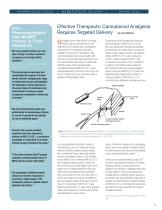
PHARMACOLOGY FOCUS Why Pharmacologists Use ALZET Pumps in Their Research “We used constant infusion of a low dose of drug to achieve sustained occupancy of only high-affinity receptors.” (p. 2109) Simard et al. Journal of Clinical Investigation 2007;117(8):2105-2113 “This dosing regimen also takes into consideration the reported 4-6 times shorter half-life of antipsychotic drugs in rodents than humans and highlights the advantage of using minipumps in the present study for continuous drug administration to achieve receptor occupancies comparable to clinical use in humans.” Effective Therapeutic...
Open the catalog to page 3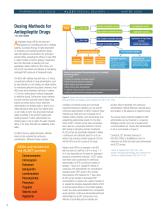
PHARMACOLOGY FOCUS Dosing Methods for Antiepileptic Drugs Soluble in tolerable solvent Not soluble in tolerable solvent Not soluble in tolerable solvent Application of high doses via food ntiepileptic drugs (AEDs) are important therapeutics for controlling seizures in epilepsy patients. Successful therapy is highly dependent on achieving and maintaining effective steadystate AED plasma concentrations for prolonged periods. When evaluating the efficacy of new AEDs in rodent models of chronic epilepsy, researchers face the critical task of selecting the most appropriate dosing method for their...
Open the catalog to page 4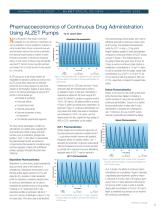
PHARMACOLOGY FOCUS Pharmacoeconomics of Continuous Drug Administration Using ALZET Pumps –by Dr. Jaymin Shah ALZET pumps are small infusion devices for implantation in laboratory animals as small as mice. ALZET pumps allow researchers to effectively control the level of drug exposure as well as the duration of administration. Relative to bolus dosing, some of the obvious advantages of using ALZET pumps in animal studies are: • Increased drug efficacy • Fewer side effects • Constant blood levels • Reduced animal stress • Reduced requirement of drug for experiment • Cost effective experimental...
Open the catalog to page 5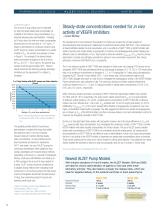
PHARMACOLOGY FOCUS (continued from page 5) The amount of drug savings can be estimated by using the target steady-state concentration as multiples of the minimum drug concentration (Cmin) obtained following bolus administration. Following an IV bolus dose, the minimum relaxin concentration observed prior to the next dose is ~9.7 ng/mL. If relaxin is administered by continuous infusion using ALZET pumps to achieve concentrations at a certain multiple of Cmin, the percent drug savings is shown in Figure 6. For example, if the desired steadystate concentration is targeted to be at six times the...
Open the catalog to page 6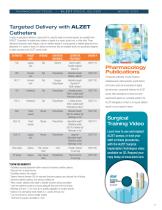
PHARMACOLOGY FOCUS Targeted Delivery with ALZET Catheters A range of specialized catheters, customized for a specific target and animal species, are available from DURECT Corporation to enable direct delivery of agents to a vessel, spinal cord, or other sites. These catheters incorporate useful features, such as retention beads or suture patches to facilitate placement and stabilization in a vessel or tissue. For added convenience, they are available sterile and specifically designed to attach securely to any ALZET pump model. CATHETER TARGET SPECIES CATHETER SITE MATERIAL Pharmacology Publications...
Open the catalog to page 7All ALZET catalogs and technical brochures
 Research Application
2 Pages
 NEUROSCIENCE RESEARCH
4 Pages
 Special Delivery
8 Pages
 CANCER RESEARCH
4 Pages
 ALZET Research Application
2 Pages
 ALZET Research Application
4 Pages
 ALZET Technical Sheet 1.1
5 Pages
 INTRACEREBRAL CANNULATION
2 Pages
 INTRATHECAL CANNULATION
2 Pages
 INTRAVENOUS CANNULATION
2 Pages
 INTRAPERITONEAL IMPLANTATION
2 Pages
 SUBCUTANEOUS IMPLANTATION
2 Pages
 Colored Flow Moderators
1 Page
 IPRECIO
3 Pages
 Wound Closure Systems
1 Page
 Catheter Fact Sheet
2 Pages


