
- Catalogs
- AMD Global Telemedicine
- AMD-2013

AMD-2013

AMD-2013
- Advanced optics for clear and detailed images.
- 2x magnification for viewing small details.
- Free-focus wheel and zoom button for image fine-tuning.
- Automatic image brightness and white balancing.
- One-touch freeze frame for quick image capture.
- USB interface for easy data communication.
- Weight: Approximately 0.2 lbs (91 g).
- Dimensions: Height 2.8” (7.1 cm), Length 4.0” (10.2 cm), Width 1.5” (3.8 cm).
- Illumination: Pressurized halogen lamp.
- Image Resolution: 1280 x 1024 pixels.
- Power Source: 3.5 V power handle and wall transformer.
- Connection/Interface: USB 2.0 with 10 ft. (3.05 m) cable.
- Electrical Rating: Lamp 3.5 Vdc, 810 mA; USB: 5.0 Vdc, 150 mA.
- Protection: IPXØ against water ingress.
- System Requirements: Windows XP Service Pack 2 or later, and a viewing screen.
- Temperature: 50° F to 104° F (10° C to 40° C).
- Relative Humidity: 30% to 75% noncondensing.
- Altitude: 700 to 1060 hPa.
- Temperature: 68° F to 120° F (20° C to 49° C).
- Relative Humidity: 95% noncondensing max.
Catalog excerpts
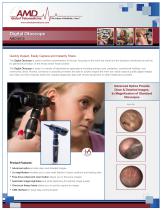
Quickly Inspect, Easily Capture and Instantly Share The Digital Otoscope is used to perform examinations of the ear, focusing on the inner ear canal and the tympanic membrane as well as for general illumination of the throat and/or nasal cavities. The Digital Otoscope is used in a variety of telemedicine applications including primary care, pediatrics, correctional facilities, and community clinics. Nurses, clinicians or specialty providers are able to quickly inspect the inner ear, easily capture quality digital images and video and then instantly share this valuable diagnostic data with remote physicians or other healthcare providers. Advanced Optics Provide Clear & Detailed Images: 2x Magnification of Standard Otoscopes Inner Ear Product Features: • Advanced optics provide clean and detailed images. • 2x magnification enables you to see small details of tubes, eardrum and hearing aids. • Free-focus wheel and zoom button allows you to fine-tune images. • Automatic image brightness and white balancing for optimal image quality. • One-touch freeze frame allows you to quickly capture an image. • USB interface for easy data commu
Open the catalog to page 1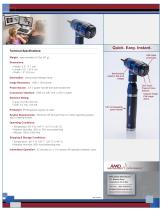
Quick. Easy. Instant. Technical Specifications: Weight: approximately 0.2 lbs (91 g) Dimensions: • Height: 2.8” (7.1 cm) • Length: 4.0” (10.2 cm) • Width: 1.5” (3.8 cm) free-focusing wheel to fine-tune images Illumination: pressurized halogen lamp Image Resolution: 1280 x 1024 pixels One-Touch Freeze-Frame Buttons: -Capture Image -Flip Image -Zoom Power Source: 3.5 V power handle and wall transformer Connection/ Interface: USB 2.0 with 10 ft. (3.05 m) cable Electrical Rating: • Lamp 3.5 Vdc, 810 mA • USB: 5.0 Vdc, 150 mA 3.5V rechargeable power handle Protection: IPXØ against ingress of water...
Open the catalog to page 2All AMD Global Telemedicine catalogs and technical brochures
 AMD-3750
2 Pages
 Connect N'Care
2 Pages
 AMD-2000
1 Page
 AGNES ConnectTM
2 Pages
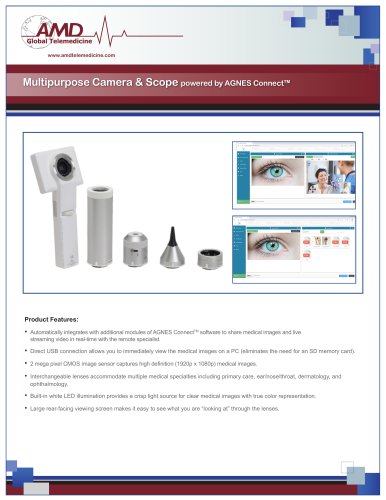 AMD_Multipurpose_CameraScope
2 Pages
 AMD-7130
1 Page
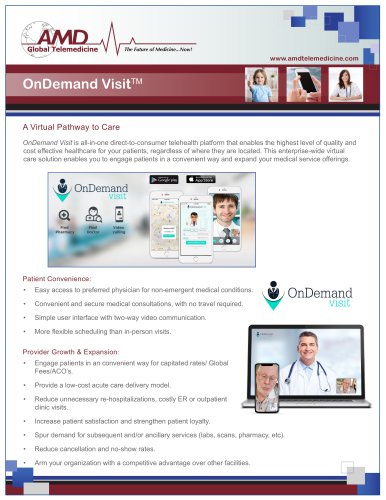 OnDemand VisitTM
2 Pages
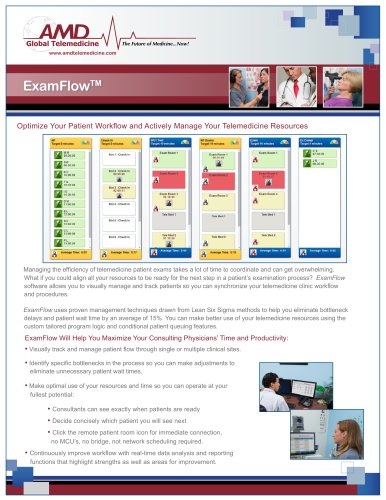 ExamFlow
2 Pages
 Telehealth Consult
1 Page
 AGNES Interactive
2 Pages


- Ultrasound system
- B/W ultrasound system
- Portable ultrasound system
- CMOS camera
- Camera with USB port
- EKG
- Digital electrocardiograph
- Multi-parameter monitor
- Cloud-based software
- Hand-held ultrasound system
- Stethoscope
- Multi-parameter O2 monitor
- Pulse oximetry multi-parameter monitor
- Blood pressure multi-parameter monitor
- Endoscope camera
- Compact multi-parameter monitor
- 12-channel electrocardiograph
- Medical camera
- Capture software
- TEMP multiparameter monitor