
- Catalogs
- Andor Technology PLC
- Andor_Newton


Andor_Newton

Andor_Newton
The document provides an overview of the Andor Newton camera series, tailored for spectroscopy applications such as multi-track spectroscopy, SERS, TERS, and luminescence mapping. It details various configurations, including EMCCD sensor versions and SO and SY models for high-energy applications. The guide covers features, installation, operation, and troubleshooting.
Contact information for technical support is available for Europe and the USA.
The Newton camera's external features, rear panel, power supply unit, and power requirements are described.
Instructions for transporting, storing, mounting, and connecting the Newton camera to a PC and power supply are provided. Guidelines for using and connecting a cooling system are also included.
Details on emergency mains disconnection, power-up and power-down sequences, and adjusting the cooling fan speed are provided.
Best practice guidelines and specific instructions for mounting and removing protective plates are included.
Information on EMCCD technology, including readout sequence, impact ionization, gain, and cooling, is provided.
Regular checks, annual electrical safety checks, cleaning procedures, and fuse replacement instructions are outlined.
Guidance on preventing condensation and other troubleshooting tips are provided.
Technical specifications, mechanical drawings, dewpoint information, and reference information are included in the appendices.
Important safety instructions and warnings are provided to ensure proper use and handling of the equipment.
Contact details for Andor Technology offices in the UK, USA, Japan, and China are provided, including telephone and fax numbers.
The information is provided "as is" without any warranty. Andor Technology is not liable for any damages arising from the use of the information.
The document and associated drawings are the property of Andor Technology Ltd. and cannot be reproduced or disclosed without permission.
Andor and its logo are trademarks of Andor Technology Ltd., an Oxford Instruments company.
The Newton camera package includes a CCD or EMCCD camera, software CD, hardware guide, performance booklet, BNC-SMB cable, USB 2.0 cable, and PSU with a country-specific power cable.
Various models of Newton cameras are available, each with specific features such as active pixels, pixel size, cooling options, and mounting options.
A range of accessories is available for the Newton cameras, including lens adaptors, shutter drivers, USB extenders, and cooling systems.
The Newton camera features high-resolution sensors, UltraVac vacuum technology, and a single AR coated UV grade silica window. It includes mounting flange and post locations, and water/liquid cooling connectors.
The rear panel includes USB 2.0, TTL/Logic, I2C, and power input connections.
The standard PS-24 PSU and optional PS-25 PSU are described, including pin configurations and power requirements.
Instructions for transporting, storing, mounting, and connecting the Newton camera to a PC and power supply are provided. It also covers connecting cooling systems and installing software and USB drivers.
Guidelines for using liquid cooling systems, including coolant types and temperatures, are provided to ensure optimal performance and avoid damage.
To install a USB 2.0 card, ensure the PC is powered off and anti-static precautions are taken. Open the PC enclosure, locate a suitable PCIe slot, and insert the card. Secure the card and reassemble the PC.
Using the equipment in an unspecified manner may impair protection. Read user guides before use.
In emergencies, disconnect the mains power cord or switch off the mains socket.
For power-up, ensure the Newton is powered, connect the USB cable, start the PC, and launch camera control software. For power-down, exit the software, turn off the camera, and disconnect from the mains if not in use.
The Newton is controlled via camera control software. Adjust cooling fan speed through the software, noting that changes may affect cooling and performance.
The Newton SO model has an open CCD sensor. Avoid using in condensing atmospheres and protect the sensor from contamination. Do not operate in vacuums exceeding 1.33 x 10⁻⁸ mb.
The SY model features a beryllium foil window for soft X-ray detection. Protect the window when not in use and avoid mounting to vacuum chambers.
EMCCDs are ultra-sensitive sensors capable of single photon detection. They include a Gain Register for electron multiplication, enhancing signal detection above readout noise.
Increasing gain can reduce dynamic range and add noise. Use the minimum necessary gain to maintain dynamic range and reduce noise effectively.
The gain of an EMCCD system is temperature-dependent, increasing as temperature decreases. Cooling the system stabilizes the gain, which is crucial for optimal performance.
EMCCD sensors generate heat during operation. Cooling is achieved using a TEC, with air or water cooling methods available. Faster clocking increases heat, affecting cooling efficiency. Key settings impacting cooling include ROI size, vertical binning, shift speeds, and clock amplitude.
This technique enhances signal detection by amplifying single photon events above read noise. It is effective when photon flux is low, ensuring accurate signal accumulation.
Users can choose between Electron Multiplying (EM) or Conventional amplifiers, depending on the CCD sensor type.
Regular checks and cleaning are essential. The camera window requires careful cleaning to avoid damage. Fuse replacement and cooling hose inspections are also necessary.
Condensation prevention is critical. Ensure coolant temperature is above the dew point to avoid damage. Use dry gas to remove moisture before reuse.
The document provides detailed specifications, including weight, dimensions, environmental conditions, and power requirements.
Additional information includes mechanical drawings, dew point data, UltraVac technology, and warranty details.
Catalog excerpts

Newton Hardware Guide Version 1.4 rev 13 Oct 2017 Covering models: • Newton CCD • Newton EMCCD • Newton SO • Newton SY
Open the catalog to page 1
Newton Revision History Version Initial release Fully revised (all sections). Updated to include Newton model variations. Additional information added regarding cooling and power requirements. Solis information removed- this is available from Solis in-built help. Updates to this Manual Changes are periodically made to the product and these will be incorporated into new editions of the manual. Please check for new releases of the manual in MyAndor: http://my.andor.com/login.aspx. If you find an issue in this manual please contact your customer support representative (Section 1.1) with a description...
Open the catalog to page 6
Newton Safety and Warning Information READ THIS INFORMATION FIRST 1. If the equipment is used in a manner not specified by Andor, the protection provided by the equipment may be impaired. 2. Before using the system, please follow and adhere to all warnings, safety, manual handling and operating instructions located either on the product or in this Hardware Guide. 3. Users must be authorised and trained personnel only; otherwise this may result in personal injury, and/ or equipment damage and impaired system performance. 4. There are no user-serviceable parts inside the product and the enclosure...
Open the catalog to page 7
Newton 20. If any ingress of liquids has occurred or is suspected, unplug the mains cables, do not use, and contact Andor Customer Support. 21. When using a liquid cooling system it is recommended that an overpressure device is fitted to avoid leaks that may find their way to the mains electricity supply and create a hazard. Refer to the information in SECTION 3.7 for general guidelines on the correct installation and use of a liquid cooling system. 22. See SECTION 7.3, “Cleaning and Decontamination”. 23. Do not expose the product to extreme hot or cold temperatures. 24. Do not expose the product...
Open the catalog to page 8
Newton Warning and Safety Labels PSUs contains hazardous voltages (100-240 VAC). Do not attempt to open the enclosure. There are no user serviceable components inside. Unpacking Information Carefully unpack the unit and retain the packaging materials to transport or return equipment if required: • If the equipment appears damaged in any way, return it to sales outlet in its original packaging. No responsibility for damage arising from the use of non-approved packaging will be accepted. Ensure all items and accessories specified at the time of ordering and as detailed on the packing list are present:...
Open the catalog to page 9
Newton SECTION 1: INTRODUCTION This manual provides an overview of the Andor Newton camera series. The Newton is available in different configurations including EMCCD sensor versions. The Newton platform is intended for spectroscopy applications such multitrack spectroscopy, SERS, TERS or luminescence mapping. SO and SY versions are also available for high energy applications. This manual includes a description of the main features of the Newton, installation, routine operation and troubleshooting. It also provides a summary of some of the technical features of the Newton series. For further...
Open the catalog to page 10
Newton 1.1 Technical Support If you have any questions regarding the use of this equipment, please contact the representative* from whom your system was purchased, or: Andor Technology Springvale Business Park South Windsor Northern Ireland Andor Technology (Japan) Andor Technology 66 Zhufang Rd, Haidian Dist. * The latest contact details for your local representative can be found on the Contact and Support page of our website.
Open the catalog to page 11
Newton 1.2 Disclaimer THE INFORMATION CONTAINED HEREIN IS PROVIDED “AS IS” WITHOUT WARRANTY, CONDITION OR REPRESENTATION OF ANY KIND, EITHER EXPRESS, IMPLIED, STATUTORY OR OTHERWISE, INCLUDING BUT NOT LIMITED TO, ANY WARRANTY OF MERCHANTABILITY, NON-INFRINGEMENT OR FITNESS FOR A PARTICULAR PURPOSE. IN NO EVENT SHALL ANDOR BE LIABLE FOR ANY LOSS OR DAMAGE, WHETHER DIRECT, INDIRECT, SPECIAL, INCIDENTAL, CONSEQUENTIAL OR OTHERWISE HOWSOEVER CAUSED WHETHER ARISING IN CONTRACT, TORT OR OTHERWISE, ARISING OUT OF OR IN CONNECTION WITH THE USE OF THE INFORMATION PROVIDED HEREIN. 1.3 Copyright and Protective...
Open the catalog to page 12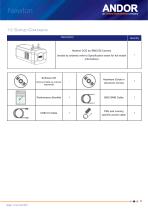
Newton 1.5 Supplied Components Description Newton CCD (or EMCCD) Camera (model as ordered: refer to Specification sheet for full model information) Hardware Guide in electronic format Performance Booklet BNC-SMB Cable PSU and country specific power cable (Solis and SDK are ordered separately)
Open the catalog to page 13
Newton 1.5.1 Newton Model Options There are a number of models of Newton available. Refer to the specification sheet links for model specific information. Newton CCD Newton EMCCD Model Code Active pixels Pixel size Air/Water cooling Mounting Options (See mechanical drawing for details) C-mount Front face 4x M4 [0.16] Mounting Posts (x3) C-mount Front face 4x M4 [0.16] Mounting Posts (x3) EMCCD and conventional CCD operation Model Specific Information see: 1024 x 255 (1024 x 256 for 1024 x 255 (1024 x 256 for Bx-DD model) Bx-DD model) or 2048 x 512 or 2048 x 512 Newton EMCCD Mounting Posts (x3)...
Open the catalog to page 14
Newton SECTION 2: PRODUCT OVERVIEW This section provides an overview of the external features and the power and signal connections of the Newton. The CCD model is outlined- refer to model specific information as described, and Section 5 for SO and SY models. 2.1 External Features of the Newton Water/Liquid cooling connectors (x2) Mounting face/flange Camera Window Mounting Flange The mounting flange has 4 off mounting holes to clear M4 x 5 deep (see Appendix B). Sensor The Newton features high resolution CCD or EMCCD sensors with coatings depending on the model. Andor’s unique UltraVacTM vacuum...
Open the catalog to page 15
Newton 2.2 Rear Panel Power Input Figure 3: Rear Panel USB 2.0 Connects the Newton to the control PC via a USB 2.0 connection. TTL / Logic The TTL/Logic connection permit connection to other devices for synchronisation and control of fire, trigger and shutter operations. Connector type: SMA, provided with SMA - BNC cable Fire (Output), External Trigger (Input), Shutter (Output). The SMB outputs (Fire & Shutter) are CMOS compatible & Series terminated at source (i.e. in the camera head) for 50Ω cable. NOTE: The termination at the customer end should be high impedance (not 50Ω) as an incorrect...
Open the catalog to page 16All Andor Technology PLC catalogs and technical brochures
 Zyla sCMOS
78 Pages
 iXon Ultra
121 Pages
 Kymera_328i
63 Pages
 Solis 64
6 Pages
 ikon xl 231
8 Pages
 zyla 5.5 scmos
12 Pages
 ixon ultra 888
12 Pages
 ikon xl 230
8 Pages
 2020 Neo 5.5 sCMOS
6 Pages
 Multi-Wavelength Imaging
11 Pages
 2017 iXon EMCCD
13 Pages
 iKon-L HF
7 Pages
 Shamrock 500 Spectrograph
13 Pages
 Shamrock 750 Spectrograph
14 Pages
 iXon Ultra 888 EMCCD
2 Pages
 iXon Ultra 897 EMCCD
2 Pages
 Zyla 5.5 HF
8 Pages
 Neo 5.5 sCMOS
6 Pages
 Microspectroscopy Gatefold
8 Pages
 Kymera 193 Spectrograph
14 Pages
 Spectroscopy
25 Pages
 High Energy Detection
28 Pages
 Spectroscopy Solutions
23 Pages
 Neo and Zyla sCMOS Cameras
17 Pages
 iXon EMCCD
13 Pages


Archived catalogs
 Clara CCD
2 Pages
 Andor iXon Life EMCCD
9 Pages
 Imaris Gatefold
8 Pages
 iKon-XL 231
8 Pages
 iKon-XL 230
8 Pages
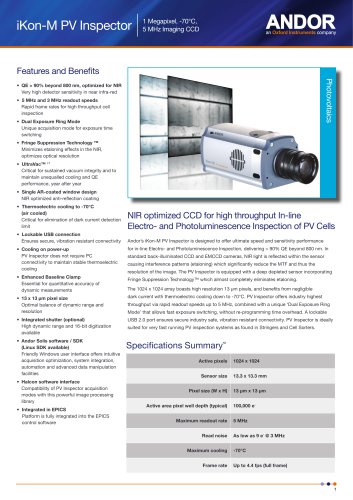 iKon-M CCD for Photovoltaics
6 Pages
- Analysis software
- Microscopy
- Compound microscope
- Laboratory microscope
- Desktop microscope
- Windows software
- Laboratory software
- CMOS camera
- Camera with USB port
- Spectroscope
- Hospital software
- LED light source
- Acquisition software
- Medical camera
- Capture software
- Biology microscope
- Benchtop spectrometer
- Microscope camera
- Research microscope