
- Catalogs
- Andor Technology PLC
- High Energy Detection


High Energy Detection
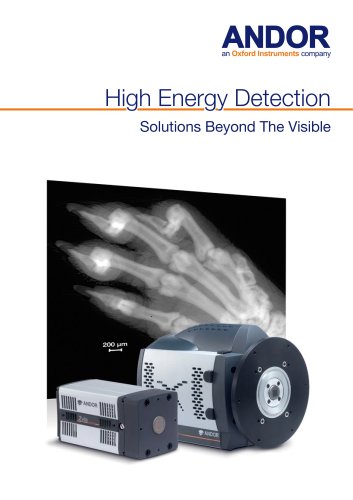
High Energy Detection
Andor's high energy camera detection systems are versatile tools for imaging and spectroscopy, applicable in fields like cell studies, medical research, and material analysis. These systems are customizable and integrate seamlessly into various experimental setups.
Andor's solutions cover a wide wavelength range, including VUV, EUV, X-Ray, and gamma regions, using both direct and indirect detection methods.
Detection methods include direct absorption of photons by the sensor and indirect conversion of high energy photons to visible wavelengths using scintillators.
Andor offers interfaces like 'Open Front', 'Fiber-Optic', and 'Stand Alone' to suit different environments, combined with energy range identifiers for optimal camera solutions.
Andor provides various camera platforms such as Zyla sCMOS, Newton CCD, iXon EMCCD, iKon L CCD, and iKon M CCD, each tailored for specific high energy detection needs.
Standard cameras can be enhanced with a MgF2 window for UV range detection, with options like Lumogen coated and Enhanced silicon sensors.
Andor's spectroscopy systems, featuring CCD and Intensified CCD detectors, are designed for high-energy applications like X-Ray Diffraction and plasma physics.
Andor offers bespoke services for custom solutions, including complete systems and accessories, tailored to specific high energy detection needs.
Andor's cameras are adaptable for various high-energy photon detection applications, with configurations for direct and indirect detection.
Optimal high-energy detection solutions involve decisions on energy range, interface, and camera attributes like field of view and sensitivity.
Andor provides software like Andor Solis for data acquisition and image analysis, supporting various programming languages and operating systems.
Andor offers accessories like the O-Y Converter flange and cooling solutions to enhance camera performance.
Includes notes on uses of Andor's platforms and technical topics like binning and quantum efficiency.
Details on experimental setups and results for applications like monochromatizing VUV photon sources.
Discusses the use of ultra-intense laser pulses for compact particle accelerators, generating electron beams and X-Rays for ultrafast processes.
Involves using a JETI laser system to generate X-Rays, with results aligning well with simulations.
Over 10,000 images were taken, reconstructing X-Ray spectra with energies up to 10 keV.
Initial experiments demonstrated betatron radiation generation, with future work exploring higher photon energies.
Highlights development of X-Ray free-electron laser sources and ultrafast high harmonic X-Rays.
Uses OPCPA architecture to generate high-energy pulses, with HHG X-Rays produced in a hollow waveguide.
Phase-matched emission extends to >1.6 keV, demonstrating potential for tomographic reconstruction.
Demonstrates phase-matched X-Ray generation in the kiloelectronvolt region for imaging applications.
Describes a spectrometer for characterizing plasma sources, calibrated for photon energies between 70 - 1900 eV.
Discusses advancements in spectrometry and imaging techniques for studying atomic and molecular structures.
Describes its application in experiments with a liquid nitrogen jet target system.
Outlines a setup for studying transient crystal diffraction curves using a pulsed X-Ray source.
Used to study impurity transport in plasmas, revealing insights into fusion processes.
Complementary to X-Ray imaging, effective for visualizing hydrogen-rich materials.
Highlights the importance of advanced spectrometry and imaging technologies in scientific research.
Visualizes internal structures using neutron beams, effective for materials like metal containers.
Recommends sCMOS and EMCCD cameras for applications requiring faster frame rates.
Includes non-destructive testing and in-situ testing applications.
Discusses binning to improve readout speed and signal-to-noise ratio.
Allows for faster temporal resolution by defining a smaller active imaging area.
Influenced by photon absorption in the sensor's depletion region, with back-illuminated sensors offering improved detection.
Uses scintillators to convert X-ray photons into visible photons for indirect detection.
Discusses X-ray detection methods using CCD cameras, highlighting advantages and disadvantages.
Uses lens-based systems to image scintillator screens, advantageous for large active areas.
Occurs when photons are absorbed within the CCD's silicon, crucial for energy-dispersive spectroscopic applications.
Provides specifications for various CCD and sCMOS camera models.
References studies showcasing applications in neutron radiography and X-ray spectroscopy.
Encourages contact for custom solutions and emphasizes the CSR process for tailored systems.
Guidelines for maintaining Andor detection solutions, ensuring longevity and performance.
Highlights the importance of regular maintenance and notes that specifications may change without notice.
Emphasizes care for Andor detection solutions to ensure long service life.
Offers on-site specialists, training, and testing services to optimize performance.
Extended warranty packages with on-site and remote support options.
Provides contact details for Andor's offices worldwide.
Andor®, the Andor logo, and iXon® are trademarks of Andor Technology Ltd.
Catalog excerpts

High Energy Detection Solutions Beyond The Visible
Open the catalog to page 1
Contents 03 Overview 04 Detection Beyond The Visible 06 High Energy Detection 09 The Interfaces 10 O - ‘Open Front’ 11 F - ‘Fiber-Optic’ 12 Y - ‘Stand Alone’ 13 The Camera Platforms 14 Extending Andor’s ‘Standard’ Cameras For High Energy Detection 15 Standard Ultra Sensitive Cameras For Lens Coupled Indirect Detection 16 Focus On High Energy Spectroscopy 19 Customer Special Request (CSR) 20 High Energy Camera Capabilities 22 Defining A Solution 24 Software Solutions 25 Accessories 26 Application and Technical Notes 48 Standard Part Numbers 50 Research Papers 53 Looking After Your System Overview...
Open the catalog to page 2
Detection Beyond The Visible Typical Application Andor’s high energy camera solutions cover a broad wavelength range, spanning VUV, EUV, X-Ray and gamma regions. Detection is achieved either through direct detection of the high energy photon by the sensor or by indirect detection of visible photons emitted from a phosphor or scintillator, either a fiber-optic or a lens coupled to the detector. Soft X-Ray Imaging / Microscopy Soft to Hard X-Ray X-Ray Spectroscopy (e.g. SAXA), Plasma Diagnostics Hard X-Ray Diffraction / Crystallography, Phase Contrast Imaging Hard X-Ray to Gamma Gamma Tomography...
Open the catalog to page 3
High Energy Detection The two main methods of detecting high energy photons with scientific cameras are ‘Direct’ and ‘Indirect’ detection. Direct Detection Indirect Detection Andor employs the notation ‘S’ to indicate cameras that are optimal for detection of ‘soft’ lower energy photons. With direct detection, the incident VUV to soft X-Ray photon is absorbed directly within the silicon of the sensor resulting in the production of multiple electron-hole pairs. This method of detection limits the range of usage of the sensor to photon energies that silicon can absorb directly, as shown in Fig....
Open the catalog to page 4
The Interfaces Andor has a comprehensive portfolio of imaging and spectroscopic camera platforms developed for use in a wide range of high energy applications. To suit these many different requirements it is often necessary to modify the camera’s interface to allow optimal integration with the sampling environment. The large area X-Ray Andor CCD system has been used to acquire much more data on each shot, enabling researchers using the Central Laser Facilities to make significantly faster progress than previously possible. This section highlights Andor’s dedicated range of interface types and...
Open the catalog to page 5
Interface - ‘Open Front’ design Interface - ‘Fiber-Optic’ design Andor’s ’O’ interface type describes an open front design, coupling directly onto a vacuum chamber’s port, ensuring maximum detection efficiency and spatial resolution. A number of Andor’s camera platforms can be configured with the ‘F’ type protruding fiberoptic interface, ideal for indirect detection of high energy X-Ray or gamma photons that are incident on a phosphor or scintillator. ‘Open front’ cameras are designed to be coupled to the outside of a vacuum chamber. There are two types of sealing options available: knife edge...
Open the catalog to page 6
Interface - ‘Stand Alone’ design Andor’s ‘Y’ style interface is available across the iKon and Newton CCD camera platforms, and is built with a window that blocks visible wavelengths but allows higher energy photons through to the sensor. It is ideal for direct detection in the soft X-Ray energy range or, with inclusion of a phosphor coated fiber-optic, for indirect detection of hard X-Ray photons. Description Compact sCMOS platform, multi megapixel array, lownoise, ultra fast frame rates and high resolution imaging. High performance CCD camera with variable readout rates up to 3 MHz through plug...
Open the catalog to page 7
Extending Andor’s ‘Standard’ Cameras For High Energy Detection Standard Ultra Sensitive Cameras For Lens Coupled Indirect Detection Many applications require use of lens based cameras within indirect detection systems, where a ‘stand alone’ camera solution images a scintillator screen. Such applications include both X-Ray and Neutron Tomography. Extending to the ‘UV’ Andor’s standard range of ultra-sensitive imaging and spectroscopy camera platforms can be readily customized with a MgF2 window, extending detection in the UV down to ~120 nm. Note, Features the system performance is also dependent...
Open the catalog to page 8
Focus On High Energy Spectroscopy Engineered from the outset with ease-of-use and performance in mind, Andor’s Spectroscopy systems feature a combination of market leading CCD, Intensified CCD detectors and UV-NIR spectral instruments. iStar ICCD Typical Applications X-Ray Diffraction (XRD) X-Ray plasma physics X-Ray laser characterization USB 2.0 platform, with a unique software controlled, ultra-low-jitter on-board Digital Delay Generator (DDG™) and high-voltage, high-speed gating electronics for < 2 ns time resolution down to 120 nm. Andor’s vacuum-compatible CCDs and Intensified CCDs combine...
Open the catalog to page 9
Customer Special Request (CSR) At Andor we realise that, sometimes, even our adaptable and flexible off-the-shelf products are not enough to meet some of the more demanding application requirements of our customers. A CSR solution can encompass a complete system, a single camera or an accessory. Here are some examples of Andor’s CSR capabilities. For this reason we provide a bespoke service to our customers, whereby a dedicated highly experienced team of engineers and application specialists provide customer specific solutions. The process involves discussing your core requirements, advising...
Open the catalog to page 10
High Energy Camera Capabilities The following diagram can be used as a guide to Andor’s broad capabilities in the area of high energy photon detection, demonstrating our ability to adapt our various highperformance camera platforms to meet a broad gamut of specific application and set-up requirements. S Direct Detection Cameras O Open Front Systems H Indirect Detection Cameras Y Stand Alone Systems F Fiber Optic Interface Many of the camera types represented are available as standard products, as represented on page 50 of this brochure. Please use Andor’s Customer Special Request (CSR) service...
Open the catalog to page 11All Andor Technology PLC catalogs and technical brochures
 Zyla sCMOS
78 Pages
 iXon Ultra
121 Pages
 Andor_Newton
44 Pages
 Kymera_328i
63 Pages
 Solis 64
6 Pages
 ikon xl 231
8 Pages
 zyla 5.5 scmos
12 Pages
 ixon ultra 888
12 Pages
 ikon xl 230
8 Pages
 2020 Neo 5.5 sCMOS
6 Pages
 Multi-Wavelength Imaging
11 Pages
 2017 iXon EMCCD
13 Pages
 iKon-L HF
7 Pages
 Shamrock 500 Spectrograph
13 Pages
 Shamrock 750 Spectrograph
14 Pages
 iXon Ultra 888 EMCCD
2 Pages
 iXon Ultra 897 EMCCD
2 Pages
 Zyla 5.5 HF
8 Pages
 Neo 5.5 sCMOS
6 Pages
 Microspectroscopy Gatefold
8 Pages
 Kymera 193 Spectrograph
14 Pages
 Spectroscopy
25 Pages
 Spectroscopy Solutions
23 Pages
 Neo and Zyla sCMOS Cameras
17 Pages
 iXon EMCCD
13 Pages


Archived catalogs
 Clara CCD
2 Pages
 Andor iXon Life EMCCD
9 Pages
 Imaris Gatefold
8 Pages
 iKon-XL 231
8 Pages
 iKon-XL 230
8 Pages
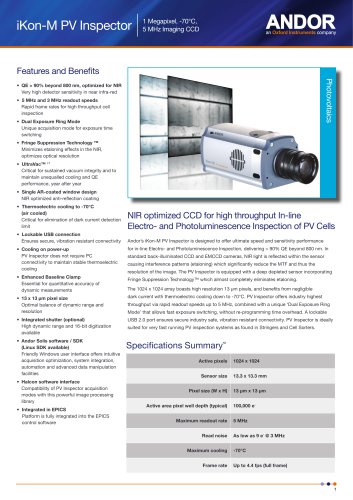 iKon-M CCD for Photovoltaics
6 Pages
- Analysis software
- Microscopy
- Compound microscope
- Laboratory microscope
- Desktop microscope
- Control software
- Windows software
- Laboratory software
- CMOS camera
- Camera with USB port
- Hospital software
- LED light source
- Acquisition software
- Medical camera
- Capture software
- Biology microscope
- Benchtop spectrometer
- Microscope camera
- Research microscope