
- Catalogs
- Andor Technology PLC
- iXon EMCCD


iXon EMCCD

iXon EMCCD
Andor Technology introduced scientific Electron Multiplying CCD (EMCCD) cameras in 2000, setting industry standards for sensitivity and speed, essential for detecting weak signals like single photon events.
The iXon series has undergone several advancements:
- 2000: First EMCCD cameras launched, winning the Photonics Circle of Excellence Award.
- 2001: Back-illuminated sensors introduced for enhanced sensitivity.
- 2006: iXon+ series with EMCAL™ and RealGain™ for improved sensitivity and gain control.
- 2010: iXon3 series with OptAcquire for application optimization and Count Convert for data calibration.
- 2012: iXon Ultra series, increasing frame rates and introducing USB connectivity.
- 2014: iXon Ultra 888, offering the largest field of view and first USB 3.0 enabled EMCCD.
- EMCCD Advantage: Provides ultimate sensitivity and fast speeds for photon measurement applications.
- UltraVac™ Technology: Ensures deep cooling and sensor protection.
- OptAcquire: One-click optimization for various applications.
- Count Convert: Real-time or post-processing data calibration in electrons or photons.
- EMCAL™: Automated recalibration of EM gain over time.
iXon cameras are used in:
- Photon counting and adaptive optics.
- Single molecule detection and super-resolution microscopy.
- Live cell imaging and fluorescence microscopy.
- Astrophysics and atmospheric studies.
iXon series models include:
- iXon Ultra 888: Large field of view, high sensitivity, fast frame rates for demanding applications like super-resolution microscopy.
- iXon Ultra 897: Focuses on speed and sensitivity for low-light applications requiring high temporal resolution.
Andor's iXon EMCCD cameras offer flexibility, functionality, and performance, preferred by scientists and researchers for high sensitivity and speed.
The document discusses the iXon Ultra 897, highlighting its photon counting, cooling efficiency, and data processing capabilities.
- Cooling to -100ºC for reduced dark current and noise.
- Lowest EM-amplified dark current and minimized Clock-Induced Charge (CIC).
- RealGain™ for precise EM gain control.
- UltraVac™ for enhanced sensor longevity.
- Direct data access via Camera Link output for real-time processing.
- Superior quantitative stability with baseline rigidity and EM gain stability.
- Anti-Ageing and EMCAL™ features to maintain EM gain.
- Versatile operation modes: EMCCD for high sensitivity and CCD for low noise.
- Extensive software solutions for data acquisition and analysis.
- Suitable for low light imaging applications like luminescence experiments and super-resolution microscopy.
- Andor provides extensive customer support, including on-site assistance, training, and extended warranty options.
The iXon Ultra 897 is a leading EMCCD camera with advanced cooling, photon counting, and data processing capabilities, suitable for a wide range of scientific imaging applications.
Catalog excerpts

iXon EMCCD Driving the absolute best from EMCCD technology
Open the catalog to page 1
The Industry’s Highest Performance Scientific EMCCD Cameras Andor Technology pioneered the world’s first scientific Electron Multiplying CCD (EMCCD) cameras, shipping the initial cameras back in 2000 and winning the Photonics Circle of Excellence award. At that time, Andor coined the name ‘Electron Multiplying CCD (EMCCD)’, which has been adopted right across this burgeoning industry. 2000 Since then, Andor has consistently set progressively higher EMCCD performance standards with our successive iXon series of deep-cooled, vacuum sealed, quantitative EMCCD cameras. For example, Andor introduced...
Open the catalog to page 2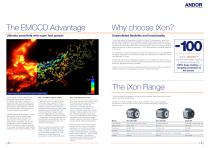
Ultimate sensitivity with super fast speeds Unparalleled flexibility and functionality The principal reason for making use of Andor’s iXon EMCCD technology is to ensure the absolute highest sensitivity from a quantitative scientific digital camera, particularly under fast frame rate conditions. In particular, truly exceptional speed performance is now available through the new iXon Ultra model. Andor’s proven UltraVac™ vacuum technology, carrying a seven year warranty, is critical to ensure both -100ºC deep cooling and complete protection of the sensor. The iXon series of cameras are designed...
Open the catalog to page 3
iXon Ultra 888 Field of View and Sensitivity... now 3x faster! Features and Benefits Overclocked to 30 MHz readout Absolute EMCCD gain selectable directly from a linear and quantitative scale. Fringe Suppression (optional) Optimize the highly flexible iXon for different application requirements at the click of a button. Count Convert Quantitatively capture and view data in electrons or incident photons. Applied either in real time or postprocessing, Count Convert does this important conversion for you. Patented user-initiated self-recalibration of EM gain. Exposure time fast switching provides...
Open the catalog to page 4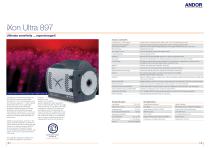
iXon Ultra 897 Ultimate sensitivity ... supercharged! Features and Benefits Overclocked to 17 MHz readout Optically Centred Crop Mode (live cell super-resolution) Optimize the highly flexible iXon for different application requirements at the click of a button Count Convert Quantitatively capture and view data in electrons or incident photons. Applied either in real time or postprocessing, Count Convert does this important conversion for you. Patented user-initiated self-recalibration of EM gain. Exposure time fast switching provides market leading acquisition efficiency. Minimal Clock-Induced...
Open the catalog to page 5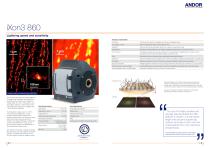
iXon3 860 Lightning speed and sensitivity Features and Benefits 513 full fps Fast frame rates ideal for ion signaling microscopy and adaptive optics. Critical for elimination of dark current detection limit. Absolute EMCCD gain selectable directly from a linear and quantitative scale. Optimize the highly flexible iXon3 for different application requirements at the click of a button. Count Convert Quantitatively capture and view data in electrons or incident photons. Applied either in real time or postprocessing, Count Convert does this important conversion for you. Exposure time fast switching...
Open the catalog to page 6
Performance & Innovations Industry Fastest Frame Rate Maximum frame rate performance in EMCCDs is a function of two parameters; (1) Pixel Readout Speed (horizontal); (2) Vertical Clock speed. The former dictates how rapidly charge is pushed horizontally through the EM gain register and the remaining readout electronics, while the latter dictates the speed at which charge is vertically shifted down through both the exposed sensor area and masked frame transfer area of the chip. iXon offers industry fastest vertical shift speeds, resulting in faster frame rates and reduced smearing, significantly...
Open the catalog to page 7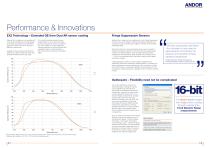
Performance & Innovations EX2 Technology – Extended QE from Dual AR sensor coating Fringe Suppression Sensors Selected iXon models are now available with a new Dual Anti-Reflection coating applied to the back-illuminated sensor, affording a significant enhancement of the Quantum Efficiency performance. Selected iXon models are now available with a new Fringe Suppression property in the sensor design, reducing spatial etaloning effects that can arise through monochromatic imaging in the Near Infra-Red (NIR) wavelength range. Available on the new speed-boosted iXon Ultra 897 and 888 models, EX2...
Open the catalog to page 8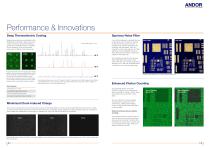
Performance & Innovations Deep Thermoelectric Cooling Spurious Noise Filter Single thermal electrons are amplified by the EMCCD gain mechanism. Deep vacuum TE cooling is critical to optimize the sensitivity performance of EMCCD sensors, otherwise the raw sensitivity will be compromised, even under conditions of short exposures. It can still be desirable to optionally filter the remaining spurious noise (Clock-Induced Charge or photons) to give as ‘black’ a background as possible, eradicating any remaining ‘salt and pepper’ noise. It is important to utilize noise selection and filter algorithms...
Open the catalog to page 9
Performance & Innovations Vacuum The iXon is well regulated in terms of both Baseline (bias offset) rigidity and superior EM gain stability, lending for enhanced quantitative reliability throughout and between measurements. Baseline Clamp OFF Window (Anti-reflection Coated) Heat Removal EM Gain Stability Mean ROI signal / ADU Andor’s proprietary UltraVac process has a proven track record of field reliability, accumulated over more than 15 years of shipping high-end vacuum cameras. UltraVac also enables use of only one input window, improving photon-throughput by 8%. Permanent, All-Metal Seal...
Open the catalog to page 10
Performance & Innovations Software Solutions ‘2 in 1’ Performance - EMCCD and CCD Three of the back-illuminated iXon models offer ‘2 in 1’ performance flexibility, in terms of operating as a single photon EMCCD or a low noise conventional CCD, readily user selectable through software selection. Such versatility is attractive in laboratories that can require the camera to operate in low light conditions under both fast and slow frame rates. In photon starved applications, choosing the EMCCD amplifier usually yields better signal to noise ratio when under faster frame rates conditions (> 1 fps),...
Open the catalog to page 11All Andor Technology PLC catalogs and technical brochures
 Zyla sCMOS
78 Pages
 iXon Ultra
121 Pages
 Andor_Newton
44 Pages
 Kymera_328i
63 Pages
 Solis 64
6 Pages
 ikon xl 231
8 Pages
 zyla 5.5 scmos
12 Pages
 ixon ultra 888
12 Pages
 ikon xl 230
8 Pages
 2020 Neo 5.5 sCMOS
6 Pages
 Multi-Wavelength Imaging
11 Pages
 2017 iXon EMCCD
13 Pages
 iKon-L HF
7 Pages
 Shamrock 500 Spectrograph
13 Pages
 Shamrock 750 Spectrograph
14 Pages
 iXon Ultra 888 EMCCD
2 Pages
 iXon Ultra 897 EMCCD
2 Pages
 Zyla 5.5 HF
8 Pages
 Neo 5.5 sCMOS
6 Pages
 Microspectroscopy Gatefold
8 Pages
 Kymera 193 Spectrograph
14 Pages
 Spectroscopy
25 Pages
 High Energy Detection
28 Pages
 Spectroscopy Solutions
23 Pages
 Neo and Zyla sCMOS Cameras
17 Pages


Archived catalogs
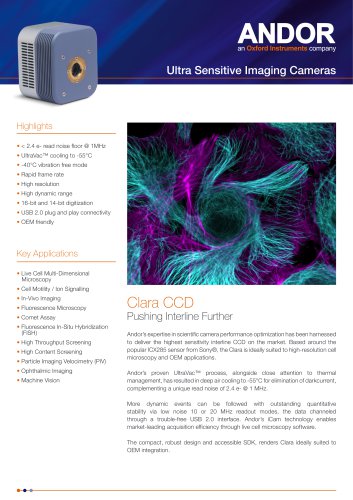 Clara CCD
2 Pages
 Andor iXon Life EMCCD
9 Pages
 Imaris Gatefold
8 Pages
 iKon-XL 231
8 Pages
 iKon-XL 230
8 Pages
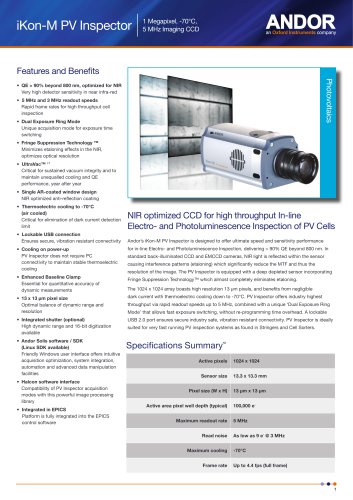 iKon-M CCD for Photovoltaics
6 Pages
- Analysis software
- Microscopy
- Compound microscope
- Laboratory microscope
- Desktop microscope
- Control software
- Windows software
- Laboratory software
- CMOS camera
- Camera with USB port
- Spectroscope
- Hospital software
- LED light source
- Acquisition software
- Medical camera
- Capture software
- Biology microscope
- Benchtop spectrometer
- Microscope camera
- Research microscope