

ALK

ALK
Catalog excerpts

GenASIs Scan & Analysis - ALK Personalized Medicine in Non-Small Cell Lung Cancer GenASIs Scan & Analysis ALK is a computer aided solution aiding in the evaluation of gene rearrangements involving the ALK gene, which has been identified as a significant factor in the development of non-small cell lung cancer (NSCLC). GenASIs allows clinicians to • automatically scan and analyze ALK slides via fluorescence in situ hybridizatio (FISH) in formalin-fixed paraffin-embedded (FFPE) non-small cell lung cancer (NSCLC) tissue specimens stained with Vysis ALK Break Apart FISH Probe Kit from Abbott, and • identify the ALK gene rearrangement while achieving accurate, repeatable and standardized results which enhance clinical accuracy and save time. The Vysis Anaplastic Lymphoma Kinase (ALK) Break Apart FISH Probe Kit could aid in the selection of previously treated non-small cell lung cancer patients for treatment with the Pfizer drug Xalkori® (Crizotinib), which may result in a life-prolonging survival benefit. With GenASI’s ALK, pathologists can focus more time on the professional aspect of the case, and leave the cell counting to the computer. Negative Class
Open the catalog to page 1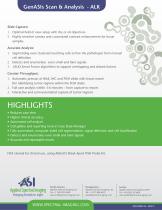
GenASIs Scan & Analysis - ALKSlide Capture: 1. Optimal field of view setup with dry or oil objectives 2. Highly sensitive camera and customized contrast enhancement for tissue samples. Accurate Analysis: 1. Segmenting even clustered touching cells to free the pathologist from manual cell definition 2. Detects and enumerates even small and faint signals 3. (ALK) Smart Fusion algorithms to support overlapping and distant fusions Greater Throughput: 1. Automatic prescan of H&E, IHC and FISH slides with tissue-match (for identifying tumor regions within the FISH slide) 2. Full case analysis within...
Open the catalog to page 2All Applied Spectral Imaging catalogs and technical brochures
 Karyotyping
2 Pages
 HiSKY
HiSKY2 Pages
 HIPath
2 Pages
 HER2/neu
2 Pages
 FISH Capture & Analysis
2 Pages
 CTC
CTC2 Pages
 CDM
CDM2 Pages
 Case Data Manager
2 Pages
 GenASIs HyperSpectral
16 Pages
 GenASIs Cytogenetics Suite
8 Pages
 GenASIs Pathology Suite
12 Pages
 GenASIs Platforms
2 Pages

- Cell imaging system
- Automatic cell imaging system
- Laboratory cell imaging system
- Fluorescence cell imaging system
- Research cell imaging system
- Diagnostic cell imaging system
- Molecular biology cell imaging system
- Confocal cell imaging system
- Tissue cell imaging system
- 3D cell imaging system
- Histopathology cell imaging system
- Clinical cell imaging system
- FISH cell imaging system