


- Company
- Products
- Catalogs
- News & Trends
- Exhibitions
Skin IQ®

Skin IQ®
Microclimate refers to the moisture and temperature conditions at the skin/surface interface. It is crucial for patients at risk of maceration and skin breakdown, as variations in these conditions can increase skin sensitivity to pressure, shear, and friction.
Skin IQ Microclimate Manager
The Skin IQ Microclimate Manager is designed to prevent and manage pressure injuries. It features a waterproof, vapor-permeable top layer that acts as a bacterial and viral barrier. The Negative Airflow Technology (NAT) effectively removes excess moisture, reducing staphylococcus aureus growth and odor at the skin/mattress interface. It is compatible with various pressure redistribution mattresses.
Product Features
- Moisture Vapor Transfer Rate (MVTR) of 130g/m2/hr for standard, 171g/m2/hr for reusable, and 165g/m2/hr for bariatric versions.
- Top layer material reduces shear and friction.
- Quick setup and maintenance with a low-profile design.
Braden Scale for Predicting Pressure Sore Risk
The Braden Scale assesses risk based on sensory perception, moisture, activity, mobility, nutrition, and friction & shear. Each category is rated from 1 to 4, with lower scores indicating higher risk.
Conclusion
Effective microclimate management is essential for pressure injury prevention. The Skin IQ Microclimate Manager offers advanced solutions to maintain skin integrity and improve patient outcomes.
Catalog excerpts

PRESSURE INJURY PREVENTION Skin IQ ® “Controlling microclimate is an important and often overlooked area of pressure ulcer prevention” Advanced microclimate management Dr. Joyce Black, former president, National Pressure Ulcer Advisory Panel Microclimate Management the critical link to skin integrity Skin IQ Microclimate Manager • Microclimate refers to the conditions of moisture and temperature at the point(s) of skin/surface interface1 An effective and intuitive solution for the prevention and management of pressure injuries. • Microclimate is a key factor for patients at risk of maceration and skin breakdown • Excess variation in moisture and/or temperature increases skin sensitivity to the damaging effects of pressure, shear, and friction2 Microclimate Friction Maceration AND/OR Shear Pressure injuries • A waterproof, vapour-permeable top layer that offers a bacterial and viral barrier3 • Negative Airflow Technology (NAT) continually draws excess moisture away from the skin / mattress interface. Bench studies show that Skin IQ MCM removes 3.8 times more moisture at the skin/mattress interface than the same mattress without Skin IQ MCM4 • Bench studies show that Skin IQ MCM reduces staphylococcus aureus growth by 3.1 logs over a 24 hour period. A percentage reduction of greater than 99.9%.5,* • Bench studies show that Skin IQ MCM significantly reduces odour at the skin/mattress interface when compared to the same surface without airflow6 • Designed for compatibility with pressure redistribution mattresses on the market today (eg, AtmosAir™ 9000 Mattress Replacement System) *The level of treament stated indicates theoretical levels
Open the catalog to page 1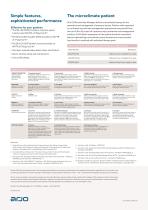
The microclimate patient Skin IQ Microclimate Manager delivers microclimate therapy for the prevention and management of pressure injuries. Patients with suspected or confirmed microclimate management requirements may benefit from the use of Skin IQ as part of a pressure injury prevention and management solution. A full holistic assessment of the patient should be considered before implementing microclimate control measures to ensure product functionality is matched with individual therapy goals. SKIN IQ MICROCLIMATE MANAGER ORDERING INFORMATION Simple features, sophisticated performance Effective...
Open the catalog to page 2All Arjo catalogs and technical brochures
 Maxi Twin
2 Pages
 MAXI MOVE
44 Pages
 Tornado™
2 Pages
 Alenti®
2 Pages
 Skin IQ® Case study booklet
24 Pages
 Therakair Visio®
4 Pages
 Auto Logic® 110
3 Pages
 Simulflex™
3 Pages
 Walker®
2 Pages
 Sara® Plus
2 Pages
 Sara® Flex
8 Pages
 Sara® 3000
2 Pages
 Sara® Stedy
2 Pages
 Maxi Sky® 1000
2 Pages
 Maxi 500®
2 Pages
 Alpha Active® 3
3 Pages


Archived catalogs
 Flowtron Excel
4 Pages
 Flusher disinfector range
9 Pages
 Alpha Active® 4
3 Pages
 AtmosAir® 9000
2 Pages
 IndiGo
2 Pages
 IndiGo brochure
2 Pages
 AtmosAir Plus Brochure
4 Pages
 Bathing solutions
16 Pages
 Auto Logic® 200
2 Pages
 RIK® Fluid Overlay
2 Pages
 Dri-Flo®
2 Pages


- Hospital bed
- Inclinable bed
- Stretcher trolley
- Trendelenburg bed
- Hospital bed mattress
- Transport gurney
- Reverse Trendelenburg bed
- Medical bed
- Foam mattress
- Height-adjustable stretcher trolley
- Patient lifter
- Anti-decubitus mattress
- Electric patient lift
- Shower chair
- Stretcher trolley with adjustable backrest
- 2-section stretcher trolley
- Emergency stretcher trolley
- Shower chair with armrests
- Intensive care bed
- Shower chair with backrest