


Applications of ACP* in knee surgery Surgical Technique

Applications of ACP* in knee surgery Surgical Technique
Autologous blood products, particularly Autologous Conditioned Plasma (ACP), are gaining interest in orthopaedic therapies due to their healing effects supported by growth factors released by platelets. The ACP Double Syringe System facilitates the sterile separation of non-homogenous liquids, allowing blood withdrawal using a standard cannula with a LuerLock connection.
- Induce proliferation and differentiation of cell types like osteoblasts and chondroblasts.
- Enhance matrix production, including collagen and proteoglycan.
- Stimulate angiogenesis and chemotaxis.
- Unique two-in-one system for ACP preparation.
- Quick preparation within minutes.
- Usable in clinics or OR settings under sterile conditions.
- Easy and safe handling due to the Double Syringe design.
ACP preparation results in a 2-3 fold increase in platelet concentration. Platelets release growth factors outside the bloodstream, supporting the healing process synergistically.
- Applicable for Levels 1-3 ruptures, and Level 4 in older active patients.
- Procedure involves puncturing, blood withdrawal, and ACP production.
- Post-treatment includes brace usage, weight-bearing transition, and proprioceptive training.
- Up to 2 weeks: Mecron brace at 20°, partial weight bearing, passive ROM.
- Weeks 3-6: Functional leg brace, transition to full weight bearing, proprioceptive training.
- From 7th week: Training therapy.
- After 3 and 6 months: Clinical and KT1000 examinations.
For healed collateral ligaments with laxity, surgical techniques involve microperforation and ACP injection.
Post-suturing, ACP is injected to support healing, with specific instruments used for preparation and injection.
Details on available Arthrex ACP kits, centrifuges, and related instruments are provided for ordering.
Catalog excerpts

Applications of ACP* in knee surgery Surgical Technique * ACP - Autologous Conditioned Plasma
Open the catalog to page 1
Introduction Autologous blood products like blood plasma have created a growing interest for use in a number of orthopaedic therapies. The healing effects of plasma are supported by growth factors released by platelets. The ACP (Autologous Conditioned Plasma) Double Syringe System is used for sterile separation of non-homogenous liquids. This device will allow the withdraw of blood from the human body using a commercial available cannula with LuerLock connection. Mechanism of ACP If blood is prepared in the form described, the plasma contains a 2 - 3 fold platelet concentration over baseline.7...
Open the catalog to page 2
Surgical Technique Partial rupture of the anterior cruciate ligament 9 Treatment of partial ruptures Levels 1 - 3 (up to Level 4 for older, but active patients) of the anterior cruciate ligament following prior arthroscopic evaluation. The procedure can be used for acute and for chronic injuries that have not responded sufficiently to the treatment. A side-to-side difference of a maximum of 3 mm in the KT1000 test, negative pivot shift, maximum indicated pivot glide and subjective stability are considered as a positive response to treatment. 1 First, puncture the proximal stump with a cannula...
Open the catalog to page 3
3 For Level 3 and 4, use a small chisel (approx. 3 mm) to fold a thin osseous flake from the roof of the fossa intercondylaris into the remainder of the anterior cruciate ligament. 4 Insert one cannula into the proximal attachment of the partially ruptured anterior cruciate ligament and another into the median compartment, drain off the irrigation solution and remove the arthroscope. Post-treatment protocol Up to 2 weeks post-op • Mecron brace 20° • Partial weight bearing 10 kg • Passive range of Motion (ROM): 0 °/ 20 °/ 60° Weeks 3 - 6 • Functional leg brace during the day 0° / 10 °/ 90° • Mecron...
Open the catalog to page 4
Surgical Technique Partial rupture of the medial collateral ligament (MCL) For partial ruptures that do not involve any surgical treatment, inject ACP conservatively into the rupture site, which has been identified using magnetic resonance imaging (perform depot injections at several sites) and repeat after two weeks. Support the procedure using functional movement-limiting therapy / a knee brace. Healing response for elongated MCL – surgical treatment option 9 For a healed collateral ligament (diagnosis during anterior cruciate ligament reconstruction) with (clinically relevant) laxicity. 1...
Open the catalog to page 5
Withdraw the Langenbeck hook. Use the ClawInstrument to perforate the collateral ligament (coronary ligaments, capsular lining) from outside through the collateral ligament into the periosteum (microperforation technique in line with Rosenberg): Firstly from proximal to distal 1 , then from proximal to dorsal 2 and from dorsal to ventral 3 . 5 Finally, inject the ACP into the collateral ligament (perform depot injections at several sites). Repeat the injection post-op conservatively after two weeks and four weeks.
Open the catalog to page 6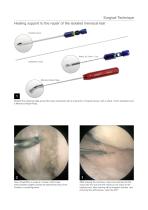
Surgical Technique Healing support to the repair of the isolated meniscal tear Torpedo shaver Meniscus Repair Rasp 1 Refresh the meniscal edge around the injury intensively with a small joint or Torpedo shaver, with a sharp 1.6 mm Guidewire and a Meniscus Repair Rasp. 2 Use a PowerPick to make 5 - 6 holes in the Fossa intercondylaris slightly outside the attachment area of the Posterior cruciate ligament. 3 After suturing the meniscus, insert one cannula into the suture site and one into the meniscus rim (close to the capsule) and, after draining off the irrigation solution and removing the arthroscope,...
Open the catalog to page 7
Ordering information Arthrex ACP Double Syringe ABS-10014 Centrifuge Hettich Rotofix 32 with Swing Out Rotor 1324, 220 V 1206-Art Centrifuge Hettich Rotofix 32 with Swing Out Rotor 1324, 110 V 1206-01-Art Bucket with Screw Cap for Centrifuge (spare) ABS-10022 ArthrexACP counterweight for centrifugation of ACP Double Syringe, 15ml ABS-10027 Meniscus Repair Rasp AR-4130 Guidewire, Ankle Arthroscopy, 1.6 mm AR-8655K-16 An anticoagulant can be ordered on request. 1. Borzini P, Mazzucco L: Tissue Regeneration and in Loco Administration of Platelet Derivates: Clinical Outcomes, Heterogeneous Products,...
Open the catalog to page 8All Arthrex catalogs and technical brochures
 Imaging and Resection Catalog
108 Pages
Archived catalogs
 ACL TightRope® RT - LS0178
2 Pages
 HTO Medial PEEK Implant
6 Pages
 A rthrex Graft Tubes
4 Pages
 Clavicle Plate and Screw System
12 Pages
 For Fracture Treatmen
8 Pages
 Hip Labral Scorpion
1 Page
 Imaging & Resection
80 Pages
 Hand & Wrist
64 Pages
 Foot and Ankle
12 Pages
 Shoulder Repair Technology
114 Pages
 Ankle Arthroscopy
11 Pages
 Arthroscopic Hand Instruments
28 Pages
 Foot & Ankle
138 Pages




- Bone plate
- Compression plate
- Planning software
- Suture thread
- Surgery software
- Non-absorbable suture thread
- Arthrex® suture anchor
- Foot compression plate
- Arthrex® non-absorbable suture anchor
- Orthopedic surgery suture thread
- Rotator cuff suture anchor
- Suture button
- Calcaneus compression plate
- Small joint suture anchor
- ACL reconstruction suture button
- Shoulder prosthesis
- Knotless suture anchor
- Preoperative planning software
- Suture needle
- Biceps tendon suture anchor