
- Catalogs
- Arthrosurface
- Restore Your Active Lifestyle

Restore Your Active Lifestyle

Restore Your Active Lifestyle
This pamphlet introduces the Arthrosurface PF Wave as an alternative to total knee replacement, aimed at patients seeking to maintain an active lifestyle. It highlights the limitations of traditional knee replacements and presents the PF Wave as a solution that preserves natural joint anatomy.
Knees and Arthritis
Arthritis can affect the condyles and the patello-femoral joint, leading to pain during activities like standing or climbing stairs. The document explains how arthritis can worsen over time due to cartilage damage.
Treatment Options
Various treatments for cartilage damage are discussed, including marrow stimulation, allografts, injections, and joint restoration with Arthrosurface implants. Each method has its pros and cons, with the PF Wave offering a minimally invasive option that preserves more of the natural joint.
Arthrosurface PF Wave
The PF Wave implant is custom-fitted to the patient's joint, requiring less bone and cartilage removal compared to traditional replacements. It is designed to maintain joint motion and can be performed on an outpatient basis. The implant has shown stability over 12 years with minimal loosening.
Comparison with Traditional Joint Replacement
Traditional total joint replacements involve significant removal of bone and cartilage, leading to limited motion and activity. The PF Wave, however, preserves more of the natural joint, allowing for future surgical options if needed.
Patient Experience
A patient story illustrates the success of the PF Wave procedure, highlighting a return to an active lifestyle post-surgery.
Considerations and Questions
The pamphlet provides questions for patients to discuss with their doctors and outlines criteria for being a candidate for the PF Wave.
Contact Information
Contact details for Arthrosurface, Inc. are provided for further inquiries and finding a doctor.
Catalog excerpts

Restore Your Active Lifestyle Patello-Femoral Patient Pamphlet
Open the catalog to page 1
Find out if the Arthrosurface PF Wave is right for you!
Open the catalog to page 2
OUR PATIENTS STAY ACTIVEThe active alternative to a total knee replacement Have you been told that you may need a total knee replacement? Did you know that artificial joints can limit a person's range of motion and ability to perform daily tasks? Or that they also restrict physical activities such as cycling, martial arts, and weightlifting? Unlike a total knee replacement, the Arthrosurface® Joint Restoration System can allow you to resume full activity by preserving the natural anatomy of your joint. Consisting of a cap and screw that allow the surgeon to restore only the damaged area of the...
Open the catalog to page 3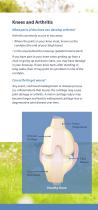
Knees and Arthritis What parts of the knee can develop arthritis? Arthritis commonly occurs in two areas: • Where the joints in your knee meet, known as the condyles (the end of your thigh bone) • In the area behind the kneecap (patello femoral joint) If you have pain in your knee when getting up from a chair or going up and down stairs, you may have damage in your kneecap. If your knee hurts after standing or long walks, then it may point to a problem in one of the condyles. Can arthritis get worse? Any event, continued malalignment or disease process (i.e. inflammation) that injures the cartilage...
Open the catalog to page 4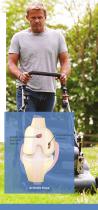
Compartment Arthritis Patello Femoral Arthritis Arthritic Knee
Open the catalog to page 5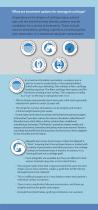
What are treatment options for damaged cartilage? In a marrow stimulation procedure, a surgeon uses a pick or an awl to create holes in the exposed defect, which will cause bleeding. This initiates a fibro-cartilage healing response. The fibro-cartilage then grows and fills the lesion creating a new surface. This response is similar to a “scar” or the way a scab grows over a cut. Depending on the degree of cartilage injury, patient age, and the level of activity desired, patients may be candidates for a variety of treatments. These include marrow stimulation, grafting, injections, an Arthrosurface...
Open the catalog to page 6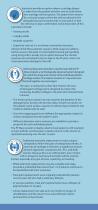
Injections provide an option where a cartilage biopsy is taken from the patient and then sent to a lab where new cartilage cells are grown. The patient then returns for a second surgery where the cells are placed in the damaged area and covered with a tissue patch so that the cells stay in place until healed. Some downsides of this procedure include: IN J EC Varying results Lengthy rehab ● E xpensive costs as it is not always covered by insurance. Arthrosurface joint restoration is performed with the PF Wave implant, a technologically advanced system designed to match the shape and contour of...
Open the catalog to page 7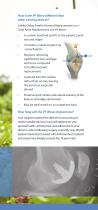
How is the PF Wave different than other existing devices? Unlike Onlay Patello Femoral Replacements or a Total Knee Replacement, the PF Wave: • Is custom matched and fit to the patient's joint size and shape • Provides a stable implant via screw fixation • Requires removing significantly less cartilage and bone compared to traditional joint replacements • Is placed into the surface rather than on top, leaving the joint less surgically altered • Preserves joint motion and natural anatomy of the knee so no bridges are burned • May be performed on an outpatient basis How long will the PF Wave...
Open the catalog to page 9
The PF Wave leaves more bone intact, providing more options should future surgery be required. If your PF Wave ever fails, it may be replaced with a traditional total joint replacement. Does the PF Wave "burn any bridges?" There is minimal bone removed with the PF Wave because, unlike existing joint replacements, it does not require not surgically removing the entire bone surface on both sides of the joint. Removing the entire ■ bone surface on both sides of the joint leaves less of the natural bone to work with if future surgery is required. Will I feel the device? No. The implant is surgically...
Open the catalog to page 10
Questions to ask your doctor during your visit • Will my joint feel normal and move naturally after I have the surgery? • Will you remove my ACL? • Is my cartilage damage localized? • Is the alignment of my joint close to normal? • Is my joint unstable? • Do I have any joint space remaining? • How long will I be hospitalized? • Can the procedure be performed on an outpatient basis? • Will the recovery take weeks or months? • Can I go back to all my previous sports and activities? Are you a candidate for the PF Wave? • You are aged 35 to 75 years old • You want to regain your active lifestyle •...
Open the catalog to page 13
A Patient’s Story “I was training for a half ironman when my knee just locked up.” After severly injuring her knee, Letia initially elected for an Osteotomy with a lateral release and ACI (Autologous Chondrocyte Implantation). Not only did these surgeries fail, she was also burdened with severe complications from the procedure, including an infection from the hospital. Very discouraged by the failed surgery and the many complications she endured, Letia decided to make an appointment with Dr. Brian Mckeon at New England Baptist Hospital. After exploring all of her options with Dr. McKeon, they...
Open the catalog to page 14
Due to its general applicability, do not rely on information in this brochure to assess any particular patient condition. Individual results may vary. Seek professional medical advice for specific personal care. Do not delay seeking professional medical advice or disregard professional medical advice because of something you have read in this brochure. Arthrosurface, Inc. 28 Forge Parkway, Franklin, MA 02038, USA Tel: 508.520.3003 / Email: [email protected] © 2018 Arthrosurface, Inc. All Rights Reserved. To find a doctor near you, call 1.508.520.3003 or visit www.arthrosurface.com/find-a-doctor...
Open the catalog to page 16All Arthrosurface catalogs and technical brochures
 Kahuna
2 Pages
 NanoFx
2 Pages
 KISSloc™
2 Pages
 hip hemicap
2 Pages
 When it’s your last move
2 Pages
 Product Portfolio
15 Pages
 Hip HemiCAP®
12 Pages
 Great toe HemiCAP®
7 Pages
 Shoulder HemiCAP®
1 Page
 UniCAP
2 Pages
- Bone plate
- Arthrodesis plate
- Knee prosthesis
- Metallic arthrodesis plate
- Foot arthrodesis plate
- Arthrodesis screw
- Cemented knee prosthesis
- Metallic arthrodesis screw
- Foot arthrodesis screw
- Headless arthrodesis screw
- Digit joint implant
- Unicondylar knee prosthesis
- Non-locking arthrodesis plate
- Foot phalange arthrodesis plate
- Metatarsophalangeal joint implant
- Humeral head prosthesis
- Patello-femoral prosthesis