

Chemical hoods

Chemical hoods
The document provides detailed information on ASEM® fume cabinets, focusing on their design, functionality, and safety features. ASEM® is a leader in fume hood production, ensuring operator safety in laboratories.
ASEM® fume hoods are certified according to EN 14175 and UNI TS 11710 standards, ensuring compliance with safety objectives. The company emphasizes quality through rigorous testing and certification processes, including electrical and aerodynamic tests.
The concept of fume hoods dates back to 1450, invented by Giuliano Sorboni to prevent self-poisoning during chemical preparations. This method evolved over centuries, becoming a staple in laboratory safety.
ASEM® offers a range of fume hoods with various sizes and materials, designed to meet safety standards and enhance performance. They are tested for containment and certified for safety and efficiency.
- Airfoil: Promotes air entry and prevents vortex formation.
- Double Extraction: Enhances removal of heavy vapors.
- Alarm System: Alerts operators to low flow conditions.
- Sash and Locks: Provides secure access and maintains containment.
- Economy Flow: Reduces suction volume without compromising safety.
The DPC2 system with VAV (RMP) offers rapid response times and balanced double suction, enhancing safety and efficiency. The RMP system provides mechanical flow regulation, ensuring constant suction speed and immediate response to sash movements.
- Reduces required flow rates and avoids turbulence.
- Allows continuous suction on the worktop.
- Ensures high safety performance with low containment index values.
ASEM® fume hoods are designed to provide maximum safety and efficiency in laboratory environments. Their innovative systems and rigorous testing ensure they meet the highest standards of quality and performance.
The document details various models of ASEM fume cabinets, highlighting their versatility, flexibility, and safety features. The cabinets are constructed with metal structures coated with anti-acid epoxy paints, suitable for use with solvents and flammable products. They are available in different classes and configurations, including single and double sashes, and are designed for routine laboratory applications.
The document outlines the operation of the fume hoods, including manual and automatic settings for air flow control. It describes the use of microprocessor control systems with hot wire anemometric sensors for precise air flow management. The systems allow for remote management, display of operating parameters, and alarm notifications.
The fume cabinets are certified according to EN 14175 standards, ensuring safety and reliability. The document also mentions compliance with electrical safety standards EN 61010-1 and EMC immunity standards EN 61000-6-2 and EN 61000-6-4.
For optimal performance, the document recommends using the hoods with the appropriate accessories and services, such as the SMART SYSTEM AC 4000 for enhanced control and monitoring. It also suggests the use of presence sensors and motorised sash opening systems for improved safety and efficiency.
The document highlights several key features, including the RMP mechanical flow regulator for maintaining constant air speed, the ACF automatic compensation flow system for air balance, and various accessories like armrests with probes and low consumption locks.
The document provides detailed data on air flow rates, energy consumption, and cost savings achieved through the use of variable air volume (VAV) systems. It emphasizes significant energy savings and reduced operational costs when using these systems.
The ASEM fume cabinets offer a comprehensive solution for laboratory air management, combining safety, efficiency, and flexibility. The integration of advanced control systems and compliance with international standards make them a reliable choice for laboratory environments.
The document provides detailed specifications for various worktop models, including dimensions, opening dimensions, fixed and variable volume capacities, and chemical resistance levels. Each model is identified by a unique code and includes measurements in millimeters for width, depth, and height, as well as specific volume capacities in cubic meters per hour (m3/h). The chemical resistance is noted as less than 0.1 ppm for all models.
The containment index section lists various air volume extraction rates at different velocities (0.3 m/s and 0.5 m/s). These rates are presented in a tabular format, indicating the volume of air extracted at specified velocities, which is crucial for maintaining safe and efficient operation of fume cabinets.
- Monolithic Stone: Made from a mixture of clays, quartz, kaolin, and feldspar, fired at 1300°C. It features high chemical resistance, smooth surface, and compliance with DIN 12916 standards.
- Laminated Stone: A 3 mm thick stone slab reinforced with fiberglass, offering high chemical resistance and compatibility with food. It is fire-resistant and recyclable.
- Polypropylene: Injection-moulded with perimeter edges, offering excellent chemical resistance to acids and alkalis, suitable for temperatures up to 140°C.
- Stainless Steel: Made from 316 AISI 18/10 stainless steel, featuring anti-overflow edges and a smooth surface to prevent bacterial growth. Complies with various UNI standards.
- Acrylic Resin: Composed of acrylic resin and mineral fillers, offering high resistance to impact, wear, and UV rays. It is non-porous, eco-friendly, and available in various colors.
1. Porcelain and Vitrified Steel Worktop: Made from decarburised steel with anti-overflow edges, acid-resistant enamel, and double-fired at 820°C. Resistant to chemicals, oils, and stains. Dimensions: Depth 750 mm, Thickness 45 mm.
2. HPL Laminate Worktop: Composed of thermosetting resins and wood fibers, non-porous, resistant to chemicals, and adaptable for laboratory needs. Standard color light grey. Dimensions: Depth 750 mm, Thickness 16 mm.
3. Glass + Laminate Worktop: 6 mm tempered glass, chemically inert, supported by a water-repellent chipboard. Dimensions: Depth 750 mm, Thickness 31 mm.
1. Fume Cabinet Dimensions: Various materials and sizes available, including monolithic stone, laminated stone, stainless steel, porcelain steel, acrylic resin, glass, polypropylene, and HPL laminate.
2. Metal and Laminate Cabinets: Certified for storing harmful chemicals, available in various dimensions, with features like shockproof edges and adjustable shelves.
3. Cleaning Plenum: Made of PVC, ensures uniform suction and purification of fumes through nebulised water and condensation methods.
1. Suction Modules: Designed for efficient air purification, with options for customization and accessories.
2. Electric Suction Devices: Made for chemical labs, with IP55 protection, suitable for outdoor use, and available in single-phase or three-phase versions.
1. Customizable Accessories: Includes electrical services, water and gas services, and technical gas taps.
2. Safety and Compliance: Products comply with various standards, ensuring safety and efficiency in laboratory environments.
The document describes various types of electric suction devices and fume cabinets, highlighting their construction and performance specifications. The devices are made from UV-resistant polypropylene and feature high-performance fans with forward-curved blades. They are available in both single-phase and three-phase versions with IP55 protection. The motors range from 0.18 KW to 3 KW, with varying flow rates and prevalence.
The document outlines the installation and maintenance procedures for the suction devices and fume cabinets. It emphasizes the importance of placing withdrawal points in straight sections of ductwork to ensure accurate measurements and sampling. The document also provides guidelines for the installation of accessories such as dampers, flexible tubes, and chimneys.
The fume cabinets are certified according to European directives EN14175-2-3-4-5-6-7, ensuring safety and performance. The document also references compliance with Decree Law 81/08 and related decrees, as well as various UNI EN standards for testing and installation.
The document recommends using activated carbon filter boxes for treating fumes and vapors, which should be positioned before the centrifugal extractor. It also suggests using manual dampers for hoods equipped with alarms without automatic air speed regulators.
- The fume cabinets are designed for collective protection, preventing the formation of explosive atmospheres and protecting against chemical projections.
- The structure is made of sheet steel with a modular design for easy interchangeability and maintenance.
- The sash is equipped with laminated glass and can be opened in various positions for operator safety.
- The document includes detailed descriptions of accessories and installation components, such as fireproof pipes, curves, and reduction/increase fittings.
- The document highlights the importance of adhering to safety standards and ensuring proper installation to minimize risks to laboratory workers.
- It provides detailed specifications for each model of suction device and fume cabinet, including motor power, flow rate, and prevalence.
- The document emphasizes the need for regular maintenance and easy replacement of parts to reduce management costs.
The document outlines the specifications for ASEM fume cabinets, focusing on safety features, construction materials, and operational guidelines. The cabinets are designed to comply with EN 14175 standards, ensuring user safety through features like automatic locking systems and optical/acoustic alarms. The sash frames are equipped with safety devices to prevent accidental falls in case of cable or belt breakage.
The fume cabinets are constructed using TIG welded steel tubes for high load capacity and are treated with pickling and hot phosphating processes. The enamel coating is applied electrostatically and undergoes a drying and firing treatment. The structure is reinforced with hexagonal steel screws for robustness. The worktops and internal coverings are made from materials like monolithic stone, laminated stone, polypropylene, epoxy, and stainless steel.
The cabinets include a mechanical locking system for the sash, which can be opened up to 450 mm from the worktop. An optical/acoustic alarm system is activated upon voluntary opening, and the locking system reactivates automatically when the sash is lowered. The counterweights are placed outside the hood to avoid contact with corrosive vapors.
The manual force required to operate the sash should not exceed 30 N per linear meter. The fume cabinets are designed for the extraction of vapors and dust, preventing explosive atmospheres and protecting against chemical projections. They are not suitable for handling biological agents.
The document provides detailed dimensions and air flow rates for various models, including CPR127EN to CPR247EN and CPRW127EN to CPRW247EN. The air flow rates vary based on speed settings, with options for variable volume (VAV) and economy modes.
The cabinets are equipped with various control systems, including options for flow regulation, speed display, and touch controls. The number of supports for fixing lattice varies by model.
The fume cabinets can be equipped with optional features like motorized sashes, external power supply sockets, and various taps for water, vacuum, gas, and compressed air. The design allows for easy replacement of parts to reduce maintenance costs.
The document outlines various models of fume cabinets, including CPR125EN, CPR155EN, CPR185EN, CPR215EN, and CPR245EN. Each model has specific dimensions, materials, and features. The construction includes self-supporting hoods with full-height sides and safety glass sashes. Worktops are available in materials like monolithic stone, laminated stone, polypropylene, epoxy, and stainless steel.
Flow regulation and speed display are available in certain models, with options for LED displays and touch controls. The document specifies the number of supports for fixing lattice and the availability of motorized sashes.
All models maintain a pressure drop of 50 Pa and are equipped with external sockets rated at 230 V 16 A IP 55, with internal socket options at IP 56. Lighting is provided by LED outside the suction volume, offering 800 lux.
For optimal performance, it is recommended to utilize the variable air volume (VAV) systems, which offer economy modes to reduce air flow rates and energy consumption. The sash lock heights are adjustable to 450 mm or 300 mm for economy settings.
The document provides detailed air flow rates at different speeds (0.5 m/s and 0.3 m/s) for each model, along with VAV and VAV economy variable volume speeds. The containment efficiency is noted as 0.5/0.01 s/ppm across all models.
Each model's dimensions, weight, and working space are specified, ensuring users can select the appropriate model based on their spatial and functional requirements. The document emphasizes the importance of maintaining the specified pressure and utilizing the recommended materials for durability and safety.
The document provides detailed specifications for various models of fume cabinets, including dimensions, weights, air flow rates, and materials used. The working width, depth, and height are consistent across models, with variations in weight and air flow rates depending on the model.
Air flow rates are specified at different speeds (0.5 m/s and 0.3 m/s) for each model. Variable air volume (VAV) systems are described, including economy modes that reduce air flow for energy efficiency.
Different models of alarm control systems are available, with features such as flow regulation, speed display, and touch controls. Some models offer optional flow displays.
The fume cabinets are constructed with various materials, including stone, glass, polypropylene, and stainless steel. The construction includes safety glass sashes and optional windows.
Details on power supply sockets, thermal switches, and lighting are provided. External sockets are available, and lighting is positioned outside the suction volume.
The document explains the air flow mechanism, emphasizing the importance of an expulsion system for fumes. It highlights the need for proper design to ensure smooth operation and maximum safety.
Guidelines for positioning fume hoods in laboratories are provided, including minimum distances from walls, doors, and other equipment to ensure safety and efficiency.
Recommendations for safe use include avoiding unsuitable electrical sockets, not using the hood for storage, and ensuring proper air flow. Users are advised to keep equipment raised and away from sides to prevent obstruction.
Advice on setting up connections and piping in laboratories is included, with recommendations for materials and configurations to ensure safety and compliance with standards.
- Maintain a clear space between the lower edge of the sliding panel frame and the work surface.
- Keep the hood's vertical sash in the lowest possible position during work and close it when not in use.
- Position your head vertically in front of the sash for protection against accidental explosions or leaks.
- Avoid putting your head inside the hood to check ongoing processes.
- Open and close the sash slowly to maintain suction efficiency.
- Place emission sources at least 15-20 cm inside the hood and mark safe areas on the worktop.
- Only keep necessary materials inside the hood and avoid leaving bottles or apparatus inside.
- Use a raised rack for small accessories to allow airflow and avoid disturbing the flow.
- Avoid using large equipment that can create dead spaces and compromise hood effectiveness.
- Do not modify the hood structure as it can affect performance.
- The hood should not be used for disposing of toxic products.
- Minimize sudden movements inside the suction chamber to prevent fume escape.
- The operator's position in front of the hood influences its suction capacity.
- Various models of ASEM fume cabinets are available, differentiated by height, sash configuration, and compatibility with acids, bases, and flammable substances.
- Models include CPR and CP series with heights of 2300 mm and 2500 mm, available with one or two sashes.
- ASEM S.r.l. is the manufacturer, located in Casale sul Sile, Italy.
- Contact information: Phone +39 0422 785536, Fax +39 0422 827135, Email [email protected], Website www.atcasem.it
Catalog excerpts

PROTECTING YOUR LIFE IN THE LABORATORY
Open the catalog to page 1
CONTENTS INTRODUCTION
Open the catalog to page 3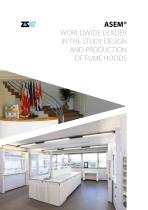
WORLDWIDE LEADER IN THE STUDY DESIGN AND PRODUCTION OF FUME HOODS
Open the catalog to page 4
This is ASEM® this is the Quality this is the Certification CERTIFICATION = SAFETY Certification is the guarante of compliance with the SAFETY objective that we give all our Customers through our products. SAFETY to guarantee health without compromise. EXPERIENCE 50 years in the industry have let ASEM® acquire a technical background that can provide all-round solutions. QUALITY The countless supplies we have provided to the most important industries, universities, hospitals and research centres, in Italy and abroad, confirm a consensus on quality that endures over time. TECHNOLOGY Constant research...
Open the catalog to page 5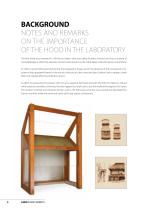
BACKGROUND NOTES AND REMARKS ON THE IMPORTANCE OF THE HOOD IN THE LABORATORY The first hood was invented in 1450 by an Italian, who was called Giuliano Sorboni and was a student of Lucrezia Borgia, or rather her assistant, and who used arsenic on the noble lady’s orders for reasons we all know. In order to avoid “self-poisoning” during the preparation phase, and in the absence of the mechanical components that appeared thanks to the arrival of electricity a few centuries later, Sorboni had to design a fairly basic but equally effective protection device. In effect, by preparing the potions with...
Open the catalog to page 6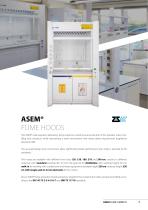
ASEM® FUME HOODS The ASEM® total expulsion laboratory fume extraction hoods ensure protection of the operator when handling toxic products, while maintaining a work environment that meets safety requirements (Legislative Decree 81/08). The accurate design and construction allow significantly better performance than what is required by EN standards. The hoods are available with different front sizes 120, 150, 180, 210 and 240 cm, versions in different materials with standard worktop 90 cm from the ground; for distillation with worktop height 50 cm; walk-in for working with cumbersome and heavy...
Open the catalog to page 7
8. ECONOMY FLOW (LOW CONSUMPTION LOCK) 7. AIR-FOIL ARMREST WITH ANEMOMETRIC PROBE 6. HORIZONTALLY SLIDING WINDOWS 1. AIRFOIL Elements that promote the entry of air inside the hood, avoiding the formation of vortices that could disrupt the flow, and helping to avoid dead spots where vapours could stagnate. SAFETY to guarantee health without compromise.. 2. DOUBLE EXTRACTION As a double base, it promotes elimination of heavy vapours by increasing the extraction speed from the back. Easy to remove, it makes it possible to "sanitise" the rear part from any sludge and hazardous dust, as required by...
Open the catalog to page 8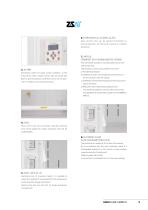
6. HORIZONTALLY SLIDING GLASS Glass sections that can be opened horizontally allowing operation, with the sash lowered, in complete protection. 7. AIRFOIL (ARMREST WITH ANEMOMETRIC PROBE) 3. ALARM Monitoring system for good suction operation. In the event of low flow, a buzzer and an LED will sound and flash to get the operator’s attention when the “containment” conditions are not being ensured. The anemometric probe is normally positioned on the roof of the hood. This position involves some problems over time: a) Possible dust deposit. b) Interference due to the temperature of the hot air in...
Open the catalog to page 9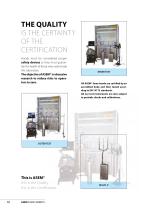
THE QUALITY IS THE CERTAINTY OF THE CERTIFICATION Hoods must be considered proper safety devices as they must guarantee the health of those who work inside the Laboratory. The objective of ASEM® is obsessive research to reduce risks to operators to zero. INNER TEST All ASEM® fume hoods are certified by an accredited body and then tested according to EN 14175 standards. All our test instruments are also subject to periodic checks and calibrations. OUTER TEST This is ASEM® this is the Quality this is the Certification ASEM FUME CABINETS
Open the catalog to page 10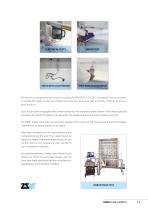
ELECTRICAL TESTS SMOKE TEST TESTS WITH LIGHT METER TESTS WITH DYNAMOMETER All electrical components are tested according to EN 61010-1 CEI 66-5 standards. Every six months a certification body checks all production processes to ensure that all hoods conform to the original product. Each of our hoods is equipped with a serial number for the traceability of the “dossier” where the production processes are stored; this allows us to guarantee the supply of spare parts and assistance over time. All ASEM® hoods come with an instruction booklet with a report of the tests carried out and the relative...
Open the catalog to page 11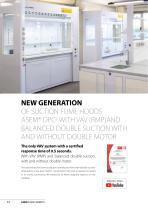
NEW GENERATION OF SUCTION FUME HOODS ASEM® DPC2 WITH VAV (RMP)AND BALANCED DOUBLE SUCTION WITH AND WITHOUT DOUBLE MOTOR The only VAV system with a certified response time of 0.5 seconds. With VAV (RMP) and balanced double suction, with and without double motor. The total extraction fume hoods are normally provided with “double suction” obtained by a rear panel which, connected to the roof, increases the speed in its “cavity”, promoting the extraction of heavy stagnant vapours on the worktop. ASEM DPC2 VIDEO
Open the catalog to page 12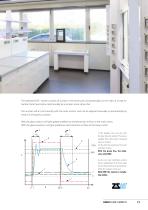
The patented DPC2 system consists of suction in the lower part, and potentially on the sides of a total extraction fume hood, done mechanically by a remote motor-driven fan. This suction will act concurrently with the main suction, and can be adjusted manually or automatically by means of a frequency variator. With the glass raised, it will give greater preference and extraction air flow to the main motor. With the glass lowered, it will give preference and extraction air flow to the lower motor. C In the diagram you can see, with the blue line, the trend of the classic variable flow (VAV) with...
Open the catalog to page 13
THE ADVANTAGES OF THE DOUBLE SUCTION SYSTEM The advantages of the system are a reduction in the required flow rates, a homogeneous suction that avoids turbulence, the possibility to increase or decrease the suction according to the needs of the operator and the type of product being handled. This system avoids the problem created by the classic VAV (variable volume) system which, once the sash has been lowered, keeping the suction speed constant, drastically reduces the volume of air flow so it is no longer sufficient to guarantee “washing”, especially when the interior uses bunsens, sand baths...
Open the catalog to page 14All ASEM SRL catalogs and technical brochures
 ETA_SERIES
68 Pages

Archived catalogs
 RIC_SERIES
50 Pages
- Laboratory hood
- Benchtop fume hood
- Chemical fume hood
- Laboratory bench
- Floor-standing fume hood
- Exhaust fume hood
- Stainless steel fume hood
- Containment fume hood
- Stainless steel laboratory bench
- Laboratory bench with sink
- Dental laboratory fume extractor
- Fume hood for the pharmaceutical industry
- Medical fume hood
- Laboratory bench with shelves
- Acid-resistant fume hood
- Research laboratory fume hood
- Modular laboratory bench
- Island laboratory bench
- Mobile laboratory bench
- Custom laboratory bench