

- Company
- Products
- Catalogs
- News & Trends
- Exhibitions
Volar -E Surgical Technique
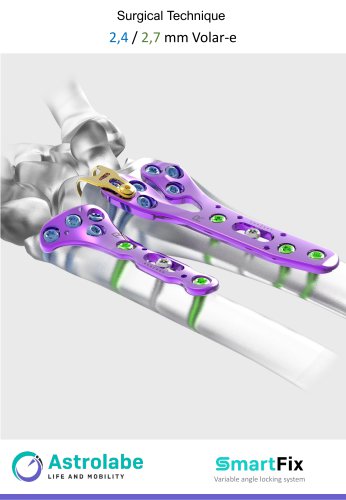
Volar -E Surgical Technique
Catalog excerpts
Surgical Technique 2,4 / 2,7 mm Volar-e A Astrolabe Variable angle locking system
Open the catalog to page 1
2,4 / 2,7mm Volar-e System Surgical Technique Atrolabe recognizes that proper surgical procedures and techniques are responsibilities of medical professionals. The following guidelines are provided for information purposes only. Each surgeon must evaluate the appropriateness of the procedures based on their medical training, experience and condition of the patient. Before using the system the surgeon must consult the operating instructi
Open the catalog to page 3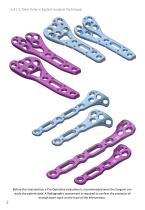
2,4 / 2,7mm Volar-e System Surgical Technique Before the intervention, a Pre-Operative evaluation is recommended were the Surgeon can study the patient data. A Radiographic assessment is required to confirm the presence of enough bone stock on the local of the intervention.
Open the catalog to page 4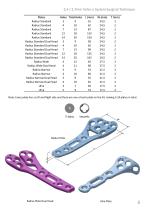
Radius Standard Radius Standard Radius Standard Radius Standard Radius Standard Radius Standard Dual Head Radius Standard Dual Head Radius Standard Dual Head Radius Standard Dual Head Radius Standard Dual Head Radius Wide Radius Wide Dual Head Radius Narrow Radius Narrow Radius Narrow Dual Head Radius Narrow Dual Head Ulna Ulna Holes Total Holes
Open the catalog to page 5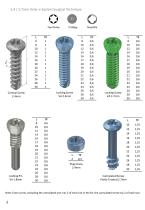
2,4 / 2,7mm Volar-e System Surgical Technique Torx Drive Ti Alloy Smartfix Cannulated Screw Partly Treated 2.7mm Note: Every screw, excluding the cannulated one, has 5 of each size in the kit, the cannulated screw has 2 of each size.
Open the catalog to page 6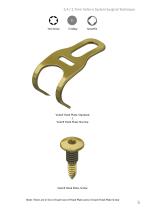
2,4 / 2,7mm Volar-e System Surgical Technique Ti Torx Drive VolarE Hook Plate, Standard / VolarE Hook Plate, Narrow VolarE Hook Plate, Screw Note: There are in kit 2 of each size of Hook Plate and 2 of each Hook Plate Screw
Open the catalog to page 7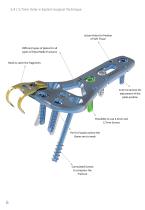
2,4 / 2,7mm Volar-e System Surgical Technique Suture Holes for fixation of Soft Tissue Different types of plates for all types of Distal Radio Fractures Hook to catch the fragments 1mm Increment for adjustment of the plate position Pin for Fixation where the Bones are to week Cannulated Screws to compress the Fracture
Open the catalog to page 8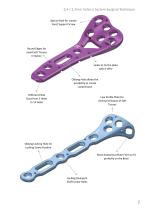
2,4 / 2,7mm Volar-e System Surgical Technique Special Hole for Lunate Facet Support Screw Round Edges for avoid Soft Tissues Irritation Holes to Fix the plate with K-Wire Oblong Hole allows the possibility to create compression Different Plate Sizes from 3 Holes to 14 Holes Low Profile Plate for minimal Irritation of Soft Tissues Oblong Locking Hole for Locking Screw Fixation Most Anatomical Plate Form to fit perfectly on the Bone Locking Divergent Shaft Screw Holes
Open the catalog to page 9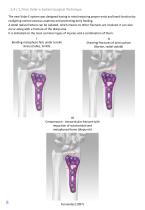
2,4 / 2,7mm Volar-e System Surgical Technique The new Volar-E system was designed having in mind restoring proper wrist and hand function by realigning normal osseous anatomy and promoting bony healing. A distal radius fracture can be isolated, which means no other fractures are involved. It can also occur along with a fracture of the distal ulna. It is indicated on the most common types of injuries and a combination of them: I Bending-metaphysis fails under tensile stress (Colles, Smith) II Shearing-fractures of joint surface (Barton, radial styloid) III Compression - intraarticular fracture...
Open the catalog to page 10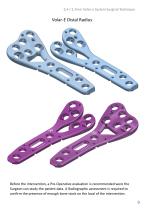
2,4 / 2,7mm Volar-e System Surgical Technique Volar-E Distal Radius Before the intervention, a Pre-Operative evaluation is recommended were the Surgeon can study the patient data. A Radiographic assessment is required to confirm the presence of enough bone stock on the local of the intervention.
Open the catalog to page 11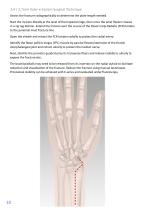
2,4 / 2,7mm Volar-e System Surgical Technique Assess the fracture radiographically to determine the plate length needed. Start the incision distally at the level of the trapezial ridge, then cross the wrist flexion creases in a zig zag fashion. Extend the incision over the course of the Flexor Carpi Radialis (FCR) tendon to the proximal most fracture line. Open the sheath and retract the FCR tendon radially to protect the radial artery. Identify the flexor pollicis longus (FPL) muscle by passive flexion/extension of the thumb interphalangeal joint and retract ulnarly to protect the median nerve....
Open the catalog to page 12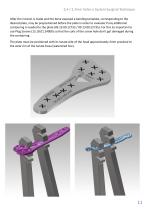
2,4 / 2,7mm Volar-e System Surgical Technique After the incision is made and the bone exposed a bending template, corresponding to the desired plate, may be prepositioned before the plate in order to evaluate if any additional contouring is needed to the plate (09.13.00.12735 / 09.13.00.22735). For this its important to use Plug Screws (15.18.01.24000) so that the coils of the screw hole don’t get damaged during the contouring. The plate must be positioned with its lunate side of the head approximately 2mm proximal to the volar rim of the lunate fossa (watershed line).
Open the catalog to page 13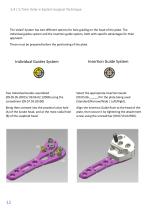
2,4 / 2,7mm Volar-e System Surgical Technique The VolarE System has two different options for hole guiding on the head of the plate. The individual guides system and the insertion guide system, both with specific advantages for their approach. These must be prepared before the positioning of the plate. Insertion Guide System Individual Guides System Two Individual Guides assembled (09.05.05.20015/ 09.06.02.12008) using the screwdriver (09.07.03.02590) Select the appropriate Insertion Guide (09.05.06._____) for the plate being used (Standard/Narrow/Wide | Left/Right). Being then screwed into the...
Open the catalog to page 14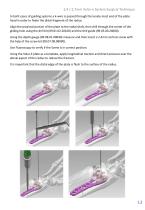
2,4 / 2,7mm Volar-e System Surgical Technique In both cases of guiding systems a k-wire is passed through the lunate most end of the plate head in order to fixate the distal fragment of the radius. Align the proximal portion of the plate to the radial shaft, then drill through the center of the gliding hole using the drill bit (09.01.02.20100) and the drill guide (09.05.00.24000). Using the depth gauge (09.08.01.00040) measure and then insert a 2.4mm cortical screw with the help of the screw bit (09.07.08.08090). Use Fluoroscopy to verify if the Screw is in correct position. Using the Volar-E...
Open the catalog to page 15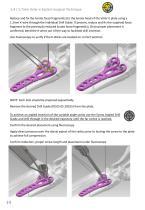
2,4 / 2,7mm Volar-e System Surgical Technique Reduce and fix the lunate fossa fragment(s) to the lunate head of the Volar-E plate using a 1.2mm K-wire through the Individual Drill Guide. If present, reduce and fix the scaphoid fossa fragment to the previously reduced lunate fossa fragment(s). Once proper placement is confirmed, bend the K-wires out of the way to facilitate drill insertion. Use Fluoroscopy to verify if the K-Wires are located on correct position. NOTE: Each hole should be prepared sequentially. Remove the desired Drill Guide (09.05.05.20015) from the plate. To achieve an angled...
Open the catalog to page 16All Astrolabe catalogs and technical brochures
 Box Components SMA 2,7
8 Pages
 Box Components DRP 2,7
8 Pages
 Box Components RSS 2,7
8 Pages
 Box Components Small Fragments
28 Pages
 Box Components Cannulated 7,0mm
12 Pages
 Box Components Lapidus 2,7
10 Pages
 Arrow Plate 3,5
10 Pages
 Midfoot 2,7
10 Pages
 Rearfoot 3,5
16 Pages
 Metaphyseal 3,5 / 4,5
8 Pages
 Malleolus 3,5mm
8 Pages
 Box Components RCS 2.0/2.7
12 Pages
 Box Components ForeFoot
12 Pages
 Box Components Fíbula
12 Pages
 Box Components RLS
8 Pages
 Box Components Akin & Weil
8 Pages
 Box Components Hallux Valgus
10 Pages
 Box Components CMS
10 Pages
 Catalog 4Hand
32 Pages
 DCS Surgical Technique
17 Pages
 DCS Box Components
10 Pages
 Surgical Technique DCS
17 Pages
 Box Components DCS
10 Pages
 Box Components Tibia Osteotomy
12 Pages
 Box Components Large Fragments
28 Pages
 Box Components Large Fragments
28 Pages
 Box Components Cannulated Screws
10 Pages
 Box Components Clavicle
10 Pages
 Box Components Volar-E
16 Pages
 Box Components Mallelous 3.5
8 Pages
 Reamers Astrolabe
12 Pages
 OTHOS System - Tibia Osteotomy
16 Pages
 VolarE System - Distal Radius
11 Pages
 2.7/3.5 Hallux Valgus System
20 Pages



- Bone plate
- Compression plate
- Metallic compression plate
- Locking compression plate
- Titanium compression plate
- Distal compression plate
- Compression bone screw
- Metallic compression bone screw
- Proximal compression plate
- Metal burr
- Lateral compression plate
- Medial compression plate
- Forearm compression plate
- Tibia compression plate
- General purpose compression bone screw
- Arthrodesis plate
- Radius compression plate
- Humerus compression plate
- Cannulated compression bone screw
- Metallic arthrodesis plate