

White Paper_Auricular Vagus Nerve Stimulation_VIVO
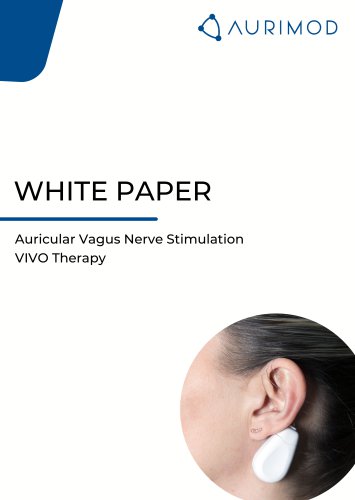
White Paper_Auricular Vagus Nerve Stimulation_VIVO
- Migraine Treatment: Straube et al. (2015) found a significant reduction in headache days over 12 weeks with 1 Hz stimulation compared to control. The responder rate was 29.4% for 1 Hz stimulation versus 13.6% for 25 Hz stimulation, with reduced acute headache medication use and improved MIDAS and HIT-6 scores.
- Perioperative Pain: Likar et al. (2007) reported that sham aVNS significantly reduced VAS scores 15 minutes post-procedure and decreased cumulative analgesic use compared to the control group.
- Significant reduction in pain scores and medication use with aVNS.
- Improved responder rates over time with continued aVNS therapy.
Catalog excerpts
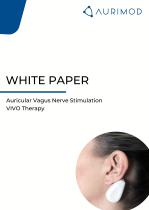
WHITE PAPER Auricular Vagus Nerve Stimulation VIVO Therapy
Open the catalog to page 1
2 Vagus nerve stimulation 3 The anatomy of the auricular vagus nerve 5 Overview of clinical studies
Open the catalog to page 3
Auricular vagus nerve stimulation (aVNS) is a peripheral, non-pharmacological and minimally invasive neuromodulation technique which is easy to use, personalisable and well tolerated. aVNS acts through the modulation of central brain stem nuclei, which influence the autonomic and central nervous system through their projections. VIVO is a CE-certified medical device for the concomitant treatment of chronic pain, specifically chronic back pain, by means of aVNS. The VIVO system consists of a portable neurostimulation device including an electrode unit which stimulates the auricular vagus nerve...
Open the catalog to page 5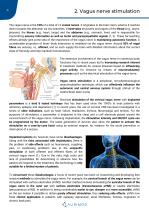
2. Vagus nerve stimulation The vagus nerve is the 10th of a total of 12 cranial nerves. It originates in the brain stem, whence it reaches down towards the abdomen via two branches. It innervates structures and organs of the throat (e.g., larynx, pharynx), the thorax (e.g., heart, lungs) and the abdomen (e.g., stomach, liver) and is responsible for transmitting sensory information as well as motor and parasympathetic signals (1, 2). These far-reaching effects already give some idea of the importance of the vagus nerve in maintaining autonomic function. A considerable proportion of brain–body...
Open the catalog to page 6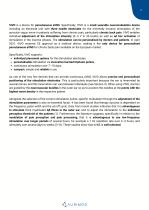
VIVO is a device for percutaneous aVNS. Specifically, VIVO is a small wearable neuromodulation device including an electrode unit with three needle electrodes for the minimally invasive stimulation of the auricular vagus nerve in patients suffering from chronic pain, particularly chronic back pain. VIVO enables individual adjustment of the stimulation intensity (0–5 V in 36 levels) as well as ad hoc activation of stimulation in the inactive phases. The stimulation can be personalised by doctors and patients. In April 2021, VIVO received CE approval as a medical device, making it the only device...
Open the catalog to page 7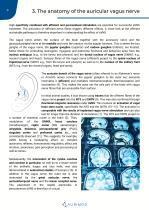
3. The anatomy of the auricular vagus nerve High specificity combined with efficient and personalised stimulation are essential for successful aVNS treatment. The activation of different nerve fibres triggers different effects. A close look at the afferent activatable pathways is therefore important in understanding the effect of aVNS. The vagus nerve enters the surface of the brain together with the accessory nerve and the glossopharyngeal nerve at the medulla and exits the cranium via the jugular foramen. This is where the two ganglia of the vagus nerve, the jugular ganglion (superior) and...
Open the catalog to page 8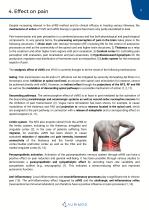
4. Effect on pain Despite increasing interest in the aVNS method and its clinical efficacy in treating various illnesses, the mechanisms of action of VIVO and aVNS therapy in general have been only partly elucidated to date. Pain transmission and pain perception is a combined process and has both physiological and psychological components. In very general terms, the processing and perception of pain in the brain takes place in the following structures: 1) Brain stem with reticular formation (RF) including RN for the control of autonomic processes as well as the connectivity of the spinal cord...
Open the catalog to page 9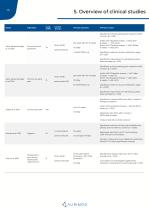
5. Overview of clinical studies Indication Therapy duration Primary results Significant and long-lasting pain reduction aVNS vs. sham (p < 0.05) per week 48 h for 6 weeks Sator-Katzenschlager et al. 2003 Chronic cervical syndrome Sham aVNS 12 h/day aVNS: VAS 7 baseline (mean) -> VAS 2 after 6 weeks -> VAS 2.5 FU Sham: VAS 7 baseline (mean) -> VAS 5.5 after 6 weeks -> VAS 6.5 FU same points (11) 4 weeks follow-up Significant reduction of pain medication usage (p < 0.05) Significant improvement in well-being, activity level and sleep (p < 0.05) Significant and long-lasting pain reduction aVNS vs....
Open the catalog to page 10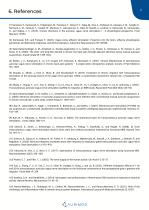
6. References (1) Kaniusas, E., Kampusch, S., Tittgemeyer, M., Panetsos, F., Gines, R. F., Papa, M., Kiss, A., Podesser, B., Cassara, A. M., Tanghe, E., Samoudi, A. M., Tarnaud, T., Joseph, W., Marozas, V., Lukosevicius, A., Ištuk, N., Šarolić, A., Lechner, S., Klonowski, W., Varoneckas, G., and Széles, J. C. (2019). Current directions in the auricular vagus nerve stimulation I - A physiological perspective. Front Neurosci 13:854. (2) Komisaruk, B.R., and Frangos E. (2022). Vagus nerve afferent stimulation: Projection into the brain, reflexive physiological, perceptual, and behavioral responses,...
Open the catalog to page 11
No liability is assumed for the completeness of the information shared in this white paper or its correctness, despite careful research. The primary purpose of this white paper is to inform medical professionals about the method of auricular vagus nerve stimulation and the technologies developed by AURIMOD GmbH. The Netter illustration was used with the permission of Elsevier Inc. All rights reserved. www.netterimages.com This project has received funding from the European Union's Horizon 2020 research and innovation programme under grant agreement No 807694 and No 880603. © AURIMOD GmbH, Modecenterstrasse...
Open the catalog to page 12