
- Catalogs
- Bausch + Lomb
- DreamLens Test Supplement


DreamLens Test Supplement

DreamLens Test Supplement
The DreamLens Certification Course is designed to support the certification process for the DreamLens product, used in contact lens corneal reshaping. It provides information on Bausch & Lomb Vision Shaping Treatment™ (VST) for temporary myopia reduction and certifies participants on the DreamLens Design. Ongoing training is recommended for effective patient care management.
FDA Approvals
In June 2004, the FDA approved the Boston® Orthokeratology Lens for overnight orthokeratology using Boston® Equalens® II. A supplemental approval in December 2004 included fitting using topography/software.
Vision Shaping Treatment™ Overview
VST encompasses overnight orthokeratology methods and designs, offering various high-performance lens designs and fitting methods. Corneal topography is essential for assessing and monitoring ortho-k patients. Four designs are marketed under the VST banner, providing flexibility in fitting methods.
High Dk Material
Boston® Equalens® II material, with a Dk of 85, is approved for daily, extended, and overnight wear. It offers excellent stability and wettability, reducing debris and surface deposits. Lenses are color-coded for easy differentiation between right (red) and left (yellow) lenses.
Reverse Geometry Ortho-k Shaping Lens Design
The design includes multiple curves: Back Optic Zone Radius (BOZR), Reverse Curve, Alignment Curve, and Peripheral Curve, each serving specific functions for effective corneal reshaping.
Patient Selection
Ideal candidates are moderate to low myopes (-1.00D to -5.00D) with specific corneal characteristics. Poor candidates include those with high myopia/astigmatism, low eccentricity, or previous GP/PMMA lens wearers.
Contraindications
Patients with active corneal infections, severe dry eyes, or allergies to lens care solutions should avoid this treatment. Conditions like keratoconus or corneal dystrophy are also contraindications.
Care and Maintenance
Patients should ensure lens movement before removal and use rewetting solutions. A DMV remover may be needed for lens removal. Only approved GP lens care products should be used.
Possible Adverse Effects
Patients should discontinue lens wear and contact their practitioner if experiencing pain, discomfort, or vision issues. Practitioners should monitor for corneal hypoxia or staining greater than Grade 2.
DreamLens Design
The DreamLens is a dual compression lens with a patented design, featuring a base curve and alignment curve for corneal reshaping.
Overview of DreamLens Vision Shaping Treatment
This document provides a comprehensive overview of the DreamLens Vision Shaping Treatment, focusing on the design, fitting, and expected outcomes of orthokeratology lenses.
Lens Design and Functionality
The DreamLens utilizes a base curve to reduce myopia and an alignment curve for centration. It includes a compression factor to account for regression after lens removal. Two main types of lenses are discussed: double reverse curve and tangent periphery lenses.
Clinical Studies and Outcomes
Studies show significant myopia reduction after one night of wear, with most patients achieving 20/20 vision within a week. The FDA study indicates high success rates for patients with less than 5 diopters of myopia.
Patient Selection Criteria
Successful treatment depends on factors such as age, occupation, lifestyle, and ocular health. Conditions like keratoconus and excessive corneal astigmatism should be avoided.
Fitting and Dispensing Process
The DreamLens fitting process involves collecting topographical data and using proprietary software for lens design. Follow-up visits assess lens fit and vision stability.
Conclusion
The DreamLens system is designed to simplify the ordering and fitting process, ensuring high success rates for suitable candidates. Proper patient selection and adherence to fitting protocols are crucial for optimal outcomes.
Topography Evaluation
Initial topography assessments are crucial for determining the effectiveness of the DreamLens. The document highlights the importance of not rushing to change lenses based on suboptimal initial results.
Follow-Up Visits
Patients should return for follow-up visits at one week, and then at one, three, and six months. Consistency in visual and topographical findings is key.
Problem Solving Techniques
The document outlines strategies for addressing issues such as lens decentration and loss of treatment effect.
Lens Change Process
When a lens change is necessary, data is imported into the DreamLens program for adjustments.
Summary of Major Points
The DreamLens system offers no initial startup costs, free software, and reduced chair time. Patient selection is critical for success.
Conclusion
The document concludes by reiterating the efficiency and accuracy of the DreamLens system, encouraging adherence to guidelines for optimal results.
Catalog excerpts

Vision Shaping Treatment Certification Course
Open the catalog to page 1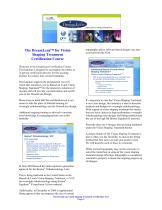
The DreamLens™ for Vision Shaping Treatment Certification Course Welcome to the DreamLens Certification Course. This handout is designed to accompany the online or in-person certification process for this exciting product for contact lens corneal reshaping. This handout supports the presentation you will watch that introduces you to Bausch & Lomb Vision Shaping Treatment™ for the temporary reduction of myopia and will provide you information and certify you on the DreamLens Design. Please keep in mind that this certification test is not meant to take the place of detailed training on overnight...
Open the catalog to page 2
created by the annular tear pool under a steeper second or reverse curve. High Dk Material Boston® Equalens® II – Dk 85* (ISO/Fatt) • Outstanding stability • Excellent wettability • Ideal for overnight wear – Approved for daily wear, extended wear and overnight ortho-k • Red and Yellow Buttons – Convenient differentiation for patients between Right (Red) and Left (yeLLow) lenses The Boston Equalens II material has been available for a number of years in North American and has been FDA approved for extended wear since 1991. It provides a significant amount of oxygen exchange having a Dk of 85...
Open the catalog to page 3
This zone, comprised of one or more curves, is typically 0.6 to 1.0mm wide depending on the design of the shaping lens. Let’s start the DreamLens Certification process. Here are the directions for completing your Answer Sheet. • If you decide to change your answer draw an “X” through the answer you do not want to be counted 3rd Curve = Alignment Curve/Fitting Curve Mark your choice on the answer sheet by completely coloring-in the circle on the answer sheet • Closely aligns peripheral cornea providing a bearing zone • Optimizes shaping lens centration Choose the best answer from among those offered...
Open the catalog to page 4
Beware of those patients with higher amounts of myopia, low corneal eccentricity measurements and flat corneas. Against the rule astigmatism greater than three quarters of a diopter can also be problematic, in that this reshaping process may induce even higher amounts of against the rule astigmatism. These types of patients may not be as well-suited for vision shaping treatment. Also, proceed with caution with previous GP and PMMA lens wearers. These patients should remain out of their lenses until the corneal and refractive measurements have stabilized, often 2 to 4 weeks or more. Patient Selection...
Open the catalog to page 5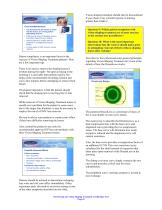
Vision shaping treatment should also be discontinued if you observe any corneal hypoxia or staining greater than Grade 2. Care and Maintenance • It is important for the wearer to check that the lenses are moving before attempting removal. • Instill several drops of rewetting solution just before sleep and upon waking. Question 9: Which patient symptoms with vision shaping treatment are of most concern to the contact lens practitioner? • Instruct patients to contact office for guidance on management of bound lenses. • In some cases, a DMV remover may be required. Question 10: What is the most...
Open the catalog to page 6
In the study approximately 72% of the subject’s myopia was decreased after the first night of wear and after one week the process is mostly complete with a marked reduction in myopia. Double Reverse Curve vs. Tangent Periphery Double reverse curve In this study over 90% of patients did not require a lens change in the first month. Tangent Periphery There are two general types of Ortho-K or shaping lenses on the market today, the double reverse curve and the tangent periphery lenses. • Eyes with –5.00D and less: – 84.8% achieved 20/25 or better – 92.6% achieved 20/30 or better – 95.1% achieved...
Open the catalog to page 7
And finally, the patient should be able to function without thinking about their vision during those daytime hours. Patient Selection • • • • • • Corneal scarring can cause atypical shaping results in the area of the scar. If the scar is in the visual axis unwanted distortion could develop. Age/gender Occupation/personality types Hobbies/lifestyles Rx Eye or general health conditions Past correction history Patient selection is a critically important factor for success with the DreamLens for vision shaping treatment. Along with the spectacle prescription and ocular measurements consider the prospective...
Open the catalog to page 8
redistributed corneal tissue starting to fill in the steeper areas of the cornea. Notice the 90 degree meridian no longer has the welldefined dumbbell pattern and the curvature in this meridian had decreased. Unfortunately, the flat meridian flattened more than the steep meridian resulting in an increase in the amount of cylinder. If the area of steepness was smaller and the amount of flattening greater causing more tissue to be displaced, then the cylinder would have been reduced. Choose patients who have less than 1.50D of with the rule astigmatism and where their amount of cylinder is limited...
Open the catalog to page 9
and the data will be extracted from the topographer and transferred into program for lens calculation. DreamLens Software Importing into DreamLens Software Total Communication by E-mail We have attempted to simplify the ordering process by setting up an electronic email communication mechanism. Here is a flow diagram of how to place an order using the proprietary DreamLens Software. For a normal order the data is sent to the help desk at your DreamLens distributor lab. The help desk will review the record to make sure there are no questions on the order. The lens will be fabricated to the customized...
Open the catalog to page 10
Have the staff instruct insertion and removal. Consider dispensing a DMV to remove the lenses as the DreamLens is larger than a standard GP lens and can be more difficult to remove with traditional removal techniques. Advise the patient to apply a drop of lubrication solution before the lens is inserted to provide a thicker film for the lens to rest on, thus decreasing the chance for lens adhesion. Pressing the confirm button will take you to the order screen shown above where you can ensure that the data inputted is correct. Choose which method you want to use to order the lenses. Use “mail...
Open the catalog to page 11All Bausch + Lomb catalogs and technical brochures
 enVista Aspire™ Toric
2 Pages
 Surgical Product Support
4 Pages
 VICTUS
8 Pages
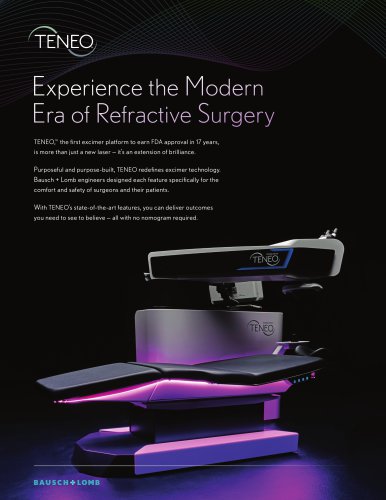 TENEO, ™
6 Pages
 Elevate Your Everyday
16 Pages
Archived catalogs
 Stellaris PC Product Catalog
24 Pages
 Stellaris PC Brochure
4 Pages
 VICTUS Product Overview
16 Pages
 VICTUS Features Brochure
11 Pages
 Cataract surgery catalog
6 Pages
 TECHNICAL SPECIFICATIONS
2 Pages
 VICTUS
12 Pages

- Surgery forceps
- Grasping forceps
- Syringe
- Diode laser
- Bent forceps
- Disposable forceps
- Sterile syringe
- 23G needle
- 10 ml syringe
- 25G needle
- 27G needle
- Removing forceps
- BAUSCH + LOMB intraocular lens
- Ophthalmology forceps
- Ophthalmic laser
- BAUSCH + LOMB monofocal intraocular lens
- Floor-standing laser
- Pre-filled syringe
- Multifocal intraocular lens
- Toric intraocular lens