
- Catalogs
- Bausch + Lomb
- Elevate Your Everyday


Elevate Your Everyday

Elevate Your Everyday
Catalog excerpts

enVista Aspire™ and enVista Aspire™ Toric Intermediate Optimized monofocal lOLs
Open the catalog to page 1
Cataracts are a common condition and for many are a normal part of aging that causes the natural lens of your eye to become cloudy and your vision to become impaired. If you have cataracts, you may have noticed: • Blurry vision • Dull, yellow, or muted colors • Difficulty seeing, even with glasses • Sensitivity to bright lights and glare • Difficulty seeing at night • Distorted vision (astigmatism)
Open the catalog to page 2
Cataract surgery is the most commonly performed surgical procedure in the world1 1 Cataract removal The cloudy lens is removed from the eye. Lens insertion Your surgeon replaces the cataract with an enVista Aspire™ IOL. Vision restored See more clearly than you did before. Before you know it, you’ll be back to enjoying everyday activities with a fresh look on life
Open the catalog to page 3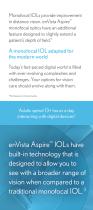
Monofocal IOLs provide improvement in distance vision. enVista Aspire™ monofocal optics have an additional feature designed to slightly extend a patient’s depth of field.* A monofocal IOL adapted for the modern world Today’s fast-paced digital world is filled with ever-evolving complexities and challenges. Your options for vision care should evolve along with them. *Not based on clinical studies. Adults spend 13+ hours a day interacting with digital devices2 enVista Aspire™ IOLs have built-in technology that is designed to allow you to see with a broader range of vision when compared to a traditional...
Open the catalog to page 4
Broader range of vision Mid-range vision Near vision
Open the catalog to page 5
When you have astigmatism, your eye is more oval-shaped than round. As a result, light enters the eye and bends more in one direction than the other, which allows only part of an object to be in focus at one time. With astigmatism, objects may look blurry or distorted. enVista Aspire™ Toric is designed to correct your astigmatism and make objects look less blurry or distorted. • Designed to treat low amounts of astigmatism as well as high amounts of astigmatism.4 • Excellent contrast, which is helpful for lower light conditions.5
Open the catalog to page 6
of cataract patients have a low amount of astigmatism7 • Avoid the need to have other procedures done on your eye during cataract surgery. • Avoid the need for glasses after surgery to correct blurriness caused by astigmatism.8 Trust in enVista Aspire™ Toric to correct your astigmatism. Treating astigmatism is about accuracy. enVista Aspire™ Toric stays stable in your eye so that your vision remains clear.4,6
Open the catalog to page 7
ELEVATE YOUR EVERYDAY VISION WITHOUT ENVISTA ASPIRE™ IOL Simulated images. Built on a trusted and stable platform that has been implanted in over 3 million eyes, the technology in the enVista Aspire™ IOL allows for a broader range of vision than standard monofocal lenses.2
Open the catalog to page 8
ASPIRE FOR CLEAR VISION AGAIN VISION WITHOUT ENVISTA ASPIRE™ TORIC IOL Cataract treatment without astigmatism correction VISION WITH ENVISTA ASPIRE™ TORIC IOL Simulated images. Delivered on a trusted and stable platform that has been implanted in over 500,000 eyes, the enVista Aspire™ Toric IOL provides cataract treatment while also correcting astigmati
Open the catalog to page 9
Dedicated to helpi SEE BETTER TO
Open the catalog to page 10
ing people O LIVE BETTER. Founded in 1853, Bausch + Lomb has over 170 years of eye health experience and has been at the forefront of some of the most significant lens technology advancements in eye health. Talk to your doctor They have been trained on Bausch + Lomb lens technologies, and can explain your lens options considering your current personal vision profile and your vision goals. Your doctor can also explain the risks and benefits, and how to prepare for cataract surgery.
Open the catalog to page 11
FAQs Will I feel anything during surgery? Your surgeon will use a special device to stabilize your eye and keep your eyelids open. It is typical you may experience some slight pressure during the procedure, but you should experience very little to no pain. Ask your doctor about their pain management plan. How long does cataract surgery take? Typical cataract surgery takes between 10-15 minutes. Expect the entire visit to take a few hours. Will I be able to see without glasses? Every patient case, surgery plan, and eye recovery is different, but with the enVista Aspire™ IOLs, you can expect to...
Open the catalog to page 12
How often will I need my eyes checked after surgery? Your doctor will advise you based on your procedure. Patients typically have follow-ups up to 30 days after surgery. Make sure you follow the appropriate recommendations from your doctor for the best outcomes. Does my insurance cover my lens choice? Private insurance carriers as well as Medicare cover the cost of a monofocal lens, including the enVista Aspire™ monofocal IOL. Advanced technology lenses like the enVista Aspire™ Toric IOLs require a patient out-of-pocket cost. Speak with your doctor on available payment plans or other ways you...
Open the catalog to page 13
INDICATIONS: The enVista Aspire™ IOL is indicated for use in patients for visual correction after cataract removal. COMPLICATIONS: Cataract surgery is not completely risk-free. Complications may occur as a result of the removal of your cataract whether or not an intraocular lens is implanted. Complications of cataract surgery range from minor, usually temporary side effects, to sight-threatening complications. Fortunately, significant sight-threatening complications are extremely rare. They include, but are not limited to: infection, hemorrhage, and retinal detachment. People with existing medical...
Open the catalog to page 14
INDICATIONS: The enVista Aspire™ Toric IOL is indicated for use in patients for visual correction, including correction of astigmatism after cataract removal. COMPLICATIONS: Cataract surgery is not completely risk-free. Complications may occur as a result of the removal of your cataract whether or not an intraocular lens is implanted. Complications of cataract surgery range from minor, usually temporary side effects, to sight-threatening complications. Fortunately, significant sight-threatening complications are extremely rare. They include, but are not limited to: infection, hemorrhage, and...
Open the catalog to page 15All Bausch + Lomb catalogs and technical brochures
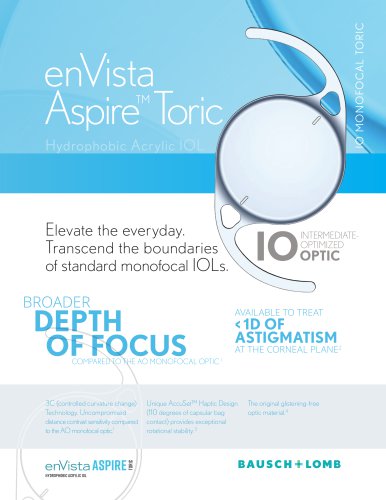 enVista Aspire™ Toric
2 Pages
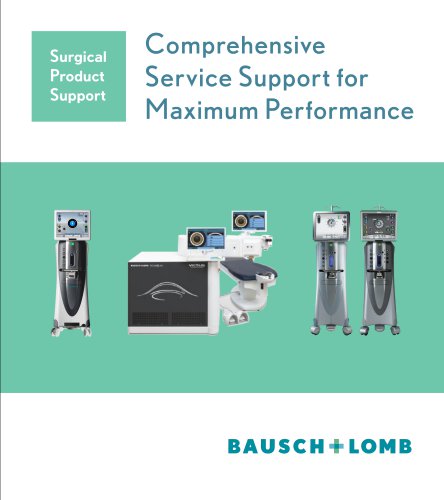 Surgical Product Support
4 Pages
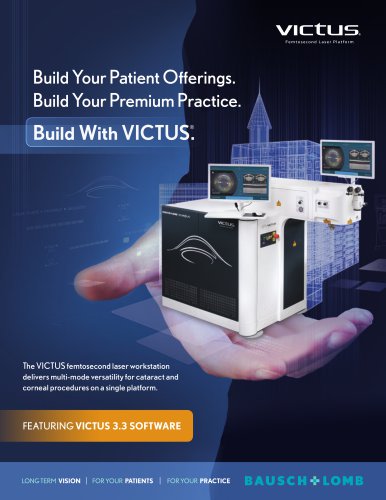 VICTUS
8 Pages
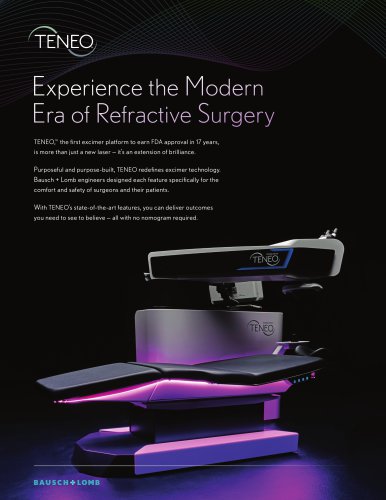 TENEO, ™
6 Pages
Archived catalogs
 DreamLens Test Supplement
15 Pages
 Stellaris PC Product Catalog
24 Pages
 Stellaris PC Brochure
4 Pages
 VICTUS Product Overview
16 Pages
 VICTUS Features Brochure
11 Pages
 Cataract surgery catalog
6 Pages
 TECHNICAL SPECIFICATIONS
2 Pages
 VICTUS
12 Pages

- Surgery forceps
- Grasping forceps
- Syringe
- Diode laser
- Bent forceps
- Disposable forceps
- Sterile syringe
- 23G needle
- 10 ml syringe
- 25G needle
- 27G needle
- Removing forceps
- Ophthalmology forceps
- Ophthalmic laser
- BAUSCH + LOMB monofocal intraocular lens
- Floor-standing laser
- Pre-filled syringe
- Multifocal intraocular lens
- Toric intraocular lens