


Guidelines – The Crown and Bridge Technique
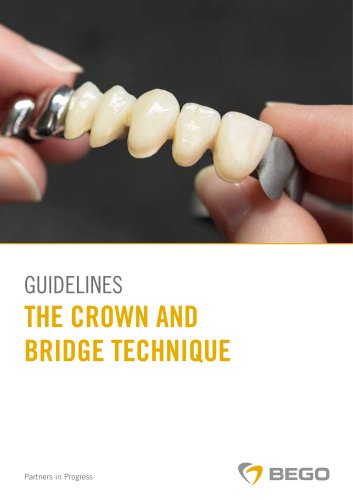
Guidelines – The Crown and Bridge Technique
BEGO has been a leader in dental materials and technology for over 45 years, providing a comprehensive system for fabricating fixed restorations suitable for ceramic veneering. Despite advancements in CAD/CAM technology, traditional dental techniques remain essential, focusing on the safe and systematic application of BEGO products.
BEGO develops non-precious alloys in-house, such as the Wirobond® family, suitable for various processing methods including laser sintering, high-speed cutting, and casting. These alloys are clinically tested and proven, ensuring safety and reliability for dental professionals and patients.
BEGO offers a range of consumables and innovative equipment like the Nautilus® CC plus casting unit, supporting both non-precious and precious-metal alloys, ensuring optimal processing and compatibility with various dental materials.
- Model Making: Begins with creating a precise master model using BegoStone plus plaster, requiring proper cleaning, drying, and mixing techniques for accuracy.
- Coping Fabrication: Copings can be made using spacer foils or wax, with specific steps to ensure proper fit and support for ceramic veneering.
- Sprue System: Proper attachment and positioning of sprues are crucial to avoid cavities and ensure even cooling during casting.
BEGO offers high-strength soldering materials like Wirobond® and Wiron® solder for extensions, with a preference for laser welding to ensure biocompatible connections.
BEGO provides investment materials like Bellavest® SH and Bellavest® DR, offering precise expansion control and reduced dust development, enhancing health protection in dental laboratories.
BEGO's extensive experience in metal-ceramic systems is supported by comprehensive training and support services, ensuring dental professionals can achieve optimal results with their products.
- BellaStar XL: Suitable for crowns and bridges made from precious-metal alloys, using BegoSol® K as the liquid.
- Bellavest® T: Suitable for all crown and bridge alloys, with BegoSol® as the liquid. BegoSol® HE can be used for greater expansion.
- Bellasun: Offers a long working time at high ambient temperatures, using BegoSol® as the liquid.
- Maintain ideal material and room temperatures to ensure proper setting and surface quality.
- Follow specified mixing ratios and concentrations to control expansion and hardness.
- Store materials in dry, dark, and cool conditions to prevent degradation.
- Preheating temperatures vary based on the alloy and casting unit used, with specific instructions for shock-heating and conventional heating methods.
- Detailed procedures for using vacuum pressure casting and centrifugal casting machines like Nautilus® and Fornax® are provided, highlighting the importance of precise temperature control and timing.
1. Vacuum Pressure and Centrifugal Casting: For Wiron® 99 and Wirocer plus, continue heating for 0-12 seconds after the last solid constituent is immersed, then initiate casting. For Wiron® light, continue heating for 0-10 seconds and initiate casting when the oxide film is torn.
2. Centrifugal Flame Casting: Use a propane/oxygen flame with specific pressure settings. Preheat the ceramic crucible and heat the metal until it glows bright red. Continue heating until the metal merges under a joint oxide film.
Cooling and Deflasking:
Allow moulds to cool slowly and avoid quenching in water. Place cooled moulds in water to moisten before deflasking. Use Korox® 110/250 for blasting and ensure careful handling to avoid damaging crown margins.
Surface Finishing and Pretreatment:
Use diamond grinding stones or carbide cutters for finishing. Blasting with Korox® 250 is necessary before veneering. Avoid using rubber polishers on surfaces to be veneered.
Dental Ceramics Processing:
Use metal-to-ceramics and press-to-metal ceramics as per ISO 9693-1. Ensure proper application and firing of the matrix for a reliable bond. Blasting with Korox® 250 at 3-4 bar is recommended for optimal retention.
Cooling After Dentine Firing:
Normal cooling is recommended for most alloys, with prolonged cooling suggested for Wirobond® C.
Jointing Technology:
Laser welding is preferred for its high strength and biocompatibility. Ensure proper argon coverage during welding to avoid discoloration and cracks.
Friction Elements:
WiroFix elements facilitate friction adjustment in non-precious constructions, offering strong retentive force and easy processing.
Important Recommendations:
Follow ceramic manufacturers' instructions for firing and ensure thorough cleaning before each firing. Avoid using compressed air for drying frames to prevent contamination.
Catalog excerpts
Partners in Progress ^7 BEGO
Open the catalog to page 1
Achieving success with the BEGO System – What does this mean for you? For over 45 years BEGO has offered a coordinated system of materials, alloys and equipment, as well as training courses on the fabric ation of fixed restorations suitable for veneering with ceramics. Although the traditional skill of the dental technician has undergone major changes following the introduction of CAD/CAM technology in recent years, the key steps of the work process have retained their importance. Our top priority here is safe usage and further processing by dental technicians. As an innovative dental company...
Open the catalog to page 2
Frame production and ceramic veneering Preventive error management 36
Open the catalog to page 3
Dental processing Images and illustrations are examples. Colors, symbols, designs and information on the depicted labels and/or packaging may differ from reality.
Open the catalog to page 4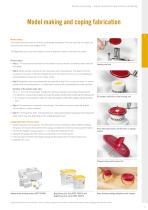
Dental processing – Frame production and ceramic veneering Model making and coping fabrication 1 Model making The model forms the basis for all work at the dental laboratory! The more carefully it is made, the more precisely crowns and bridges will fit. The BegoStone plus super-hard plaster is used to make the master model/saw-cut model. Process steps • Step 1: The impressions received from the dentist must be cleaned, disinfected and rinsed out with water. • Step 2: Before casting, carefully dry the impression with compressed air. Any water left on the impression may result in different strength...
Open the catalog to page 5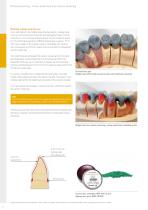
Dental processing – Frame production and ceramic veneering Modelling: Copings made from wax As an alternative to the Adapta deep drawing system, copings made from wax can be produced using the wax dipping technique. For the cement line, it is necessary to apply spacer varnish instead of spacer foil. The working temperature of BEGO dipping wax is approx. 75 °C. The crown margin of the dipped coping is completed with cervical wax. During wax-up sufficient space must be provided for subsequent ceramic veneering. The metal frame should support the ceramic veneering from the inside and ideally have...
Open the catalog to page 6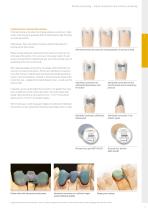
Dental processing – Frame production and ceramic veneering Compensating for missing tooth substance If the tooth stump is too small, the missing substance is built up in metal as this is the only way to guarantee that the frame/ceramic layer thickness is as even as possible. Alternatively, there is the option of already carefully blocking out or building up the tooth stump. If the tooth stump is too small, the missing substance is built up in metal Where missing substance requires the tooth stump to be built up, this is the task of the dentist. If it is built up on the master model, this will...
Open the catalog to page 7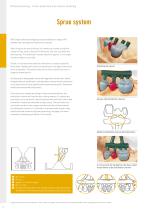
Dental processing – Frame production and ceramic veneering Sprue system 1 With single crowns and bridges sprues are waxed at an angle of 45° between the cast object and distribution channel. After fitting on the mould former, the crowns are located outside the centre of heat, close to the wall of the mould, and can cool down first after casting. The distribution channel should be approx. 2 mm longer than the bridge on each side. Overall, it must be ensured that the restoration is located outside the heat centre. Slender parts should be positioned at the edge of the mould as far as possible. This...
Open the catalog to page 8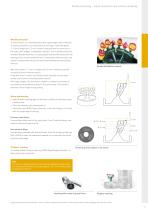
Dental processing – Frame production and ceramic veneering 1 Attaching the sprues To avoid cavities, it is recommended to also supply single crowns indirectly. The sprues should be 4 mm wide and must not taper. A wax wire approx. 2–3 mm in length and 2.5 mm in width is required here for connection to the crown. With bridges, a distribution channel 5 mm in diameter should be provided. Besides wax wires, it is also possible to use hollow sticks with side openings which can be closed with wax. If solid plastic sticks are used, they should be covered with wax as the mould may otherwise tear during...
Open the catalog to page 9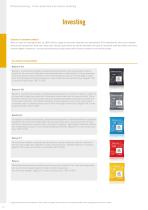
Dental processing – Frame production and ceramic veneering Investing 1 Selection of investment material When it comes to investing the wax-up, BEGO offers a range of investment materials such as Bellavest ® SH or BellaStar XL which are innovative and have also proved their worth over many years. Mixing liquids which are exactly matched to the type of investment material reliably control the required degree of expansion, so ensuring outstanding casting results with all precious-metal or non-precious alloys. Our product recommendation Bellavest® SH Rapidly or conventionally heatable, phosphate-bonded...
Open the catalog to page 10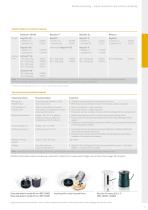
Bellavest®SH / DR Bellavest® T BellaStar XL Bellasun Detailed information about processing investment materials for crowns and bridges can be found from page 36 forwards. Images and illustrations are examples; colours, symbols, designs and information on the depicted labels and/or packaging may differ from reality.
Open the catalog to page 11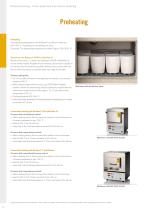
Dental processing - Frame production and ceramic veneering Preheating The preheating temperatures for Wirobond® and Wiron® alloys are 850-950 °C, depending on the casting unit used. Exception: The preheating temperature for Wiron® light is 780-830 °C! Moulds in the sizes 1-6 made from Bellavest® SH/DR or BellaStar XL can be heated rapidly. Roughen mould surfaces, place moulds upright in the furnace (funnel former facing down) without direct contact with the floor or walls (use spacer or ceramic plate, see image to the right). • 20-30 min after the start of mixing place the moulds in the furnace...
Open the catalog to page 12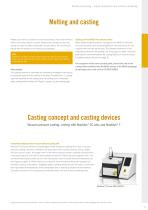
Dental processing – Frame production and ceramic veneering Melting and casting 1 Always use ceramic crucibles for non-precious alloys. Never melt different alloys in the same ceramic crucible. Always mark crucibles so that they cannot be mixed up. When casting with an open flame, the crucibles are placed with the moulds in the furnace and preheated. Note Graphite crucibles or inserts should never be used for non-precious alloys: Do not overheat alloy when melting, keep to specified casting times without fail! Alloy quantity The quantity required is calculated by multiplying the weight of the...
Open the catalog to page 13All BEGO catalogs and technical brochures
 BEGO CAD/CAM Product Catalogue
31 Pages
 The BEGO Wax and Modelling Range
28 Pages
 BEGO CAD/CAM Product Catalogue
31 Pages
 Catalogue – Dental Technology
116 Pages
- Dental restoration material
- Dental surgery instrument kit
- Dental implant
- Titanium dental implant
- Resin dental material
- Dental prosthesis dental material
- Modeling dental material
- Conical dental implant
- Dental crown material
- Biocompatible dental material
- Dental bridge material
- Dental implant surgery instrument kit
- Dental laboratory dental material
- Ceramic dental material
- Liquid dental material
- Composite dental material
- Internal dental implant
- Translucent dental material
- Impression tray dental material