
- Catalogs
- Beijing Succeeder Technology Inc.
- Coagulation Reagents - PT APTT FIB TT D-Dimer


Coagulation Reagents - PT APTT FIB TT D-Dimer

Coagulation Reagents - PT APTT FIB TT D-Dimer
Document Overview:
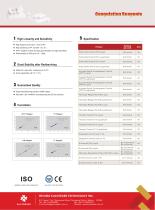
This technical document appears to relate to reagents used for coagulation testing, specifically for Thrombin Time (TT), Fibrinogen (FIB), Prothrombin Time (PT), and Activated Partial Thromboplastin Time (APTT). It includes references to quality certifications and presents calibration or validation data for these reagents.
1. Quality Standards and Certifications
- The reagents comply with ISO9001:2000 and ISO13485:2003 standards, indicating adherence to quality management systems for medical devices.
- Certification number referenced: Q1N 11 02 76148 001.
2. Reagent Types and Purpose
- TT Reagent: Used to measure Thrombin Time, assessing the conversion of fibrinogen to fibrin.
- FIB Reagent: Used for quantifying fibrinogen levels in plasma.
- PT Reagent: Used to determine Prothrombin Time, evaluating the extrinsic coagulation pathway.
- APTT Reagent: Used for Activated Partial Thromboplastin Time, assessing the intrinsic coagulation pathway.
3. Calibration and Validation Data
The document includes graphical data with regression equations and correlation coefficients (R²) for each reagent, indicating strong linear relationships and good assay performance:
- TT Reagent: Regression equation y = 1.0307x - 0.4432, R² = 0.9835, sample size N=70.
- FIB Reagent: Regression equation y = 1.0708x - 0.2305, R² = 0.9901, sample size N=57.
- PT Reagent: Regression equation y = 1.0313x - 0.1211, R² = 0.9839, sample size N=123.
- APTT Reagent: Regression equation y = 0.981x + 1.2778, R² = 0.9732, sample size N=99.
These data suggest high accuracy and reproducibility of the reagents in measuring coagulation parameters.
4. Key Parameters and Performance Indicators
- High correlation coefficients (R² > 0.97) indicate reliable assay linearity.
- Sample sizes range from 57 to 123, supporting statistical validity.
- Regression slopes close to 1 and small intercepts indicate minimal systematic bias.
5. Recommendations and Usage Notes
While explicit procedural instructions are not detailed, the presence of calibration data implies the reagents are validated for clinical or laboratory use in hemostasis testing. Users should ensure compliance with ISO standards and verify reagent performance against these benchmarks.
Catalog excerpts
APTT Reagent
Open the catalog to page 2All Beijing Succeeder Technology Inc. catalogs and technical brochures
 ESR Analyzer SD-1000
2 Pages
 ESR Analyzer SD-100
2 Pages


- Solvent reagent
- Molecular biology reagent
- Laboratory reagent
- Diagnostic reagent
- Protein reagent
- Buffer solution reagent
- Medium reagent
- Quality control reagent
- PCR reagent
- Blood sample reagent
- Freeze-dried reagent kit
- Magnetic bead-based reagent
- Assayed reagent
- High-sensitivity reagent
- Colorimetric reagent
- Hematology reagent
- Human-based reagent
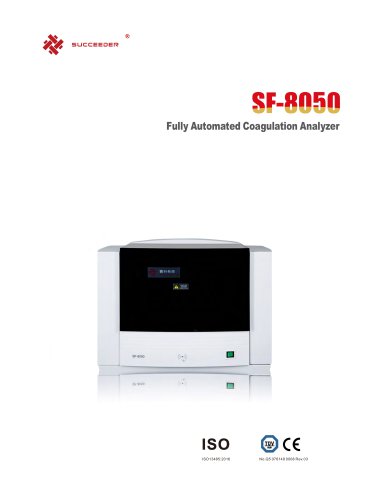
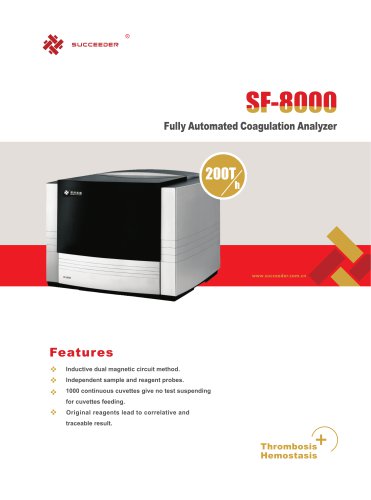
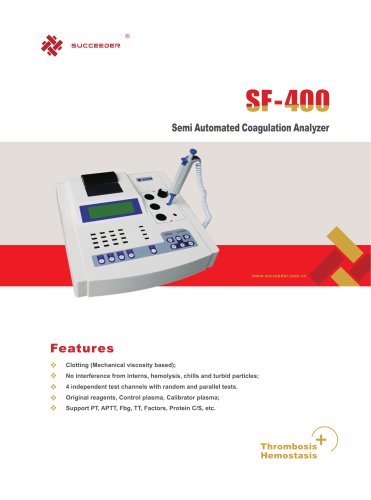
- SUCCEEDER coagulation analyzer
- Plasma reagent
- Benchtop coagulometer