
- Catalogs
- Berthold Technologies Bioanalytics
- NightOWL II LB 983 NC 100

NightOWL II LB 983 NC 100

NightOWL II LB 983 NC 100
The NightOWL II LB 983 NC 100 is an advanced molecular optical imaging system designed for bioluminescence and biofluorescence imaging. These techniques are essential for monitoring gene expression in living organisms, aiding in understanding disease mechanisms and developing new treatments.
The system features a back-illuminated CCD camera with a midband coating, enhancing quantum efficiency up to 90% in the 500-660 nm spectral range, ideal for detecting firefly luciferase and GFP derivatives. The camera is designed for high sensitivity and low noise, with efficient cooling to minimize light detection interference.
The NightOWL II uses a full-frame CCD camera, projecting images onto a parallel array, quantized into pixels, and read out serially. This setup ensures reliable image quantification, crucial for comparative research. The camera's resolution is influenced by its focal length and working distance, with macro and digital zoom options for enhanced magnification.
The cabinet is light-tight to prevent ambient light interference and includes a motor-driven camera for optimal resolution and focus, adaptable for various sample sizes. It supports accessories like gas anesthesia units and fluorescence reflectance imaging tools.
The system is versatile, supporting applications in infectious disease research, dermatology, material science, and more. It accommodates different imaging conditions, such as gas anesthesia for animals and controlled environments for plants.
FRI requires specific illumination devices and filters to excite and measure fluorescence. The system supports a wide range of filters and is optimized for near-infrared fluorescence, which penetrates deeper into tissues.
The indiGOTM software provides comprehensive control over the imaging system, offering tools for image processing and analysis. It supports quantitative analysis, image enhancement, and data export, with options for remote control and integration with other software packages.
The NightOWL II LB 983 NC 100 is a highly advanced imaging system offering superior performance in molecular optical imaging. Its design and features make it suitable for a wide range of research applications, providing researchers with the tools needed for detailed and accurate imaging.
The document provides detailed information about various imaging technologies and equipment, focusing on the NightOWL II LB 983 NC 100. It covers specifications, applications, and technical details.
The document mentions the integration of various imaging technologies such as MRI, PET, SPECT, X-ray CT, and the development of software to fuse these 3D imaging data with 2D BLI and FRI data. BERTHOLD TECHNOLOGIES is working on solutions to integrate these imaging modalities.
The NightOWL II LB 983 NC 100 is used for imaging whole animals, plants, blots, gels, microplates, and cell cultures. It is capable of detecting weak light signals with high quantum efficiency and low noise levels, making it suitable for long exposure times. Applications include in-vivo visualization of gene expression, bacterial growth, skin diseases, and more.
The NightOWL II LB 983 NC 100 features a back-illuminated CCD camera with a resolution of 1024 x 1024 pixels, quantum efficiency of 90% at 620 nm, and sensitivity from 300 to 1050 nm. It offers a dynamic range of 90 dB and cooling capabilities to -80°C to -90°C. The device supports variable pixel binning, multiple filters, and automated camera positioning.
The device complies with CE and EN regulations. It requires a stable laboratory environment with specific power supply, temperature, and humidity conditions. The PC requirements include a Pentium processor, CD ROM drive, and various ports for connectivity.
The document provides order details for the NightOWL II LB 983 NC 100, including the complete package with software and additional accessories available through separate brochures.
Catalog excerpts
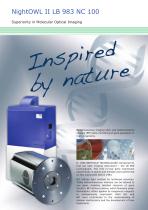
NightOWL II LB 983 NC 100 Superiority in Molecular Optical Imaging red pi ns I re tu na by Bioluminescence imaging (BLI) and biofluorescence imaging (BFI) allow monitoring of gene expression in living organisms. In 1989 BERTHOLD TECHNOLOGIES introduced its first low light imaging instrument – the LB 980 Luminograph. The first in-vivo gene expression experiments in plants and animals were performed on this instrument before 1993. BLI utilizes light emitted by luciferase enzymes. Today bioluminescence markers can be tailored to any gene, enabling detailed research of gene function. BFI utilizes...
Open the catalog to page 2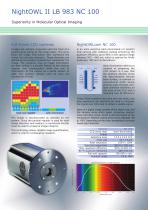
NightOWL II LB 983 NC 100 Superiority in Molecular Optical Imaging Images are optically projected onto the front of a parallel array acting as the image plane. The array takes the image information and partitions the image into discrete elements. Those elements are defined by the number of pixels thus "quantizing" the image. The resulting rows of image information are then shifted in a parallel fashion to the readout register that subsequently shifts the row of information to the output as a serial stream of data. The process repeats until all rows are transferred off chip. is an ultra sensitive...
Open the catalog to page 4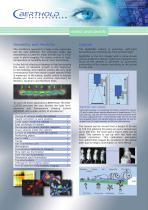
The conditions required to image living organisms can be very different. For example, today gas anaesthesia is used for small animals but is never used in plant imaging. For plants control of light, temperature or humidity are of more importance. The NightOWL cabinet is extremely light-tight preventing any interferences from ambient light. In the field of infectious diseases or food processing the study of bacterial growth is the objective. In dermatology and material science the very faint luminescence from free radical oxygen species (ROS) is measured. In life science, quality control or forensic...
Open the catalog to page 5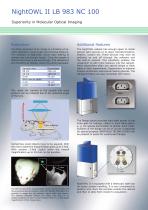
NightOWL II LB 983 NC 100 Superiority in Molecular Optical Imaging Additional features The total resolution of an image is a function of camera resolution, focal length and working distance. The software of NightOWL allows easy setting of sample size and sample height. Once the sample is defined the focus is set accordingly. The resolutions are therefore as follows, shown by some examples: The NightOWL cabinet has enough space to install special light sources or to place transilluminators, heaters, coolers etc. These devices may even be switched on and off through the software and the built-in...
Open the catalog to page 6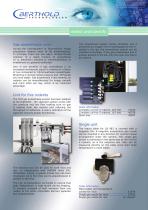
Gas anaesthesia units During the luminescence or fluorescence image acquisition rodents have to be anaesthesized. In principle, there are two ways: intraperitoneal injection of a liquid mixture of anaesthesia (e. g. ketamine / xylazine or tribromoethanol) or anaesthesia by gaseous isoflurane. The anaesthesia system comes complete, but if pressured air, oxygen line or scavenging line are installed in the lab, the anaesthesia system can be modified accordingly. If any gas anaesthesia unit is already present in the lab, only the inner tray has to be ordered. One of the benefits of gas anaesthesia...
Open the catalog to page 7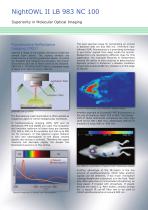
NightOWL II LB 983 NC 100 Superiority in Molecular Optical Imaging Fluorescence Reflectance Imaging (FRI)* requires a range of illumination devices to excite the sample from above. The signals emitted are measured by a camera positioned above. To excite the fluophor and measure its emission, the proper illumination and set of filters have to be choosen. BERTHOLD TECHNOLOGIES offers a complete range of filters from 340 nm up to 1100 nm. The best spectral range for penetrating an animal is between 600 nm and 900 nm. Therefore near infrared (NIR) fluorescence is a promising technique to get better...
Open the catalog to page 8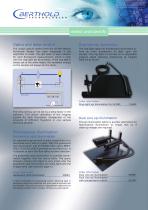
Optics and lamp control The unique optical system from the LB 940 Mithras Multimode Reader has been integrated in the NightOWL II model. The light beam is kept constant for each fluorescent measurement, which is ideal with the ring-light epi illumination. If the ring-light is always set at the same height, the excitation energy on the sample will always be the same. The ring-light option for fluorescence illumination allows an even distribution of light upon the sample. The ring-light is mounted on an adjustable support stand allowing positioning at heights from 14 to 16 cm. Order information...
Open the catalog to page 9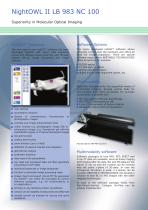
NightOWL II LB 983 NC 100 Superiority in Molecular Optical Imaging Software Options The new easy-to-use indiGO software has been developed together with users. Well organized menus and dialogue boxes guide the user through camera set-up, image processing and image analysis. The newly developed indiGOTM software allows complete control over the hardware and offers all tools for image evaluation. There are special software needs which BERTHOLD TECHNOLOGIES offers as options, for example DICOM option 21 CRF part 11 option animal alignment option digital mouse atlas alignment option, etc. Multimodality...
Open the catalog to page 10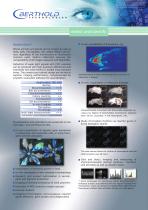
In-vivo visualization of fluorophors, e.g. Whole animals and plants can be imaged as well as blots, gels, microplates, cell culture dishes and arrays regardless of the luminescent or fluorescent markers used. Optical calibration ensures the comparability of all images captured with NightOWL. Detection of weak light signals with CCD cameras can be achieved with high quantum efficiencies and extremely low noise levels to enable long exposure times. The camera and cabinet design are the key to superior imaging performance, complemented by scientific evaluation software for quantification. Application...
Open the catalog to page 11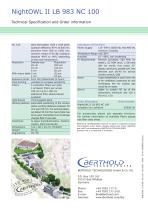
NightOWL II LB 983 NC 100 Technical Specification and Order information back illuminated, 1024 x 1024 pixel, quantum efficiency 90 % at 620 nm, sensitive from 300 to 1050 nm, dynamic range of 90 dB, cooling to absolute -80°C to -90°C depending on the room temperature. Resolution Sample size Resolution 20 cm 200 µm 10 cm 100 µm 5 cm 50 µm With macro table 2 cm 20 µm 1 cm 10 µm Exposure times from 30 milliseconds to hours Pixel binning variable to increase sensitivity Filters 4 excitation filters per slide 4 emission filters per wheel 340 nm up to 1100 nm additional filter slides/wheels available...
Open the catalog to page 12All Berthold Technologies Bioanalytics catalogs and technical brochures
 HERM LB 500
6 Pages
 FLOWSTAR² LB 514
16 Pages
 Lumat Tube Luminometer
4 Pages
 Sirius 2
4 Pages
 Zoom HT
8 Pages
 centro LB 963
4 Pages
 TRISTAR 3,TRISTAR 5
7 Pages
 Apollo Absorbance Reader
5 Pages


- Spectrophotometer
- Microplate reader
- UV-visible spectrophotometer
- Absorbance microplate reader
- 96-well microplate reader
- Immunoassay microplate reader
- ELISA microplate reader
- Microplate washer
- Automatic microplate washer
- Preclinical imaging system
- Chromatography detector
- Laboratory microplate washer
- ELISA workstation
- Automatic ELISA workstation
- ELISA test microplate washer
- Research spectrophotometer
- Molecular biology microplate reader
- Medical research preclinical imaging system
- Benchtop ELISA workstation
- Fluorescence microplate reader