


Comparison of the Diaton Transpalpebral Tonometer Versus Goldmann Applanation

Comparison of the Diaton Transpalpebral Tonometer Versus Goldmann Applanation
Background: The study focuses on Diaton tonometry, a unique method for measuring intraocular pressure (IOP) through the eyelid. This non-contact, pen-like, hand-held, and portable tonometer does not require anesthesia or sterilization.
Purpose: The research aims to compare the IOP measurements obtained using the Diaton transpalpebral tonometer with those from the Goldmann applanation method in adult patients undergoing routine eye exams.
Methods: A retrospective chart review was conducted on 64 eyes from 32 patients aged 34-91 years. IOP measurements were taken using both the Diaton tonometer and Goldmann applanation. The results were analyzed using analysis of variance (ANOVA) where applicable.
Results: The mean IOP was 15.09 +/-4.31 mm Hg for the Goldmann group and 15.70 +/-4.33 mm Hg for the Diaton group, with a p-value of 0.43. The mean IOP variation between the groups was 1.74 +/-1.42 mm Hg, ranging from 0 to 8 mm Hg. Notably, 83% of all measurements were within 2 mm Hg of each other.
Conclusions: The Diaton tonometer's transpalpebral method for measuring IOP shows good correlation with the Goldmann applanation method. The Diaton tonometer may be a clinically useful device for routine eye exams.
Catalog excerpts
Comparison of the Diaton Transpalpebral Tonometer Versus Goldmann Applanation R. S. Davidson1; N. Faberowski2; R. J. Noecker3; M. Y. Kahook1 1. Ophthalmology, Rocky Mountain Lions Eye Institute, Aurora, CO, USA. 2. Ophthalmology, Denver Health Medical Center, Denver, CO, USA. 3. Ophthalmology, UPMC, Pittsburgh, PA, USA.
Open the catalog to page 1
Financial Disclosure The authors have no financial interest in the subject matter being presented
Open the catalog to page 2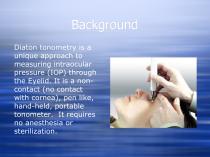
Background Diaton tonometry is a unique approach to measuring intraocular pressure (IOP) through the Eyelid. It is a noncontact (no contact with cornea), pen like, hand-held, portable tonometer. It requires no anesthesia or sterilization.
Open the catalog to page 3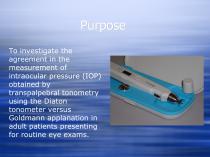
Purpose To investigate the agreement in the measurement of intraocular pressure (IOP) obtained by transpalpebral tonometry using the Diaton tonometer versus Goldmann applanation in adult patients presenting for routine eye exams.
Open the catalog to page 4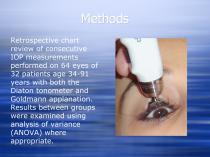
Methods Retrospective chart review of consecutive IOP measurements performed on 64 eyes of 32 patients age 34-91 years with both the Diaton tonometer and Goldmann applanation. Results between groups were examined using analysis of variance (ANOVA) where appropriate.
Open the catalog to page 5
Results Mean IOP was 15.09 +/-4.31 mm Hg in the Goldmann group and 15.70 +/-4.33 mm Hg in the Diaton group (p=0.43). Mean IOP variation between groups was 1.74 +/1.42 mm Hg (range 0-8). 83% of all measurements were within 2 mm Hg of each other.
Open the catalog to page 6
The transpalpebral method of measuring IOP with the Diaton tonometer correlates well with Goldmann applanation. Diaton applanation may be a clinically useful device for measuring IOP in routine eye exams.
Open the catalog to page 7
