
- Catalogs
- Bioceramed
- Bone Grafts – Portfolio

Bone Grafts – Portfolio

Bone Grafts – Portfolio
Neocement® - Bone Cement with Chitosan
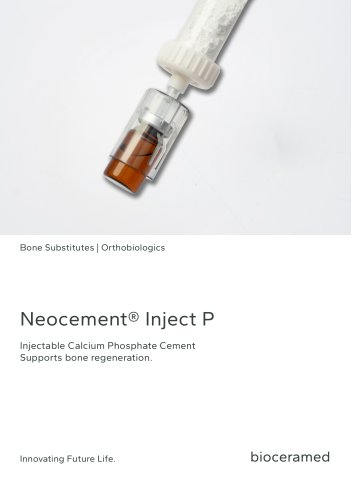
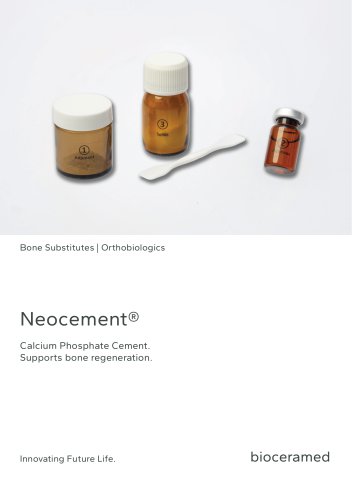
Neocement® is a calcium phosphate cement with chitosan, offering antimicrobial protection and stable integration with natural bone. It is available in two formats: a manual preparation moldable paste and an injectable pre-filled syringe for minimally invasive procedures. Both formats harden within 8–12 minutes, forming hydroxyapatite to support stable bone regeneration. Indications include fractures with bone loss, cavity filling, and arthrodesis.
Clinical Cases
Case studies demonstrate successful outcomes in bone regeneration and stability post-surgery, with Neocement® aiding in preventing articular collapse and promoting new bone formation.
n-IBS® - Injectable Hydroxyapatite Paste
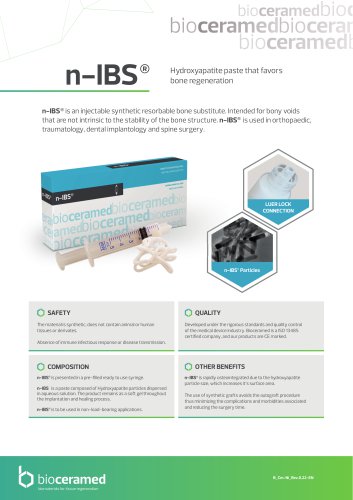
n-IBS® is a fully resorbing paste within approximately 6 months, acting as a scaffold for vascularization and new bone formation. It is osteoconductive, injectable, and radiopaque. Indications include fractures, cavity filling, and spinal applications.
Neobone® - Synthetic Bone Graft
Neobone® is composed of 75% hydroxyapatite and 25% β-TCP, designed for long-term bone regeneration. It ensures biocompatibility, osteoconductivity, and stable integration with natural bone. It resorbs within 6–24 months and supports vascularization and cellular migration.
TriOSS® - Synthetic Bone Graft
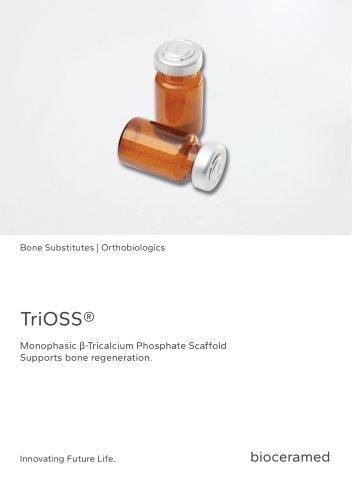
TriOSS® is composed of 100% β-TCP, designed for rapid resorption and natural bone remodeling. Its highly porous structure promotes vascularization and osteoconduction. Indications include fractures, cavity filling, and spinal applications.
Clinical Evidence and Applications
Clinical cases highlight the effectiveness of Neobone® and TriOSS® in achieving complete bone consolidation and maintaining proper alignment post-surgery. These products are used in various orthopedic, dental, and spinal applications.
Conclusion
Bioceramed's orthobiologics portfolio offers innovative solutions for bone regeneration and stability, improving patient outcomes through evidence-based products.
Catalog excerpts

Innovating future life. OrthobiologicsPortfolio bioceramed
Open the catalog to page 1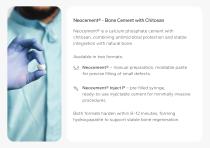
Neocement® - Bone Cement with Chitosan Neocement® is a calcium phosphate cement with chitosan, combining antimicrobial protection and stable integration with natural bone. Available in two formats: Neocement® – manual preparation, moldable paste for precise filling of small defects. Neocement® Inject P – pre-filled syringe, ready-to-use injectable cement for minimally invasive procedures. Both formats harden within 8–12 minutes, forming hydroxyapatite to support stable bone re
Open the catalog to page 2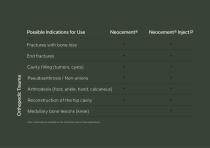
Fractures with bone loss End fractures Orthopedic Trauma Cavity filling (tumors, cysts) Pseudoarthrosis / Non-unions Arthrodesis (foot, ankle, hand, calcaneus) Reconstruction of the hip cavity Medullary bone lesions (knee) Note: similar devices available on the market are used in these applications. Neocement® Inject
Open the catalog to page 3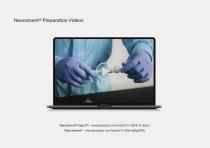
Neocement® Preparation Videos Neocement® Inject P - www.youtube.com/watch?v=2BhF-tLd2pU Neocement® - www.youtube.com/watch?v=5Gmuj6gA9Kc
Open the catalog to page 4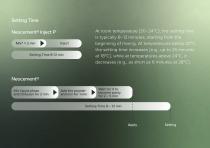
Setting Time At room temperature (20–24°C), the setting time is typically 8–12 minutes, starting from the beginning of mixing. At temperatures below 20°C, the setting time increases (e.g., up to 25 minutes at 18°C), while at temperatures above 24°C, it decreases (e.g., as short as 6 minutes at 28°C). Neocement® Mix liquid phase and chitosan for 2 min Wait for it to become pasty for 2 – 5 min
Open the catalog to page 5
Chitosan and calcium phosphate based cement
Open the catalog to page 6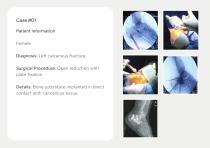
Case #01 Patient information Female Diagnosis: Left calcaneus fracture Surgical Procedure: Open reduction with plate fixation Details: Bone substitute implanted in direct contact with cancellous tissue.
Open the catalog to page 7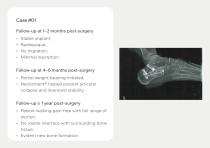
• Stable implant; • Minimal resorption. • Partial weight-bearing initiated; • Neocement® helped prevent articular collapse and improved stability. • Patient walking pain-free with full range of motion; • No visible interface with surrounding bone tissue; • Evident new bone formation.
Open the catalog to page 8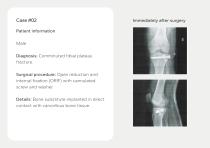
Case #02 Patient information Male Diagnosis: Comminuted tibial plateau fracture. Surgical procedure: Open reduction and internal fixation (ORIF) with cannulated screw and washer. Details: Bone substitute implanted in direct contact with cancellous bone tissue. Immediately after surgery
Open the catalog to page 9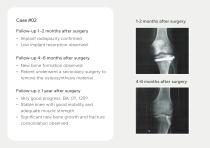
• Implant radiopacity confirmed. • Low implant resorption observed. • New bone formation observed. • Patient underwent a secondary surgery to remove the osteosynthesis material. • Very good progress. BA: 0°, 125°. • Stable knee with good mobility and adequate muscle strength. • Significant new bone growth and fracture consolidation observed.
Open the catalog to page 10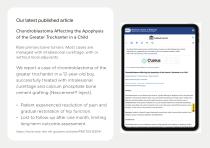
Chondroblastoma Affecting the Apophysis of the Greater Trochanter in a Child Rare primary bone tumors. Most cases are managed with intralesional curettage, with or without local adjuvants. We report a case of chondroblastoma of the greater trochanter in a 12-year-old boy, successfully treated with intralesional curettage and calcium phosphate bone cement grafting (Neocement® Inject). • Patient experienced resolution of pain and gradual restoration of hip function. • Lost to follow-up after one month, limiting long-term outcome assessment.
Open the catalog to page 11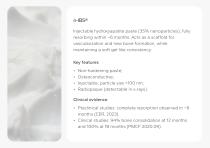
Injectable hydroxyapatite paste (35% nanoparticles), fully resorbing within ~6 months. Acts as a scaffold for vascularization and new bone formation, while maintaining a soft gel-like consistency • Non-hardening paste; • Injectable, particle size <100 nm; • Radiopaque (detectable in x-rays). • Preclinical studies: complete resorption observed in ~6 months (CER, 2023). • Clinical studies: 94% bone consolidation at 12 months and 100% at 18 months (PMCF 2020.09).
Open the catalog to page 12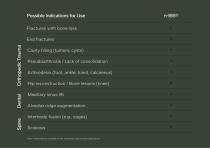
Possible Indications for Use Fractures with bone loss Orthopedic Trauma End fractures Cavity filling (tumors, cysts) Pseudoarthrosis / Lack of consolidation Arthrodesis (foot, ankle, hand, calcaneus) Hip reconstruction / Bone lesions (knee) Maxillary sinus lift Alveolar ridge augmentation Interbody fusion (e.g., cages) Scoliosis Note: similar devices available on the market are used in these applications.
Open the catalog to page 13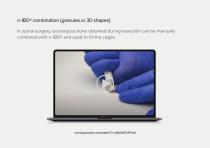
n-IBS® combination (granules or 3D shapes) In spinal surgery, autologous bone obtained during resection can be manually combined with n-IBS® and used to fill the cages.
Open the catalog to page 14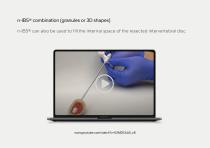
n-IBS® combination (granules or 3D shapes) n-IBS® can also be used to fill the internal space of the resected intervertebral disc.
Open the catalog to page 15
Non-hardening paste
Open the catalog to page 16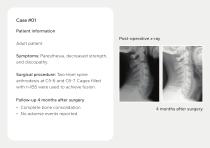
Patient information Adult patient Symptoms: Paresthesia, decreased strength, and discopathy. Surgical procedure: Two-level spine arthrodesis at C5-6 and C6-7. Cages filled with n-IBS were used to achieve fusion. Follow-up 4 months after surgery • Complete bone consolidation. • No adverse events reported.
Open the catalog to page 17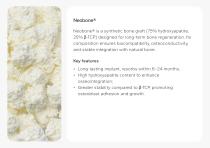
Neobone® is a synthetic bone graft (75% hydroxyapatite, 25% (3-TCP) designed for long-term bone regeneration. Its composition ensures biocompatibility, osteoconductivity, and stable integration with natural bone. • High hydroxyapatite content to enhance osseointegration; • Greater stability compared to p-TCR promoting osteoblast adhesion and growth.
Open the catalog to page 18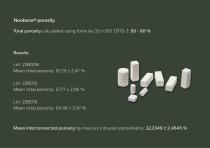
Neobone® porosity Total porosity calculated using formula (3) in ISO 13175-3: 50 - 60 % Results Lot: 22B008 Mean total porosity: 52,75 ± 2,47 % Lot: 22B012 Mean total porosity: 57,77 ± 2,06 % Lot: 22B015 Mean total porosity: 54,46 ± 2,47 % Mean interconnected porosity by mercury intrusion porosimetry: 22,2349 ± 2,4645
Open the catalog to page 19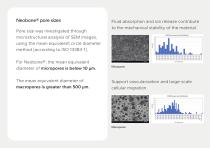
Neobone® pore sizes Pore size was investigated through microstructural analysis of SEM images, using the mean equivalent circle diameter method (according to ISO 13383-1). For Neobone®, the mean equivalent diameter of micropores is below 10 µm. The mean equivalent diameter of macropores is greater than 500 µm. Fluid absorption and ion release contribute to the mechanical stability of the material. Support vascularization and large-scale cellular migration.
Open the catalog to page 20All Bioceramed catalogs and technical brochures
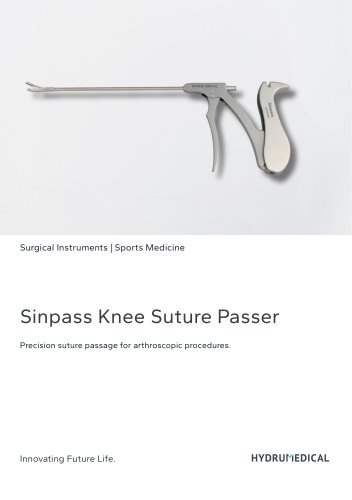 Sinpass Knee Suture Passer
4 Pages
 Knot Pusher Suture Cutter
4 Pages
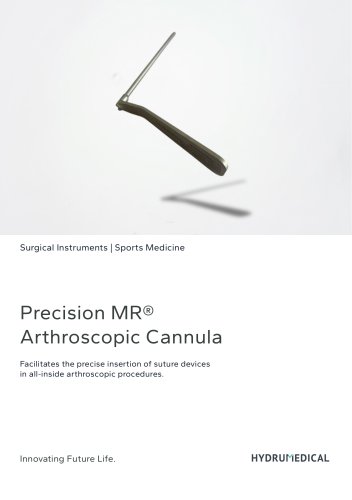 Arthroscopic access cannula
4 Pages
 SimplySilk®
4 Pages
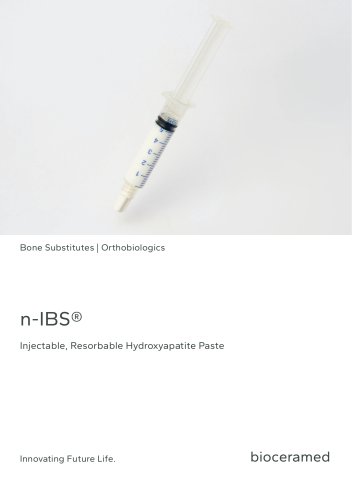 n-IBS®
4 Pages
 Neocement® Inject P
4 Pages
 Neocement®
4 Pages
 TriOSS®
4 Pages
 Precision MR®
4 Pages
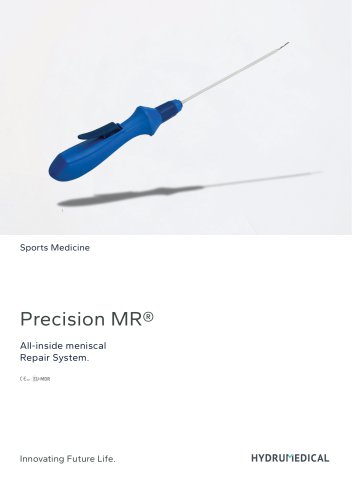
 Precision MR® Suturing Device
14 Pages
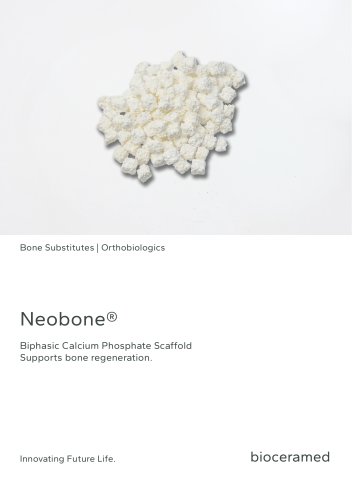 Neobone®
4 Pages
 Dental Portfolio
43 Pages
 Helavisco®
2 Pages
 NeoPRP®
2 Pages

Archived catalogs
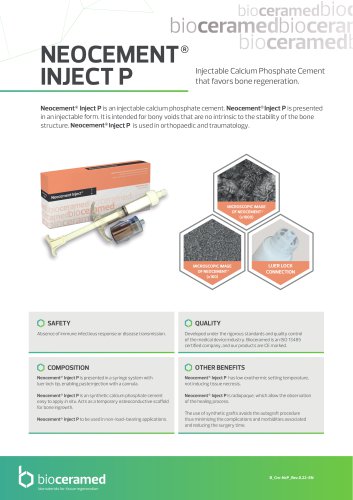 NEOCEMENT INJECT P
2 Pages
 n-IBS
n-IBS2 Pages
- Cannula
- Orthopedic surgery instrument kit
- Orthopedic surgery bone substitute
- Synthetic bone substitute
- Dental sugery bone substitute
- Granules bone substitute
- Straight cannula
- Rigid bone substitute
- Collagen tissue matrix
- Orthopedic surgery bone cement
- Access cannula
- Absorbable tissue matrix
- Buccal tissue matrix
- Putty bone substitute
- Silk tissue matrix
- Knot pusher
- Skull surgery bone substitute
- Hemostatic tissue matrix