
- Catalogs
- Bioceramed
- Dental Portfolio

Dental Portfolio
Dental Portfolio
This document outlines innovative products in regenerative dentistry, focusing on materials for bone regeneration and tissue healing. Key products include n-IBS®, Neobone®, TriOSS®, NeoPRF®, Healvisco® Dental, Vimadental® Fleece, and SimplySilk® Barrier.
n-IBS® is an injectable hydroxyapatite paste with 35% nanoparticles, fully resorbing in about 6 months. It acts as a scaffold for vascularization and new bone growth, featuring non-hardening, osteoconductivity, injectability, and radiopacity. Clinical evidence shows a match between bone formation and resorption rates.
Neobone® is a biphasic bone graft with 75% hydroxyapatite and 25% β-tricalcium phosphate, designed for long-term bone regeneration. It resorbs over 6–24 months, providing mechanical stability and promoting new bone growth, effective in sinus lift procedures.
TriOSS® is a 100% β-TCP synthetic bone graft with a 3D porous structure, promoting natural bone remodeling. It is fully resorbable and bioactive, suitable for sinus and alveolar ridge augmentation, showing significant postoperative bone height increase.
NeoPRF® is a platelet-rich fibrin concentrate that promotes tissue regeneration by releasing growth factors over 7–28 days, used in extractions, cysts, periodontal regeneration, and implantology.
Healvisco® Dental is a hyaluronic acid gel that accelerates tissue healing and regeneration, supporting gum repair and reducing scar formation. It is effective in improving gingival health and supporting periodontal treatments.
Vimadental® Fleece is a sterile collagen sponge used in dental surgery to support hemostatic care, reduce bleeding, and stimulate tissue regeneration.
SimplySilk® Barrier is a fully resorbable GBR membrane made of silk, used for bone or ridge augmentation and guided bone/tissue regeneration, offering structural integrity with optional magnesium reinforcement.
- SimplySilk® Barrier Plus: Designed for standard dental procedures, offering moderate space maintenance and limited passive support.
- SimplySilk® Barrier Plus Mg-Reinforced: Suitable for large augmentations requiring structural support, promoting healing through magnesium ions release, providing excellent space maintenance over 4-6 months.
Catalog excerpts
Innovating future life. Dental Portfolio www.bioceramed.com bioceramed
Open the catalog to page 1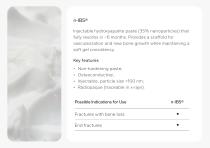
Injectable hydroxyapatite paste (35% nanoparticles) that fully resorbs in ~6 months. Provides a scaffold for vascularization and new bone growth while maintaining a soft gel consistency. • Injectable, particle size <100 nm; • Radiopaque (traceable in x-rays). Possible Indications for Use Fractures with bone loss
Open the catalog to page 2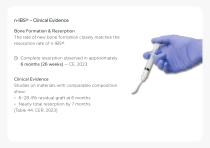
The rate of new bone formation closely matches the resorption rate of n-IBS®. © Complete resorption observed in approximately Studies on materials with comparable composition show: • 6-28.4% residual graft at 6 months • Nearly total resorption by 7 months (Table 44, CER, 2023)
Open the catalog to page 3
Non-hardening paste
Open the catalog to page 4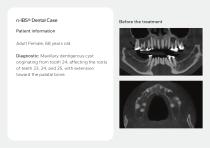
n-IBS® Dental Case Patient information Adult Female, 68 years old. Diagnostic: Maxillary dentigerous cyst originating from tooth 24, affecting the roots of teeth 23, 24, and 25, with extension toward the palatal bone.
Open the catalog to page 5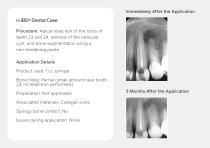
Immediately After the Application n-IBS® Dental Case Procedure: Apical resection of the roots of teeth 23 and 24, removal of the radicular cyst, and bone augmentation using a non-hardening paste. Application Details Product used: 1 cc syringe Bone filling: Partial (small amount near tooth 23; no resection performed) Preparation: Not applicable Associated materials: Collagen cone Spongy bone contact: No Issues during application: None 3 Months After the Application
Open the catalog to page 6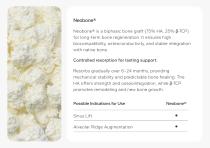
Neobone® Neobone® is a biphasic bone graft (75% HA, 25% β-TCP) for long-term bone regeneration. It ensures high biocompatibility, osteoconductivity, and stable integration with native bone. Controlled resorption for lasting support. Resorbs gradually over 6–24 months, providing mechanical stability and predictable bone healing. The HA offers strength and osseointegration, while β-TCP promotes remodeling and new bone growth. Possible Indications for Use Sinus Lift Alveolar Ridge Augmentation
Open the catalog to page 7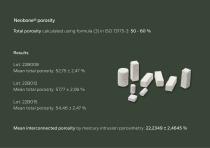
Neobone® porosity Total porosity calculated using formula (3) in ISO 13175-3: 50 - 60 % Results Lot: 22B008 Mean total porosity: 52,75 ± 2,47 % Lot: 22B012 Mean total porosity: 57,77 ± 2,06 % Lot: 22B015 Mean total porosity: 54,46 ± 2,47 % Mean interconnected porosity by mercury intrusion porosimetry: 22,2349 ± 2,4645
Open the catalog to page 8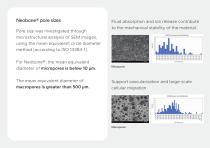
Neobone® pore sizes Pore size was investigated through microstructural analysis of SEM images, using the mean equivalent circle diameter method (according to ISO 13383-1). For Neobone®, the mean equivalent diameter of micropores is below 10 µm. The mean equivalent diameter of macropores is greater than 500 µm. Fluid absorption and ion release contribute to the mechanical stability of the material. Support vascularization and large-scale cellular migration.
Open the catalog to page 9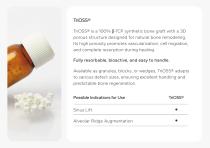
TriOSS® TriOSS® is a 100% β-TCP synthetic bone graft with a 3D porous structure designed for natural bone remodeling. Its high porosity promotes vascularization, cell migration, and complete resorption during healing. Fully resorbable, bioactive, and easy to handle. Available as granules, blocks, or wedges, TriOSS® adapts to various defect sizes, ensuring excellent handling and predictable bone regeneration. Possible Indications for Use Sinus Lift Alveolar Ridge Augmentation
Open the catalog to page 10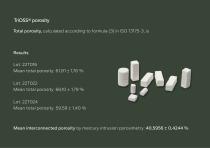
TriOSS® porosity Total porosity, calculated according to formula (3) in ISO 13175-3, is Results Lot: 22T016 Mean total porosity: 61,81 ± 1,76 % Lot: 22T022 Mean total porosity: 66,10 ± 1,79 % Lot: 22T024 Mean total porosity: 59,59 ± 1,40 % Mean interconnected porosity by mercury intrusion porosimetry: 40,5956 ± 0,4244
Open the catalog to page 11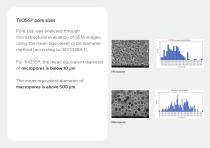
Pore size was analyzed through microstructural evaluation of SEM images, using the mean equivalent circle diameter method (according to ISO 13383-1). For TriOSS®, the mean equivalent diameter The mean equivalent diameter of
Open the catalog to page 12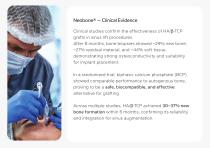
Neobone® — Clinical Evidence Clinical studies confirm the effectiveness of HA/β-TCP grafts in sinus lift procedures. After 8 months, bone biopsies showed ~29% new bone, ~27% residual material, and ~44% soft tissue, demonstrating strong osteoconductivity and suitability for implant placement. In a randomized trial, biphasic calcium phosphate (BCP) showed comparable performance to autogenous bone, proving to be a safe, biocompatible, and effective alternative for grafting. Across multiple studies, HA/β-TCP achieved 30–37% new bone formation within 6 months, confirming its reliability and integration...
Open the catalog to page 13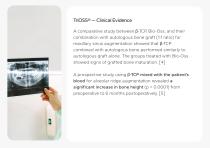
TriOSS® — Clinical Evidence A comparative study between β-TCP, Bio-Oss, and their combination with autologous bone graft (1:1 ratio) for maxillary sinus augmentation showed that β-TCP combined with autologous bone performed similarly to autologous graft alone. The groups treated with Bio-Oss showed signs of grafted bone maturation. [4] A prospective study using β-TCP mixed with the patient’s blood for alveolar ridge augmentation revealed a significant increase in bone height (p = 0.0001) from preoperative to 6 months postoperative
Open the catalog to page 14
Neobone® and TriOSS® — References • 1. Padovan, Luis & SOUSA, Diego & PADOVAN, Silvia & Oliveira, Guilherme & SILVA, Ricarda & Claudino, Marcela. (2018). Histological analysis of the use of biphasic ceramics based on hydroxyapatite and β-tricalcium phosphate in maxillary sinus floor elevation surgery: pilot study. Revista de Odontologia da UNESP. 47. 10.1590/1807-2577.10917. 2. Danesh-Sani SA, Wallace SS, Movahed A, El Chaar ES, Cho SC, Khouly I, Testori T. Maxillary Sinus Grafting With Biphasic Bone Ceramic or Autogenous Bone: Clinical, Histologic, and Histomorphometric Results From a Randomized...
Open the catalog to page 15
Blocks, wedges or granules Clinical Applications www.bioceramed.com Neobone® & TriOSS®
Open the catalog to page 16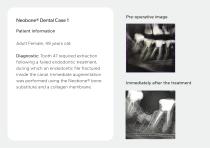
Neobone® Dental Case 1 Pre-operative image Patient information Adult Female, 49 years old. Diagnostic: Tooth 47 required extraction following a failed endodontic treatment, during which an endodontic file fractured inside the canal. Immediate augmentation was performed using the Neobone® bone substitute and a collagen membrane. Immediately after the treatmen
Open the catalog to page 17All Bioceramed catalogs and technical brochures
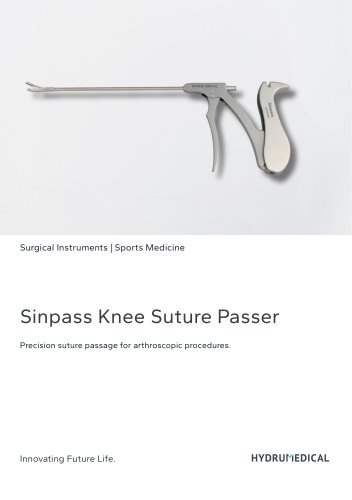 Sinpass Knee Suture Passer
4 Pages
 Knot Pusher Suture Cutter
4 Pages
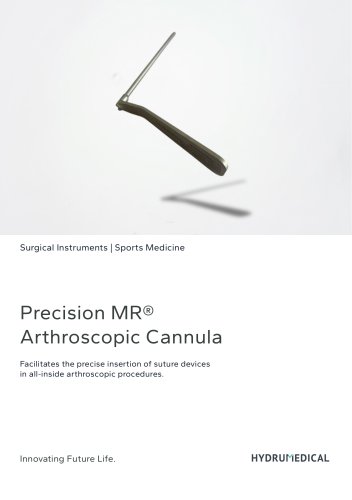 Arthroscopic access cannula
4 Pages
 SimplySilk®
4 Pages
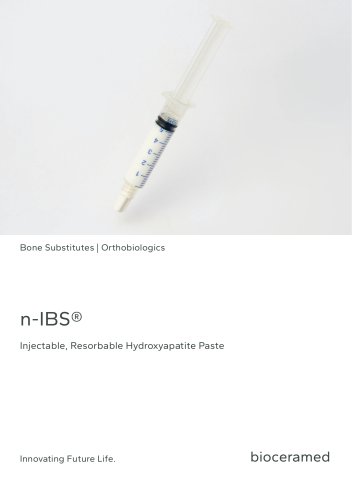 n-IBS®
4 Pages
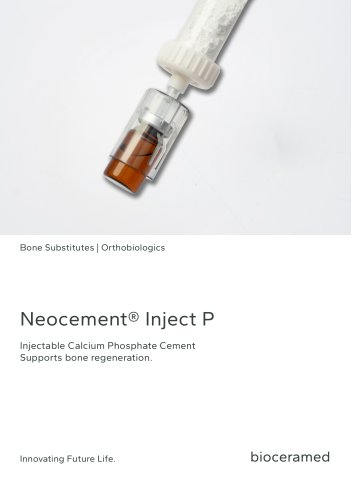 Neocement® Inject P
4 Pages
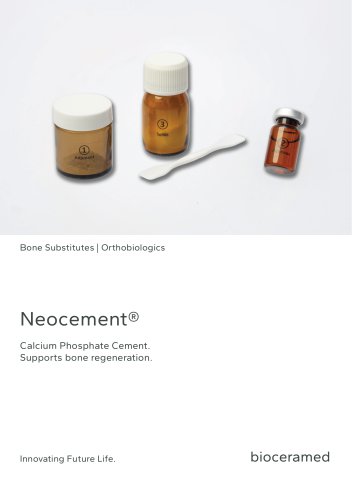 Neocement®
4 Pages
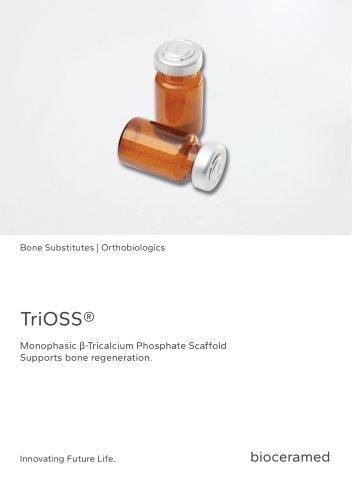 TriOSS®
4 Pages
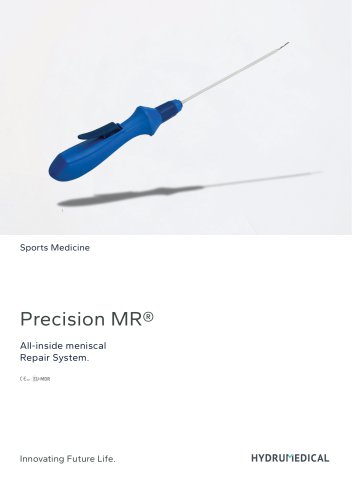 Precision MR®
4 Pages
 Precision MR® Suturing Device
14 Pages
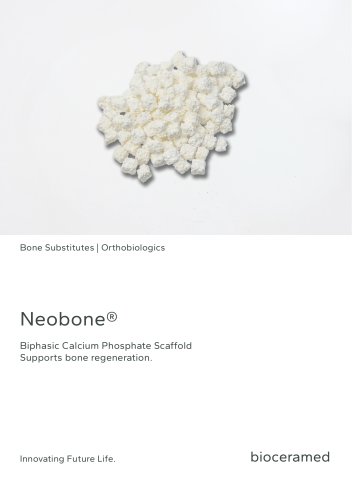 Neobone®
4 Pages
 Bone Grafts – Portfolio
30 Pages
 Helavisco®
2 Pages
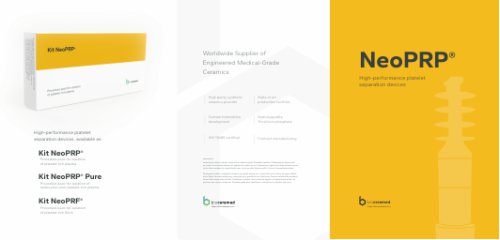 NeoPRP®
2 Pages
Archived catalogs
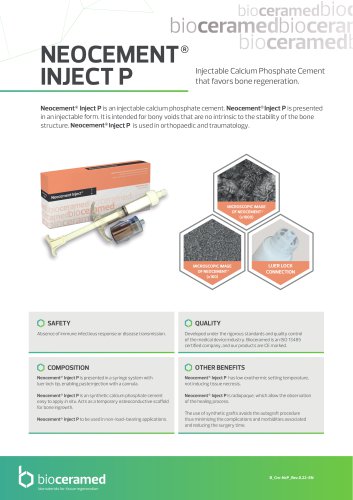 NEOCEMENT INJECT P
2 Pages
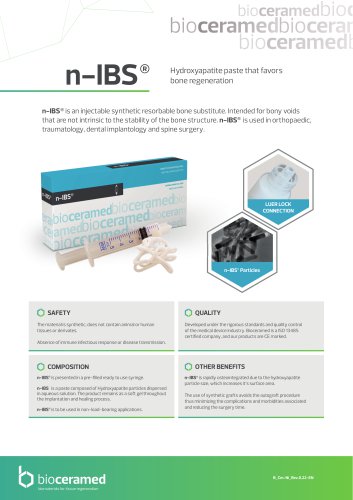 n-IBS
n-IBS2 Pages
- Cannula
- Orthopedic surgery instrument kit
- Orthopedic surgery bone substitute
- Synthetic bone substitute
- Dental sugery bone substitute
- Granules bone substitute
- Straight cannula
- Rigid bone substitute
- Bone cement
- Collagen tissue matrix
- Orthopedic surgery bone cement
- Access cannula
- Absorbable tissue matrix
- Buccal tissue matrix
- Putty bone substitute
- Silk tissue matrix
- Knot pusher
- Skull surgery bone substitute
- Hemostatic tissue matrix