

Competitive Comparison of FreeDerm® Adhesive Remover

Competitive Comparison of FreeDerm® Adhesive Remover
BioDerm, Inc. conducted a competitive comparison of its FreeDerm® Adhesive Remover against other prominent medical adhesive removers. The study focused on the effectiveness of removing adhesive tapes and the speed of evaporation from the skin.
Test Methods
180 Degree Peel Test: Strips of adhesive tape were applied to stainless steel coupons, and the time to peel off using adhesive removers was measured. A failure was noted if removal exceeded 3 minutes.
Skin Evaporation Rate: Adhesive remover wipes were applied to the skin, and the evaporation time was recorded.
Purpose
The study aimed to evaluate the speed of removal, residue left, and evaporation rate of various adhesive removers, including BioDerm FreeDerm, Bard Adhesive Remover, Smith & Nephew Uni-Solve, SENSI-CARE, and Detachol.
Test Results
- Skin Evaporation: FreeDerm evaporated in 10 seconds, the fastest among the tested products.
- Hydrocolloid Results: FreeDerm released in 26 seconds, while Bard failed within the 3-minute limit.
- Micropore Paper Tape: FreeDerm released in 12 seconds, Bard left 55% residue.
- Zonas Porous Tape: FreeDerm released in 5 seconds, no residue left by any remover.
- Tegaderm: FreeDerm released in 23 seconds, Uni-Solve failed and left 10% residue.
Conclusions
FreeDerm demonstrated superior performance in speed of removal, evaporation rate, and residue-free properties compared to competitors. It was the only remover that did not require additional cleaning before reapplication of tapes or appliances.
Contact Information
BioDerm, Inc., 12320 73rd Court North, Largo, FL 33773, USA. Orders: 727-507-7655, Support: 800-864-6755, Email: [email protected], Web: BioDermInc.com
Catalog excerpts
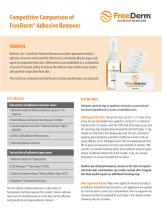
Competitive Comparison of FreeDerm® Adhesive Remover PURPOSE BioDerm, Inc.’ s FreeDerm Adhesive Remover and other prominent medical adhesive removers were tested for effectiveness removing adhesive tapes and speed of evaporation from skin. Effectiveness was established as a combination of speed of removal, ability to remove the adhesive tape without tape residue, and speed of evaporation from skin. The results are compared and significance to device performance are discussed. TEST ARTICLES Test articles of adhesive removers were: 1) BioDerm FreeDerm Adhesive Remover, spray or 1 mL ampoule 2) Bard Adhesive and Barrier Film Remover, #740020 3) Smith & Nephew Uni-Solve™ Adhesive Remover Wipes, #402300 4) SENSI-CARE Adhesive Releaser Spray 5) Detachol Adhesive Remover Test articles of adhesive tapes were: 1) BioDerm XtraDerm™ Hydrocolloid 2) 3M Micropore™ “Paper Tape”, #15303 3) Johnson & Johnson Zonas™ Porous Athletic Tape, #5107 4) Tegaderm™ Securement Dressing The test articles combined represent a wide variety of formulations that fairly represent the market. Silicone adhesive tapes were not tested because as a class they are low adhesion and typically do not require adhesive remover. TEST METHODS Adequate speed of tape or appliance removal is a practical and essential requirement for nurses or individual users. 180 Degree Peel Test: Test articles were cut into 1” x 9” strips. Three inches of each strip length were applied to a vertical 2” x 6” polished stainless steel (SS) coupon, with the 180% fold of the tape on top, and the remaining tape hanging down beyond the vertical SS plate. A 75g weight was attached to the hanging tape end. The test consisted of applying and maintaining saturation of adhesive remover at the exposed adhesive at the 180 degree bend. Time to completely peel from the SS plate was measured. Peel tests were limited to 3 minutes (180 seconds), essentially indicating failure of the adhesive remover tested. Degree of adhesive residue left on the SS plate, if any, was visually estimated as % of area that had been in contact. Another practical performance concern is the rate of evaporation from skin, and whether any resides remain after evaporation that would require an additional cleaning step. Skin Evaporation Rate: Wipes were applied to forearms of subjects according to manufacturing instructions. Each application was applied to a fresh location to avoid cross contamination. Time to evaporate was measured and the test repeated for each subject. Any obvious residue remain
Open the catalog to page 1
TEST RESULTS Skin Evapora�on Rate 80 Seconds to Release in 180 deg Peel Test 180 Degree Peel Adhesion 200 Bard Film Remover Adhesive Remover Hydrocolloid (BioDerm) Micropore Paper Tape (3M) Zonas TM Porous Tape (J&J) Hydrocolloid Results • FreeDerm results indicated superior speed of release, at 26 seconds. • The Bard Adhesive Remover failed to release within the 3 minute limit. • None of the adhesive removers left adhesive residue on the steel test coupon. Micropore Paper Tape (3M) Results • FreeDerm results indicated superior speed of release, at 12 seconds. • The Bard Adhesive Remover left...
Open the catalog to page 2All BioDerm catalogs and technical brochures
 Faceplate Strip
1 Page
 CathGrip
2 Pages
 CathGrip Oval
2 Pages
 CathGrip Double Strap
2 Pages
 CathGrip Single Strap
2 Pages

