
- Catalogs
- BioHorizons
- Laser-Lok microchannel dua-affinity surface

Laser-Lok microchannel dua-affinity surface

Laser-Lok microchannel dua-affinity surface
BioHorizons is a leader in dental implant technology, known for its biologic-based solutions and advanced implant technologies. Their products are sold in 85 markets with a 99.2% average implant success rate.
Laser-Lok microchannels are a proprietary surface treatment designed to enhance osseointegration and soft tissue attachment. This technology uses laser ablation to create microchannels that optimize the attachment of osteoblasts and fibroblasts, improving bone and tissue integration compared to traditional surfaces.
Studies show that Laser-Lok implants significantly reduce bone loss compared to traditional implants. A 3-year study showed a 70% reduction in bone loss with Laser-Lok implants. The technology supports peri-implant health and can regenerate crestal bone when combined with platform switching.
Numerous studies have evaluated Laser-Lok technology, including:
- A retrospective study showing reduced bone loss with laser-microtextured collars compared to machined collars.
- A 24-month study on immediate occlusal loading of Tapered Internal Laser-Lok implants, showing a 95.4% survival rate and minimal marginal bone loss.
BioHorizons' Laser-Lok technology offers significant clinical advantages in maintaining bone health and enhancing tissue integration, positioning the company as a leader in the dental implant industry.
This document presents research on dental implants, focusing on Laser-Lok® microtexturing effects on implant surfaces and abutments, evaluating clinical attachment levels, crestal bone remodeling, and connective tissue integration.
The document includes data on the length and diameter of 107 inserted implants, distributed between the mandible and maxilla, and details the distribution of prostheses and mean crestal bone loss over time.
A two-year study evaluated the influence of Laser-Lok® microtexturing on immediate functional loading of implants in single-tooth replacement, showing higher clinical attachment levels and less crestal bone loss in the Laser-Lok® group.
A six-month study assessed the effects of Laser-Lok® microtextured collars on immediate transmucosal implants, finding favorable conditions for tissue attachment and reduced alveolar bone loss.
Studies demonstrated the effectiveness of laser-ablated microgrooves in supporting connective tissue attachment, serving as a barrier to the apical migration of the junctional epithelium and preventing crestal bone resorption.
A study on repeated dis-/reconnection of laser microgrooved and machined implant abutments showed enhanced connective tissue attachment and preserved crestal bone levels with laser microgrooved abutments.
The research highlights the benefits of Laser-Lok® technology in improving implant stability and tissue integration, suggesting enhanced clinical outcomes by promoting better tissue attachment and reducing bone loss.
A clinical trial evaluated a tapered dental implant with Laser-Lok surface treatment, designed to enhance bone and connective tissue attachment while inhibiting epithelial downgrowth.
Implants were placed adjacent to machined collar control implants, with measurements including bleeding index, plaque index, probing depth, and crestal bone loss.
Laser-Lok implants showed superior performance in probing depths and crestal bone loss compared to control implants.
Laser-Lok implants demonstrated a stable soft-tissue seal and limited crestal bone loss, with potential better performance in the maxilla.
Further studies showed Laser-Lok implants resulted in shallower probing depths and less crestal bone loss compared to other implants.
Laser-Lok implants effectively maintain crestal bone levels and soft tissue esthetics, supporting connective tissue attachment and preventing epithelial migration.
Hard and Soft Tissue Changes After Crestal and Subcrestal Immediate Implant Placement
Immediate implants showed a 96% survival rate, with placement level not significantly affecting bone and tissue changes.
Bone trabeculae and remodeling were observed, indicating successful osseointegration.
Laser microgrooved design may maintain buccal soft tissue and prevent epithelial cell downgrowth.
Microgrooved implants showed higher bone-implant contact and reduced bone resorption.
Finite element analysis predicts reduced crestal bone stress with Laser-Lok implants.
All implant systems showed uneventful healing, with variations in tissue response based on neck design.
The document discusses the impact of implant surface geometry on tissue responses, focusing on fibroblast cell behavior.
Implants were produced by Orthogen Corporation and BioLok International, with surfaces modified using Excimer laser ablation.
Four transcutaneous implants were surgically implanted in rabbits, with histology processed at 2, 4, and 8 weeks.
Laser-machined implants showed improved soft tissue integration compared to control implants.
Laser microtextured surfaces can enhance soft tissue integration in transcutaneous implants.
Research on textured surfaces showed enhanced bone integration and control of local microstructural geometry.
Figures show scanning electron micrographs of microtextured surfaces and graphs of cell growth on microgrooved surfaces.
The document explores the influence of surface microgeometry on tissue-implant interactions, focusing on fibroblast cell behavior.
Rat tendon fibroblasts and human implant capsule fibroblasts were cultured on various microtextured surfaces.
Microgrooved surfaces significantly influenced cell orientation and shape, affecting stress fibers and focal adhesions.
Surface microgeometry can guide cell behavior, optimizing implant integration by controlling fibrous tissue growth.
Research supported by NSF SBIR Phase I grants, with collaboration from the Cornell Nanofabrication Facility.
Catalog excerpts
clinical overview Laser-Lok microchannel dual-affinity surface
Open the catalog to page 1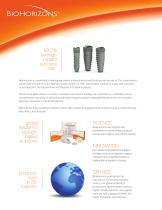
99.2% average implant success rate1 BioHorizons is committed to developing evidence-based and scientifically-proven products. This commitment started with the launch of the Maestro implant system in 1997 and remains in full force today with our most recent launches, the Tapered Plus and Tapered 3.0 implant systems. The focus of BioHorizons on science, innovation and service enables our customers to confidently use our comprehensive portfolio of dental implants and biologics products making BioHorizons one of the fastest growing companies in the dental industry. BioHorizons helps customers restore...
Open the catalog to page 2
Study Review The following review summarizes many of Che studies and presentations related to Laser-Lokmicrochannels. Latest Implant Research Challenging the Tarnow rule with Tapered Plus Immediate or delayed placement and loading, controlled Immediate load, fixed prosthesis Immediate load single-tooth replacement, controlled Single-stage implants with LADDEC® and Mem-Lok® Latest Abutment Research 4 Laser-Lok abutment proof of principle (canine) 5 Laser-Lok ball abutment case report (human) 6 Laser-Lok abutment case series (human) 7 Laser-Lok abutment tissue reattachment (human) 8 Reusing Laser-Lok...
Open the catalog to page 3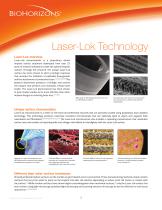
Laser-Lok Technology Laser-Lok overview Laser-Lok microchannels is a proprietary dental implant surface treatment developed from over 25 years of research initiated to create the optimal implant surface. Through this research, the unique Laser-Lok surface has been shown to elicit a biologic response that includes the inhibition of epithelial downgrowth and the attachment of connective tissue.2,3,4,5,6,7,8,9,10 This physical attachment produces a biologic seal around the implant that protects and maintains crestal bone health. The Laser-Lok phenomenon has been shown in post-market studies to be...
Open the catalog to page 4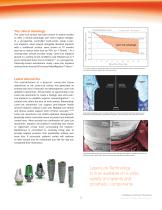
Change in Bone Level (mm) The clinical advantage The Laser-Lok surface has been shown in several studies to offer a clinical advantage over other implant designs. In a prospective, controlled multi-center study, LaserLok implants, when placed alongside identical implants with a traditional surface, were shown at 37 months post-op to reduce bone loss by 70% (or 1.35mm).11 In a retrospective, private practice study, Laser-Lok implants placed in a variety of site conditions and followed up to 3 years minimized bone loss to 0.46mm.12 In a prospective, University-based overdenture study, Laser-Lok...
Open the catalog to page 5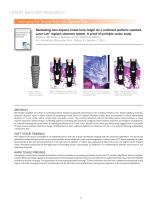
LATEST IMPLANT RESEARCH Challenging the Tarnow Rule with Tapered Plus Maintaining inter-implant crestal bone height via a combined platform-switched, Laser-Lok® implant/abutment system: A proof-of-principle canine study. M Nevins, ML Nevins, L Gobbato, HJ Lee, CW Wang, DM Kim. Int J Periodontics Restorative Dent , Volume 33, Number 3, 2013. Figure 1. Platformswitched Laser-Lok abutment and implant Figure 2. No signs of inter-implant crestal bone loss on implants placed 2mm apart Figure 3. Direct CT connection to LaserLok surfaces; osseous crest extends onto laser-ablated collar Figure 4. No crestal...
Open the catalog to page 6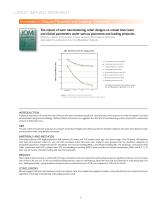
LATEST IMPLANT RESEARCH Immediate or Delayed Placement and Loading, Controlled The impact of laser microtexturing collar designs on crestal bone level, and clinical parameters under various placement and loading protocols. M Serra, L Bava, D Farronato, V Iorio Siciliano, M Grande, R Guarnieri. Submitted for publication, Int J Oral Maxillofac Implants. CBL Outcomes over the study period 0 Bone Loss Mean (mm) -0.2 L Immediate Placement and INOL L Immediate Placement and DL L Delayed Placement and INOL L Delayed Placement and DL M Immediate Placement and INOL M Immediate Placement and DL M Delayed...
Open the catalog to page 7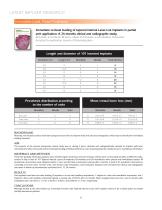
LATEST IMPLANT RESEARCH Immediate Load, Fixed Prosthesis Immediate occlusal loading of tapered internal Laser-Lokimplants in partial arch application: A 24-months clinical and radiographic study. M Grande, A Ceccherini, M Serra, L Bava, D Farronato, V Iorio Siciliano, R Guarnieri. Accepted for publication, Journal of Osseointegration. Length and diameter of 107 inserted implants Diameter mm Total Number Prosthesis distribution according to the number of units Mean crestal bone loss (mm) Three units Four units Recently, new implant surfaces have been proposed in an effort to improve hard and soft...
Open the catalog to page 8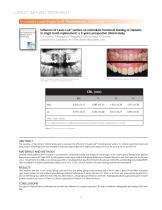
LATEST IMPLANT RESEARCH Immediate Load Single-tooth Replacement, Controlled Influence of Laser-Lok® surface on immediate functional loading of implants in single tooth replacement: a 2-years prospective clinical study. D Farronato, F Mangano, F Briguglio, V Iorio Siciliano, R Guarnieri. Submitted for publication, Int J Periodontics Restorative Dent. Figure 1. Orthopantomography of the patient who received two implants (1 LL in site 14 and 1N LL in site 24) Figure 2. Before treatment (A), after treatment (B) Mean values and SD t=2.7338, p=0.0340, the difference between the observed means is significant...
Open the catalog to page 9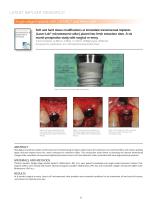
LATEST IMPLANT RESEARCH Single-stage Implants with LADDEC® and Mem-Lok® Soft and hard tissue modifications at immediate transmucosal implants (Laser-Lok® microtextured collar) placed into fresh extraction sites. A six month prospective study with surgical re-entry. V Iorio Siciliano, G Marzo, A Blasi, C Cafiero, M Mignogna, M Nicolò Accepted for publication, Int J Periodontics Restorative Dent. Figure 1. Schematic of the Single-stage Implant System. Figure 2. Clinical view after filling of the peri-implant defects with bone-derived xenograft particles (Laddec® BioHorizons, IPH. Inc). Figure 3....
Open the catalog to page 10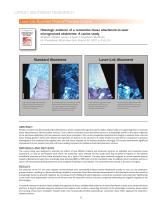
LATEST ABUTMENT RESEARCH Laser-Lok Abutment Proof of Principle (Canine) Histologic evidence of a connective tissue attachment to laser microgrooved abutments: A canine study. M Nevins, DM Kim, SH Jun, K Guze, P Schupbach, ML Nevins. Int J Periodontics Restorative Dent, Volume 30, 2010. p. 245-255. Standard Abutment A grit-blasted implant and standard abutment demonstrated apical JE migration, resulting in significant crestal bone resorption. Laser-Lok Abutment In a polarized light view, this specimen clearly demonstrates parallel running connective tissue fibers against both the abutment and...
Open the catalog to page 11All BioHorizons catalogs and technical brochures
 International Product Catalog
12 Pages
 Biologics Catalog
28 Pages
 External Dental Implant Catalog
44 Pages
 patientconnect
24 Pages
 prosthetics catalog 2017
36 Pages
 External Dental Implant
44 Pages
 Surgical Motors
2 Pages
 laser-lok
48 Pages
 AlloDerm ®
2 Pages
 biologics product catalog
12 Pages
 one-piece 3.0 & overdenture
28 Pages
 laser-lok 3.0
20 Pages
 Hu-Friedy® dental instruments
24 Pages
 guided surgery kit
24 Pages
 tapered internal implant system
28 Pages


Archived catalogs
 prosthetics catalog
40 Pages
- Titanium implant abutment
- Straight implant abutment
- Dental surgery instrument kit
- Dental burr
- Titanium dental implant
- Conical dental implant
- Dental implant surgery instrument kit
- Bone substitute
- Cylindrical dental implant
- Dental implant analog
- Straight dental implant analog
- Hexagonal dental implant
- Healing abutment
- Narrow dental implant
- Internal hexagon dental implant
- Titanium healing abutment
- Impression coping
- Dental sugery bone substitute