
- Catalogs
- Biological Industries
- MYCOPLASMA FACTS

MYCOPLASMA FACTS
MYCOPLASMA FACTS
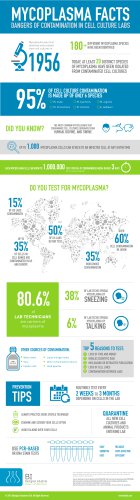
Mycoplasma contamination is a significant issue in cell culture laboratories, with at least 20 distinct species identified. However, only six species are primarily responsible for contamination: M. orale, M. hyorhinis, M. arginini, M. fermentans, M. hominis, and A. laidlawii.
Approximately 50% of US labs do not test for mycoplasma, contributing to contamination rates of up to 35% in cell banks in the US and Europe, and over 60% in Japan. Lab technicians can spread mycoplasma through talking and sneezing.
Contamination can lead to loss of time and money, invalid scientific data, misleading publications, and loss of cell lines. Common sources include water baths, liquid nitrogen tanks, sera, feeder cells, and used pipettes.
To prevent contamination, labs should routinely test every 2 weeks to 3 months, quarantine new cell cultures, practice good sterile techniques, and use PCR-based or DNA stain tests. Avoid talking over cells and regularly screen them.
Implementing these practices can help reduce the risk of mycoplasma contamination, ensuring the integrity of scientific research and cell culture viability.
Catalog excerpts
DANGERS OF CONTAMINATION IN CELL CULTURE LABS DIFFERENT MYCOPLASMA SPECIES HAVE BEEN IDENTIFIED TODAY, AT LEAST 20 DISTINCT SPECIES OF MYCOPLASMA HAVE BEEN ISOLATED FROM CONTAMINATED CELL CULTURES OF CELL CULTURE CONTAMINATION IS MADE UP OF ONLY 6 SPECIES M. orale OM. hyorhinis OM. arginini M. fermentans OM. hominis OA. laidlawii DID YOU KNOW? THE MOST COMMON MYCOPLASMAS THAT CONTAMINATE CELL CULTURES ORIGINATE FROM HUMAN, BOVINE, AND SWINE MYCOPLASMA CELLS CAN ATTACH TO AN INFECTED CELL AT ANY GIVEN TIME EACH MYCOPLASMA CELL CAN GROW TO CFU’S PER ML OF CONTAMINATED MEDIA IN ONLY (CFU = colony forming unit) CD D0 YOU TEST FOR MYCOPLASMA? « rO/ vi?:. 35% m. * x acell csns™ OF CELLS IN CELL BANKSARE '$«${ V# f 35% SNEEZING of LAB TECHNICIANS are carriers of mycoplasma TALKING OTHER SOURCES OF CONTAMINATION: • Liquid nitrogen tanks • Other contaminated cultures • Used pipettes TOP 5 REASONS TO TEST: 1 LOSS OF TIME AND MONEY 2 INVALID SCIENTIFIC DATA 3 MISLEADING OR RETRACTED PUBLICATION 4 LOSS OF CELL LINES 5 CONTAMINATION BETWEEN LABS ROUTINELY TEST EVERY 2 WEEKS to 3 MONTHS DEPENDING ON CELLS IN THE LAB ALWAYS PRACTICE GOOD STERILE TECHNIQUE © EXAMINE AND SCREEN YOUR CELLS OFTEN (£) AVOID TALKING OVER YOUR CELLS QUARANTINE ALL NEW CELL CULTURES AND ANIMAL PRODUCTS ENTERING LAB RELIABLE COST-EFFECTIVE EFFICIENT This infographic has been produced solely for informational purposes only. Please note that data has been extracted from various publications and sources, and not all contextual evidence may be represented. Sources: http://www.ncbi.nlm.nih.gov/pmc/articles/PMC3443982/, http://www.ncbi.nlm.nih.gov/pmc/articles/PMC3584481/, http://www.nature.com/nprot/journal/v5/n5/full/nprot.2010.43.html, http://en.wikipedia.org/wiki/Mycoplasma, http://csmedia2.corning.com/LifeSciences/Media/pdf/cccontamination.pdf: http://www.intechopen.com/books/biomedical-tissue-culture/contamination-of-tissue-cultures-by-mycoplasmas © 2016 Biological Industries USA. All Rights Reserved.
Open the catalog to page 1All Biological Industries catalogs and technical brochures
 NutriStem® hPSC XF Medium
2 Pages
 MSC NutriStem® XF Medium
2 Pages
 NutriVero™ Flex 10
8 Pages
 EndoGo™ XF Culture Media
2 Pages
 Human Mesenchymal Stem Cells
24 Pages


- Detection kit
- Solvent reagent
- Molecular biology reagent
- Research reagent
- Laboratory reagent
- Diagnostic reagent
- Protein reagent
- Enzyme reagent
- Histology reagent
- Cytology reagent
- Buffer solution reagent
- Medium reagent
- Clinical reagent
- Blood sample reagent
- Tissue reagent
- Cell detection kit
- Serum reagent
- Reagent for nucleic acids
- Laboratory assay kit
- Electrolyte reagent