
- Catalogs
- Biopac Systems
- MP Research Catalog

MP Research Catalog

MP Research Catalog
- Remote Monitoring: Enables local area network monitoring.
- High-Speed Sampling: Supports 400kHz aggregate sampling.
- Multiple Sample Rates: Allows variable sample rates for different channels.
- Improved User Interface: Enhanced usability and control for multiple units.
- Applications: Suitable for human and animal research.
- High Resolution: 16-bit resolution for accurate signal detection.
- Analog and Digital Inputs/Outputs: 16 analog inputs, 2 analog outputs, and digital I/O lines.
- Safety and Compliance: Isolated, human-safe, and CE marked for EU compliance.
- Interactive Program: Instant data viewing, measurement, analysis, and transformation.
- Customizable Acquisition and Analysis: Offers tools like FFT, histogram displays, and peak detection.
- Display Options: Multiple modes such as Chart, Scope, and X/Y with customizable grids.
- Measurement Tools: Manual or automatic data measurement with SOP creation and note-taking.
- Calculation Presets: Predefined settings for specific analysis tasks.
- Signal Averaging: Real-time and offline capabilities.
- Data Reduction: Automatic measurement over specified periods.
- Equipment Features: Lists various equipment such as transducer amplifiers, dynamometers, goniometers, accelerometers, and remote monitoring modules.
- Muscle Contraction Analysis: Describes methods for evaluating isometric and isotonic muscle contractions.
- Ergonomics Evaluation: Outlines procedures for analyzing body position and posture.
- Synchronization with Video Capture: Methods for synchronizing motion analysis equipment with video capture systems.
- Remote Monitoring: The TEL100C remote monitoring module set is highlighted for its ability to support a wide range of biomechanical measurements.
- Data Acquisition Systems: The MP150 and MP100 systems are described.
- Software and Analysis: AcqKnowledge software is used for data analysis and display.
- Equipment Compatibility: Emphasizes the importance of using the correct cables and interfaces.
- Data Reduction: Automatic data reduction tools in AcqKnowledge simplify the analysis process.
- Smart Sensors: A variety of Smart Sensor electrodes and transducers are compatible with the TEL100C system.
- Voltage Levels: TTL, CMOS
- Output Drive Current: ±20mA (max)
- External Trigger Input: TTL, CMOS compatible
- Time Base: Min Sample Rate of 2 samples/hour
- Trigger Options: Internal, External or Signal Level
- Power: Amplifier Module Isolation provided by the MP data acquisition unit
- CE Marking: EC Low Voltage and EMC Directives
- Leakage current: <8µA (Normal), <400µA (Single Fault)
- Fuse: 2A (fast blow)
- MP150 vs MP100 System: MP150 offers higher recording speed and aggregate sampling rate.
- Cardio-pulmonary and Neuro-physiology measurements: Both systems perform excellently.
- Direct LAN operation: Available in MP150, not in MP100.
- Interactive measurements and running multiple applications: MP150 excels in both areas.
- UIM100C: Connects 100-series amplifier modules and signal cables.
- IPS100C: Operates 100-series amplifier modules independently.
- HLT100C: Interfaces high-level output transducers to an MP System.
- CO2 Range: 0-10% CO2
- Gain: 1, 2, 5, 10 (%CO2/Volt)
- Output Range: 0-10 volts
- Repeatability: 0.03% CO2
- Resolution: 0.1% CO2
- Linearity: 0.1% CO2
- Zero Stability: 0.1% CO2/24 hours
- Response Time: 90msec @ 200 ml/min
- Flow Range: 50-200 ml/min
- Temp Range: 10-45°C
- Zero Drift: 0.01% CO2/°C
- Span Drift: 0.02% CO2/°C
- Warm Up Time: 5 minutes @ 25°C
- Sampling Port: Male Luer
- Weight: 740 grams
- Dimensions: 7cm x 11cm x 19cm
- Power Source: 12VDC @ 1 amp
- O2 Range: 0-100% O2
- Gain: 10, 20, 50, 100 (%O2/Volt)
- Output Range: 0-10 volts
- Repeatability: ±0.1% O2
- Resolution: 0.1% O2
- Linearity: ±0.2% O2
- Zero Stability: ±0.01% O2/hr
- Response Time: 160msec @ 200 ml/min
- Flow Range: 50-200 ml/min
- Temp Range: 5-50°C
- Zero Drift: ±0.05% O2/°C
- Span Drift: ±0.25% O2/°C
- Sampling Port: Male Luer
- Weight: 990 grams
- Dimensions: 7cm x 11cm x 19cm
- Power Source: 12VDC @ 1 amp
- Measures subject responses to visual or auditory stimuli.
- Includes a six-pushbutton response box for reaction time measurements.
- Requires SuperLab™ software and a Digital I/O card on a PC running Windows 95, 98, or 98SE.
- Provides pulse and waveform stimulus outputs for various physiological tests.
- Programmable stimulus duration, repetition, onset, and amplitude.
- Includes overload and pulse stimulus indicators.
- Allows data recording while subjects are mobile or distant from the recording system.
- Includes a portable amplifier/transmitter and a receiver module.
- Compatible with MP System and other standard 100-series amplifiers.
- Channels: 4
- Low Pass Filter: 30Hz, 500Hz
- High Pass Filter: DC, 0.05Hz, 0.5Hz
- Channel Gain Control: 10 levels from x50 to x50,000
- Output Range: ±9V (analog)
- Input Impedance: 2 MΩ (differential)
- CMRR: 110dB min (50/60Hz)
- CMII: 1000 MΩ min (50/60Hz)
- CMIV: ±7V (amplifier ground), ±1500 VDC (mains ground)
- Noise Voltage: 0.1µV rms (0.05-30Hz)
- Signal/Crosstalk Ratio: 65dB min (0.05-500Hz)
- Signal/Noise Ratio: 75dB min (0.05-30Hz), 65dB min (0.05-500Hz)
- Signal Transmission Range: ≤ 60 meters via coaxial cable
- TSD115: Features a scale output range of 0-5 V.
- TSD116: Pushbutton switch type with various dimensions.
- TSD120: Noninvasive blood pressure cuff.
- TSD117: Pneumotach air flow transducer.
- TSD121C: Isometric dynamometer.
- TSD122: Stroboscope for visual evoked response applications.
- TSD123 Series: Oxygen saturation transducers.
- TSD125 Series: Force transducers.
- TSD127: Pneumotach air flow transducer for animal use.
- TSD130 Series: Goniometers for measuring limb angular movement.
- TSD137 Series: Pneumotach transducers for small animal pulmonary measurements.
- RX120 Series: Optional blood pressure cuffs.
- RX137 Series: Replacement air flow heads.
- HDW100A: Force transducer tension adjuster.
- Laser Doppler Flow Probes: Designed for invasive and endoscopic blood flow monitoring.
- AFT6: Equipped with a 22mm OD, 15mm ID coupler.
- AFT7: Smooth Bore Tubing with 35mm ID.
- AFT8: Autoclavable Mouthpiece with 30mm ID.
- AFT9: Reusable Mouthpiece for 35mm circuits.
- AFT10: Disposable Adult Facemasks for 22mm circuits.
- AFT12: Tubing for 22mm circuits.
- AFT11 Series: Flexible and rigid couplers for connecting various air flow ports.
- AFT15A: 5-liter chamber for expired gas analysis.
- AFT15B: 8-liter chamber for high volume gas analysis.
- AFT21: 35mm valve for high air flow applications.
- AFT22: 22mm valve for low to medium air flow.
- CBLSERA: Cable for connecting MP100 to MAC or PC.
- CBLEXT: Extension cable for MP100 system.
- ETHSW1: Ethernet switch for MP150 system.
- AC100A: Transformer for MP100 system.
- AC150A: Transformer for MP150 system.
- BAT100: Rechargeable battery pack for MP systems.
Catalog excerpts

Innovative practical solutions for data acquisition and analysis for PC with Windows and Macintosh
Open the catalog to page 1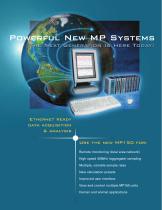
Powerful New MP Systems The Next Generation Is Here Today! Ethernet ready data acquisition & analysis Use the new MP150 for: Remote monitoring (local area network) High speed 400kHz (aggregate) sampling Multiple, variable sample rates New calculation presets Improved user interface View and control multiple MP150 units Human and animal applications
Open the catalog to page 2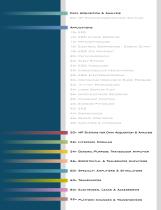
Data Acquisition & Analysis D 2 • MP SY5TEMS/Acg/Cr/VD^LEDGE SOFTWARE Applications 1D* EEG 12« ERS: Evoked Response 14* Psychophysiology 16« Electrical Bioimpedance / Cardiac Output 18* EOG: Eye Movement 2D* Plethysmography 22* Sleep Studies 24* ECG: Cardiology 26* Cardiovascular Hemodynamics 2 8* EGG: Electrogastrogram 3D* Continuous Noninvasive Blood Pressure 32* In-vitro Pharmacology 34* Laser Doppler Flow 36* Micro-electrode Recording 38* Pulmonary Function 4D* Exercise Physiology 42* EMG 44* Biomechanics 46* Remote Monitoring 48* Amplifiers & Interfaces 5D* MP Systems for Data Acquisition...
Open the catalog to page 3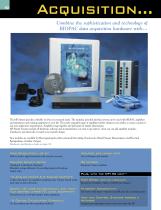
Acquisition... Combine the sophistication and technology of BIOPAC data acquisition hardware with… The MP System provides a flexible tool for your research needs. The modular, powerful interface system can be used with BIOPAC amplifiers and transducers and existing equipment in your lab. The newly expanded range of amplifiers further enhances your ability to create a system to suit your application requirements. Amplifiers snap together and pull apart for simple substitutions. MP Starter Systems include all hardware, software and documentation you need to get started…then you can add amplifier...
Open the catalog to page 4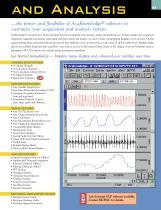
and Analysis ...the power and flexibility of AcqKnowledge® software to customize your acquisition and analysis system. AcqKnowledge® is an interactive, intuitive program that lets you instantly view, measure, analyze and transform data. Perform complex data acquisition, stimulation, triggering and analyses using simple pull-down menus and dialogs—no need to learn a programming language or new protocol. On-line analysis settings, filters and transformations provide real-time feedback or you can choose from a wide variety of off-line analysis tools. Multiple display options are available during...
Open the catalog to page 5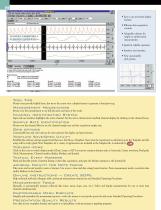
| 'Acquisition Sample Pate r-i|- -"j- J |p. r-^- • Easy to use waveform display features • Efficient data acquisition controls • Adaptable software for simple to sophisticated measurements • Quick & reliable operation • Intuitive user interface • New customizable grid options Lhy.B" h^mS-TMkrmHt rr^Fi UM-MIMl uni-'f-u'-dr IdT— -Ol'^F Tool Tips Mouse-overs provide helpful hints. Just move the cursor over a display feature to generate a descriptive tag. Measurement Mouse-overs Mouse-over the measurement to see full precision and units of the result. Channel Identification System Improved user interface...
Open the catalog to page 6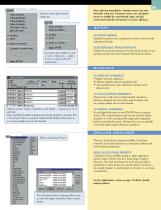
JJP15D SefcLp.Chamsb... Sehjp^cqMsilion.. Setup Iimeira... Setup :'i -Ij'.i... ShowJtipw'^etues Minuet Control.. Intuitive menu options make setup easy SetjLp^h-smeb... SetiJjaLflJiiltTL.. Start collecting immediately—intuitive menus save time and make setup easy. Customize menus, use calculation presets to simplify the experimental setup, and add measurement specific instructions to increase efficiency. Sdnctnelwork fd^rf UplSDiErialnurrlKi About MF1K Customize menu displays to suit a variety of protocols — makes it easy to comply with GLP requirements INTUITIVE MENUS Simplified setup lets users...
Open the catalog to page 7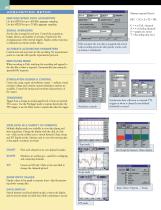
ACQUISITION SETUP Memory required (bytes): NEW HIGH SPEED DATA ACQUISITION Use the MP150 for up to 400 kHz aggregate sampling. Use the MP100 for up to 70 kHz aggregate sampling. SIGNAL AVERAGING See the data averaged in real time. Control the acquisition length, latency, and number of averages. Synchronize the averaging passes with external triggers. Employ artifact rejection to eliminate movement artifact effects. AUTOMATE ACQUISITION PARAMETERS Control start and stop times for the recording. Set measurement points to coincide with specific experimental protocol. C = # of Calc. channels A =...
Open the catalog to page 8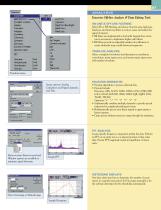
ANALYSIS Extensive Off-line Analysis & Data Editing Tools ON-LINE & OFF-LINE FILTERING Select IIR or FIR filtering, and choose from low pass, high pass, band pass and band stop filters to remove noise and isolate the signal of interest. • IIR filters are implemented as 2nd order biquads that can be run in succession to implement higher order filters. • FIR filters provide an adjustable number of coefficients to create arbitrarily steep cutoffs between frequencies. TEMPLATE ANALYSIS Select a template (waveform) and determine its correlation, convolution, mean square error, and inverse mean square...
Open the catalog to page 9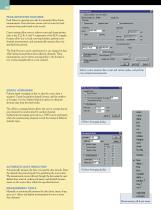
PEAK DETECTION FEATURES Peak Detector operation provides for automated data-driven measurements. Data selection cursors can be located at fixed positions from peaks found in the record. Cursor settings allow users to isolate events and characteristics such as the P, Q, R, S, and T components of the ECG complex. Features allow you to track a moving baseline, perform crosschannel measurements, and automatically measure data over specified time periods. The Peak Detector can be synchronized to one channel of data while taking measurements from adjacent channels. These measurements can be written...
Open the catalog to page 10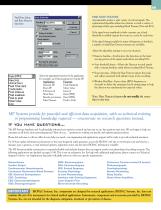
09 FIND RATE FEATURE Automatically analyze a wide variety of cyclical signals. The sophisticated algorithm allows the software to track a variety of physiological data types including Blood Pressure, Flow and ECG. Find Rate dialog and Rate Detector functions If the signal event amplitude is fairly constant, use a fixed threshold to reliably capture the event on a cycle-by-cycle basis. If the signal changes rapidly (in terms of frequency or baseline), a number of useful Rate Detector features are available. Adjust the algorithm settings to suit your situation. • Remove baseline—Synchronizes the...
Open the catalog to page 11All Biopac Systems catalogs and technical brochures
 BioHarness
2 Pages
 MP36R SYSTEMS
5 Pages
 MP160 SYSTEMS
9 Pages
 FNIR IMAGING
2 Pages
 Product Catalog 2018
9 Pages
 BSL CATALOG
11 Pages
 VR & Stimulus Catalog
16 Pages
 MRI catalog
12 Pages


- Analysis software
- Patient monitor
- Tablet computer software
- Tablet PC software
- Control software
- Windows software
- Laboratory software
- ECG patient monitor
- Monitoring software
- Automated software
- Compact patient monitor
- Acquisition software
- Medical camera
- Capture software
- Respiratory frequency patient monitor
- Heart rate patient monitor
- Tabletop patient monitor
- Patient monitor with USB port
- CCD camera
- Biosignal acquisition system