


- Products
- Catalogs
- News & Trends
- Exhibitions
BIO-GS3

BIO-GS3
- Standardized test with over 300 publications.
- High-frequency peak force capture at 1000 Hz.
- Internal memory for up to 100 values with embedded statistical calculations.
- Dedicated accessories for mice and rats, including T-shape bars and grids.
- Sensor capacity: 0 – 2.5 kg (25N), with other capacities available on request.
- Accuracy: 0.1% of full scale.
- Display resolution: 0.1 g.
- Data output via USB to computer.
- Power supply: Power adaptor (100-240 V) or rechargeable battery.
Catalog excerpts
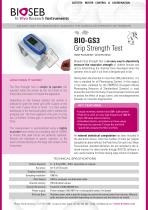
ACTIVITY, MOTOR CONTROL & COORDINATION • SPONTANEOUS PAIN - POSTURAL DEFICIT • PAIN - THERMAL ALLODYNIA / HYPERALGESIA • PAIN - MECHANICAL ALLODYNIA / HYPERALGESIA • ANXIETY & DEPRESSION DISORDER • LEARNING - MEMORY - ATTENTION - ADDICTION • PHARMACOLOGY & PHYSIOLOGICAL PARAMETERS • SURGERY & STEREOTAXY EQUIPMENT • METABOLISM AN EASY WAY TO OBJECTIVELY QUANTIFY THE MUSCULAR STRENGTH OF RODENTS BIO-GS3 Grip Strength Test INSTRUMENT OVERVIEW Bioseb’s Grip Strength Test is an easy way to objectively measure the muscular strength of rodents (mouse and rat) by determining the maximal force developed when the operator tries to pull it out from a designed grid or bar. HOW DOES IT WORK? The Grip Strength Test is simple to operate: the operator holds the animal by the tail (mice) or the body (rats) and lowers it toward the apparatus. Depending on the disease studied, the animal is allowed to grab the metal grid with 4 paws or the T-bar with 2 paws (front or hind) . It is then pulled backwards in the horizontal plane until it release the grasping tool. The force applied to the grid or to the bar, just before it loses grip, is recorded as the Peak force. The measurement is accomplished using a highly accurate force sensor at a sampling rate of 1000Hz to ensure that peak forces are perfectly captured. Results are displayed in grams, newtons, or lbs (user’s choice) directly on the large LCD screen of the instrument. Having been documented in more than 300 publications, it is now a standard for all Phenotyping Centers. In this regard, it has been validated by the EMPRESS (European Mouse Phenotyping Resource of Standardised Screens), is used around the word for the study of neuromuscular functions and to assess the effect of drugs, toxins, and neurodegenerative diseases on muscular degeneration. KEY FEATURES • Largely reviewed, standard test (300+ publications) • Peak force catch at a very high frequency of 1000 Hz • Up to 100 value internal memory • Embedded statistic calculations on those values • Dedicated accessories (T shape Bar and Grid) specifically designed for Mice and Rats An internal statistical computation has been included in the electronic device. Once the number of trials per subject (sample) has been defined, the Peak force for each trial, Mean Force/animal, standard deviation, etc are recorded in the internal memory for data transfer through BIO-CIS software: a very useful feature for those having large cohort of subjects. TECHNICAL SPECIFICATIONS Sensor Capacity Accuracy Display resolution Sampling resolution Data Output Internal memory Overall dimensions 0 – 2, 5 kg (25N) - Other capacities on request. 0,1 % of full scale 0.1 g 1000 Hz USB to computer via dedicated cable 100 individual values Footprint of 400x180x200 mm Power supply Power adaptor (100-240 V) or rechargeable battery (included) Stainless steel, with a specific design to protect the animal paws from injuries, different grids and bars are available depending on the specie and the limbs to be tested. Phone: North America +1 727 521 1808 - Europe & other Areas +33 442 344 360 - Email: i
Open the catalog to page 1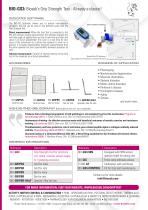
BIO-GS3: Bioseb’s Grip Strength Test - Already a classic! DEDICATED SOFTWARE The BIO-CIS Software allows you to reduce inter-operator variability. BIO-CIS can be used in two different ways with the Grip Strength Test: Direct measurement: When the Grip Test is connected to the BIO-CIS software during measurement, the software displays the real-time graph of applied force vs time in real-time and store the value in an Excel spreadsheet The curve is a real help for new users of the instrument as it allows the operator to work on is gesture. It increase reproducibility between measurements from the...
Open the catalog to page 2All Bioseb catalogs and technical brochures
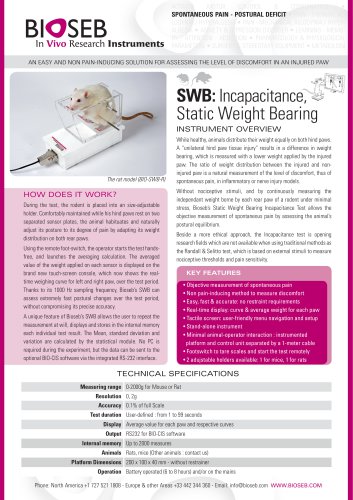 SWB
SWB2 Pages
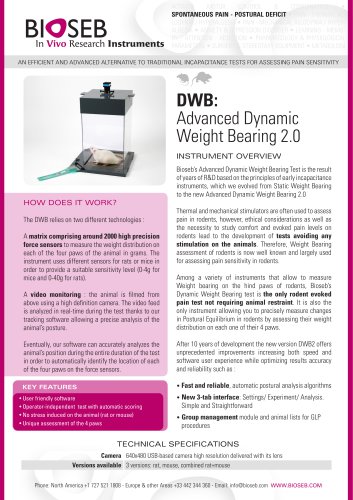 DWB
DWB2 Pages
 BIO-CH
2 Pages
 BiosebLab Catalogue
2 Pages
 Bioseb Catalogue
4 Pages
Archived catalogs
 Infrared thermometer
2 Pages
 SMALGO
2 Pages
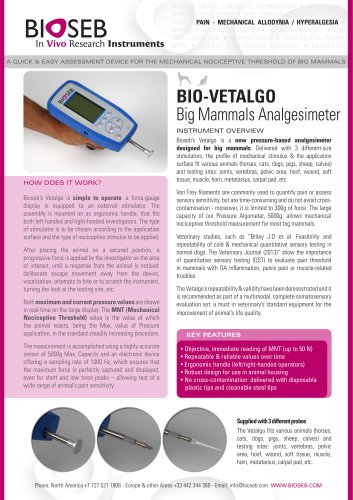 BIO-VETALGO
2 Pages
 ACTIVWHEEL
2 Pages
 OF3D
OF3D2 Pages
 Rotarod
2 Pages
 KWB
KWB2 Pages


- Anatomy model
- Training anatomy model
- Training phantom
- Bioseb analysis software
- Thermometer
- SpO2 monitor
- Surgical anatomy model
- Visualization software
- Digital thermometer
- Control software
- Reporting software
- Windows software
- Laboratory software
- Monitoring software
- Surgical phantom
- Infrared thermometer
- Electronic ventilator
- Acquisition software
- Design software
- Traceability software