


- Products
- Catalogs
- News & Trends
- Exhibitions
DWB
DWB
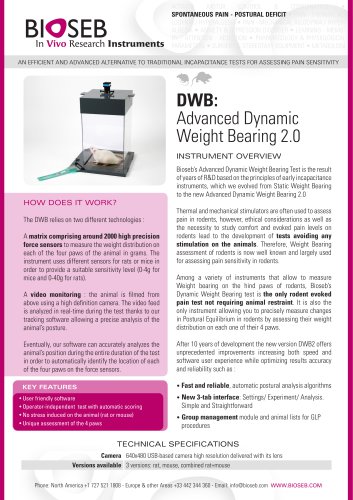
Bioseb's Advanced Dynamic Weight Bearing Test (DWB 2.0) is an innovative tool for assessing pain sensitivity in rodents without inducing stress. It improves upon traditional incapacitance tests by offering a non-invasive method to measure weight distribution across all four paws of the animal, providing insights into postural equilibrium.
Key Features
- User-friendly software with automatic scoring.
- Operator-independent testing.
- No stress induced on the animal.
- Unique assessment of all four paws.
Technical Specifications
- High-resolution 640x480 USB-based camera.
- Three versions available: rat, mouse, and combined rat+mouse.
How It Works
The DWB uses a matrix of approximately 2000 high-precision force sensors to measure weight distribution on each paw. It includes a video monitoring system that analyzes the animal's posture in real-time, allowing for precise identification of paw positions.
Software Capabilities
- Measures weight and surface area for each paw.
- Calculates weight ratios and variability.
- Tracks time spent on each paw and duration of different postures.
Applications
- Pain and nociception/analgesia studies, including bone cancer, neuropathic, and inflammation models.
- Physiological studies such as peripheral ischemia and cerebrovascular accident models.
- Neurological research including spinal cord injury recovery.
Ordering Information
The DWB is available in three configurations tailored for different rodent sizes: rat, mouse, and a dual setup for both.
Contact Information
For more details, visit www.bioseb.com or contact via phone or email provided in the document.
Catalog excerpts
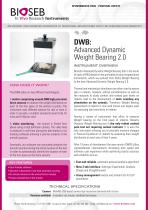
ACTIVITY, MOTOR CONTROL & COORDINATION • SPONTANEOUS PAIN - POSTURAL DEFICIT • PAIN - THERMAL ALLODYNIA / HYPERALGESIA • PAIN - MECHANICAL ALLODYNIA / HYPERALGESIA • ANXIETY & DEPRESSION DISORDER • LEARNING - MEMORY - ATTENTION - ADDICTION • PHARMACOLOGY & PHYSIOLOGICAL PARAMETERS • SURGERY & STEREOTAXY EQUIPMENT • METABOLISM AN EFFICIENT AND ADVANCED ALTERNATIVE TO TRADITIONAL INCAPACITANCE TESTS FOR ASSESSING PAIN SENSITIVITY DWB: Advanced Dynamic Weight Bearing 2.0 INSTRUMENT OVERVIEW Bioseb’s Advanced Dynamic Weight Bearing Test is the result of years of R&D based on the principles of early incapacitance instruments, which we evolved from Static Weight Bearing to the new Advanced Dynamic Weight Bearing 2.0 HOW DOES IT WORK? The DWB relies on two different technologies : A matrix comprising around 2000 high precision force sensors to measure the weight distribution on each of the four paws of the animal in grams. The instrument uses different sensors for rats or mice in order to provide a suitable sensitivity level (0-4g for mice and 0-40g for rats). Thermal and mechanical stimulators are often used to assess pain in rodents, however, ethical considerations as well as the necessity to study comfort and evoked pain levels on rodents lead to the development of tests avoiding any stimulation on the animals. Therefore, Weight Bearing assessment of rodents is now well known and largely used for assessing pain sensitivity in rodents. A video monitoring : the animal is filmed from above using a high definition camera. The video feed is analyzed in real-time during the test thanks to our tracking software allowing a precise analysis of the animal’s posture. Among a variety of instruments that allow to measure Weight bearing on the hind paws of rodents, Bioseb’s Dynamic Weight Bearing test is the only rodent evoked pain test not requiring animal restraint. It is also the only instrument allowing you to precisely measure changes in Postural Equilibrium in rodents by assessing their weight distribution on each one of their 4 paws. Eventually, our software can accurately analyzes the animal’s position during the entire duration of the test in order to automatically identify the location of each of the four paws on the force sensors. After 10 years of development the new version DWB2 offers unprecedented improvements increasing both speed and software user experience while optimizing results accuracy and reliability such as : • Fast and reliable, automatic postural analysis algorithms • User friendly software • Operator-independent test with automatic scoring • No stress induced on the animal (rat or mouse) • Unique assessment of the 4 paws • New 3-tab interface: Settings/ Experiment/ Analysis. • Group management module and animal lists for GLP TECHNICAL SPECIFICATIONS Camera 640x480 USB-based camera high resolution delivered with its lens Versions available 3 versions: rat, mouse, combined rat+mouse Phone: North America +1 727 521 1808 - Europe & other Areas +33 442 344 360 - Em
Open the catalog to page 1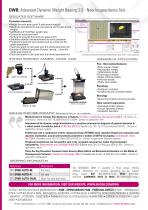
DEDICATED SOFTWARE Parameters measured: • Weight for each paw (g and % total animal weight) • Weight for grouped front and rear paws (g and % total animal weight) • Left/Right and Front/Rear weight ratio • Surface for grouped front and rear paws (mm2) • Variability (standart deviation/mean) for each parameter • Parameters given for each posture and as a mean for the whole experiment • Total time spent on each paw over the whole experiment (s) • Duration of different postures (4 paws, rearing...) over the whole experiment (s) • Total time spent on each paw over the whole experiment (s) SYSTEM...
Open the catalog to page 2All Bioseb catalogs and technical brochures
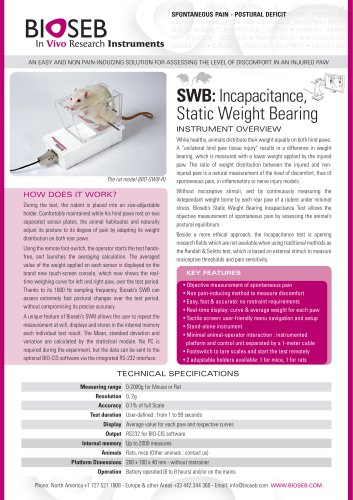 SWB
2 Pages
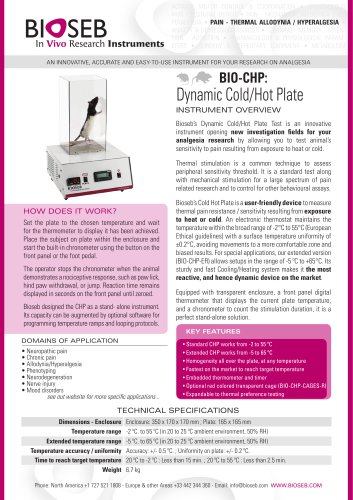 BIO-CH
2 Pages
 BiosebLab Catalogue
2 Pages
 Bioseb Catalogue
4 Pages
Archived catalogs
 Infrared thermometer
2 Pages
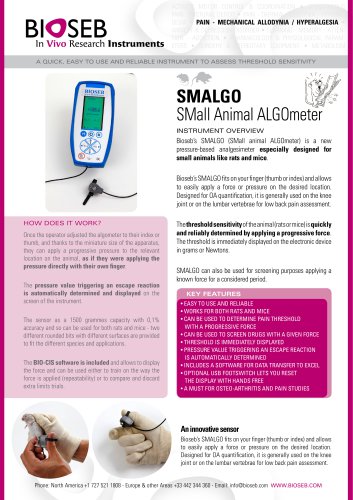 SMALGO
2 Pages
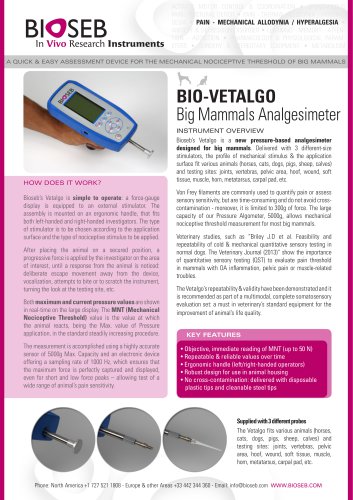 BIO-VETALGO
2 Pages
 BIO-GS3
2 Pages
 ACTIVWHEEL
2 Pages
 OF3D
2 Pages
 Rotarod
2 Pages
 KWB
2 Pages


- Anatomy model
- Training anatomy model
- Training phantom
- Bioseb analysis software
- Thermometer
- SpO2 monitor
- Surgical anatomy model
- Visualization software
- Digital thermometer
- Control software
- Reporting software
- Windows software
- Laboratory software
- Surgical phantom
- Monitoring software
- Infrared thermometer
- Electronic ventilator
- Acquisition software
- Design software
- Traceability software