


- Products
- Catalogs
- News & Trends
- Exhibitions
STUDIES ON ACTIVITY, MOTOR CONTROL & COORDINATION
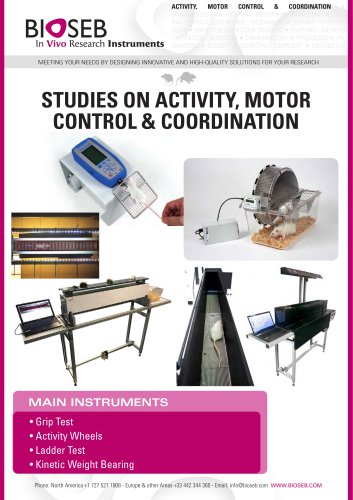
STUDIES ON ACTIVITY, MOTOR CONTROL & COORDINATION
This document outlines Bioseb's advanced tools for studying activity, motor control, and coordination in rodents, focusing on the Grip Test, Activity Wheels, and Ladder Test. These instruments are designed to measure muscular strength, spontaneous activity, and walking skills.
The Grip Strength Test measures rodent muscular strength, capturing peak force at 1000 Hz and storing up to 100 values. Validated by EMPRESS, it is used globally for neuromuscular studies and drug effects on muscular degeneration. Key features include a sensor capacity of 0-2.5 kg, 0.1% accuracy, and USB data output.
These wheels quantify rodents' spontaneous motor activity in their home cage, crucial for circadian rhythm studies. Supporting up to 64 wheels, they measure distance, speed, and acceleration, with specific designs for rats and mice.
This test assesses rodent walking capabilities, focusing on skilled walking and motor function, useful in neurodegenerative and injury studies. It includes software for automatic fault detection and video analysis.
Bioseb offers software like BIO-CIS and BIO-ACTIVW-SOFT for enhanced data analysis and reduced variability, along with accessories for different species and experimental needs.
The instruments are used in research on phenotyping, neuromuscular degeneration, motor control disorders, drug screening, aging, metabolic diseases, and cardiovascular disorders.
- Purpose: Assesses foot faults in rodents, indicating motor function and coordination.
- Technology: Uses over 150 infrared detectors and high-speed video tracking to identify faults.
- Specifications: Adjustable rung patterns for mice and rats.
- Software: Analyzes data to recognize valid runs and categorize gait behavior.
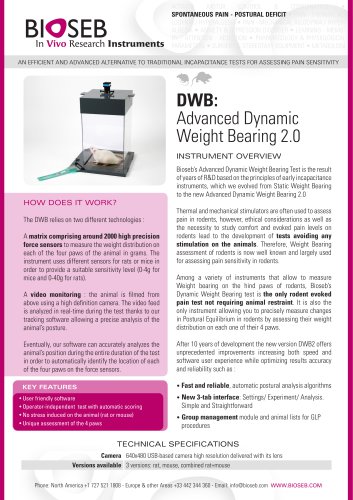
- Purpose: Measures weight distribution and gait parameters in rodents.
- Technology: Combines video tracking with 6000 force sensors for real-time measurement.
- Specifications: Includes adjustable corridors and specific camera specifications.
- Software: Measures gait parameters and provides force distribution curves.
Both systems are used in research on neurodegenerative diseases, motor-system lesions, and recovery from injuries, studying conditions like Parkinson's disease and neuropathic pain.
References for ordering configurations of the Ladder Test and KWB systems are provided, along with contact information for inquiries.
Catalog excerpts
ACTIVITY, MOTOR CONTROL & COORDINATION • SPONTANEOUS PAIN - POSTURAL DEFICIT • PAIN - THERMAL ALLODYNIA / HYPERALGESIA • PAIN - MECHANICAL ALLODYNIA / HYPERALGESIA • ANXIETY & DEPRESSION DISORDER • LEARNING - MEMORY - ATTENTION - ADDICTION • PHARMACOLOGY & PHYSIOLOGICAL PARAMETERS • SURGERY & STEREOTAXY EQUIPMENT • METABOLISM MEETING YOUR NEEDS BY DESIGNING INNOVATIVE AND HIGH-QUALITY SOLUTIONS FOR YOUR RESEARCH STUDIES ON ACTIVITY, MOTOR CONTROL & COORDINATION MAIN INSTRUMENTS • Grip Test • Activity Wheels • Ladder Test • Kinetic Weight Bearing Phone: North America +1 727 521 1808 - Europe & other Areas +33 442 344 360 - Email: info@bios
Open the catalog to page 1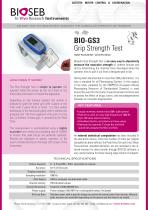
ACTIVITY, MOTOR CONTROL & COORDINATION In Vivo Research Instruments AN EASY WAY TO OBJECTIVELY QUANTIFY THE MUSCULAR STRENGTH OF RODENTS BIO-GS3Grip Strength Test INSTRUMENT OVERVIEW Bioseb's Grip Strength Test is an easy way to objectively measure the muscular strength of rodents (mouse and rat) by determining the maximal force developed when the operator tries to pull it out from a designed grid or bar. The Grip Strength Test is simple to operate: the operator holds the animal by the tail (mice) or the body (rats) and lowers it toward the apparatus. Depending on the disease studied, the animal...
Open the catalog to page 2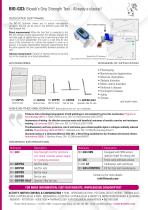
DEDICATED SOFTWARE The BIO-CIS Software allows you to reduce inter-operator variability. BIO-CIS can be used in two different ways with the Grip Strength Test: Direct measurement: When the Grip Test is connected to the BIO-CIS software during measurement, the software displays the real-time graph of applied force vs time in real-time and store the value in an Excel spreadsheet The curve is a real help for new users of the instrument as it allows the operator to work on is gesture. It increase reproducibility between measurements from the same operator but also reproducibility between operators...
Open the catalog to page 3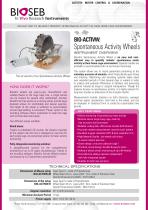
ACTIVITY, MOTOR CONTROL & COORDINATION AN EASY WAY TO QUANTIFY RODENTS' SPONTANEOUS ACTIVITY IN THEIR HOME CAGE ENVIRONMENT The rat version of our Spontaneous Activity Wheel HOW DOES IT WORK? Biosebs wheels are easy-to-use, time-efficient and reliable.Thanks to the large cage size, a single animal can be housed for several days undisturbed. Animals benefit from free access to a running wheel, and the large diameter allows for comfortable and natural exercise. The height of the wheel is sufficient to accommodate normal cage bedding. A convenient "Pause" option in the recording software allows...
Open the catalog to page 4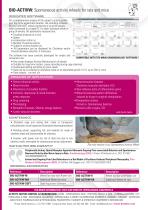
BIO-ACTIVW: Spontaneous activity wheels for rats and mice DEDICATED SOFTWARE For a comprehensive analyze of the subject's activity profile over the entire experiment duration, the recording software BIO-ACTIVW-SOFT allows monitoring of up to 64 wheels, when connected to a single PC. For each individual wheel or group of wheels, the parameters measured are: : • Acceleration m/(min.s) • Number of exercise events • Subject's activity duration (s) • All parameters can be displayed for Clockwise and/or Counterclockwise direction, if necessary The software has been carefully developed for simple and...
Open the catalog to page 5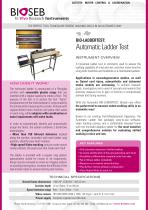
ACTIVITY, MOTOR CONTROL & COORDINATION In Vivo Research Instruments THE PERFECT TOOL TO MEASURE RODENT WALKING SKILLS IN AN AUTOMATIC WAY HOW DOES IT WORK? The horizontal ladder is constructed of a Plexiglas corridor with removable plastic rungs that are inserted with a regular spacing to create a floor. The purpose of the test is to access the foot "faults" (misplacement of the limbs between 2 rungs) made by the animal while traversing the corridor. Animals with regular/skilled motor function will place their paws on each rung, while subjects with coordination or motor impairments will make...
Open the catalog to page 6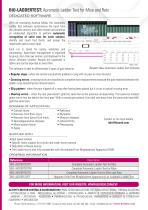
DEDICATED SOFTWARE With its innovating Analyze Mode, the Automatic Ladder Test software synchronizes the input from the infrared sensors and video stream and employs an elaborated algorithm to perform automatic recognition of valid runs for each subject, identify and count foot faults, and assign the responsible paw to each fault. Each run is saved for replay, validation and commentary. Experiment management is organized by group, then trials per animal, and displayed in the active software window. Results are organized in tables and can be exported as excel files. The software is able to differentiate...
Open the catalog to page 7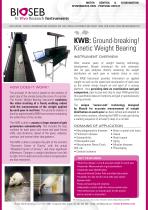
ACTIVITY, MOTOR CONTROL & COORDINATION • SPONTANEOUS PAIN - POSTURAL DEFICIT • PAIN - THERMAL ALLODYNIA / HYPERALGESIA • PAIN - MECHANICAL ALLODYNIA / HYPERALGESIA • ANXIETY & DEPRESSION DISORDER • LEARNING - MEMORY - ATTENTION - ADDICTION • PHARMACOLOGY & PHYSIOLOGICAL PARAMETERS • SURGERY & STEREOTAXY EQUIPMENT • METABOLISM EXCLUSIVE: YIELDS INFORMATION CURVES ON THE FORCE DISTRIBUTION OVER TIME FOR EACH PAW INDEPENDENTLY KWB: Ground-breaking! Kinetic Weight Bearing INSTRUMENT OVERVIEW After several years of weight bearing technology development, Bioseb introduced the only automatic test for...
Open the catalog to page 8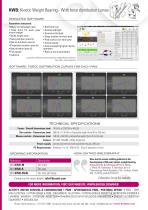
KWB: Kinetic Weight Bearing - With force distribution curves DEDICATED SOFTWARE Parameters measured: • Mean forces/weight ratio • Peak force for each paw/ animal weight • Overlap left/right • Scored prints/total • Steps number for each paw • Peak surface for each paw • Animal speed • Animal weight (g) (given by the operator) Screenshot of Biosebs Advanced Dynamic Weight Bearing Software: dual video+ sensor approach TECHNICAL SPECIFICATIONS Frame - Overall dimensions (mm) 1810 (H) x 2228 (W) x 405 (D) Rat corridor - Dimensions (mm) 260 (H) x 1130 (W) x Adjustable depth (from 60 to 165 mm) Mouse...
Open the catalog to page 9All Bioseb catalogs and technical brochures
 STUDIES ON PAIN
8 Pages
 SWB
2 Pages
 DWB
2 Pages
 BIO-CH
2 Pages
 BiosebLab Catalogue
2 Pages
 Bioseb Catalogue
4 Pages
Archived catalogs
 Infrared thermometer
2 Pages
 SMALGO
2 Pages
 BIO-VETALGO
2 Pages
 BIO-GS3
2 Pages
 ACTIVWHEEL
2 Pages
 OF3D
2 Pages
 Rotarod
2 Pages
 KWB
2 Pages


- Anatomy model
- Training anatomy model
- Training phantom
- Bioseb analysis software
- Thermometer
- SpO2 monitor
- Surgical anatomy model
- Visualization software
- Digital thermometer
- Control software
- Reporting software
- Windows software
- Laboratory software
- Monitoring software
- Surgical phantom
- Infrared thermometer
- Electronic ventilator
- Acquisition software
- Design software
- Traceability software