


- Products
- Catalogs
- News & Trends
- Exhibitions
SWB
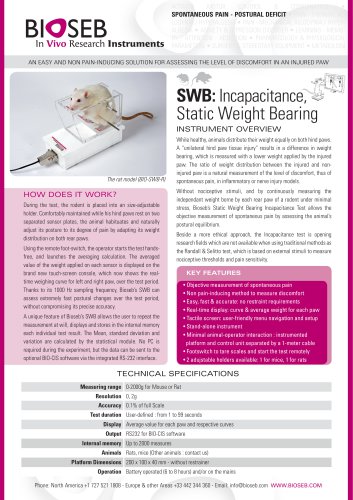
SWB
The document presents the Static Weight Bearing (SWB) Incapacitance Test, a non-pain-inducing method for assessing discomfort in injured paws of rodents. This method provides an objective measurement of spontaneous pain without the need for nociceptive stimuli, offering a more ethical approach compared to traditional methods.
Key Features
- Objective and non-pain-inducing measurement of discomfort.
- Easy, fast, and accurate with no restraint requirements.
- Real-time display of weight distribution curves for each paw.
- User-friendly tactile screen for menu navigation and setup.
- Stand-alone instrument with minimal animal-operator interaction.
- Remote footswitch for hands-free operation.
- Adjustable holders for mice and rats.
Instrument Overview
The SWB test measures the weight distribution between the injured and non-injured paws of rodents, indicating the level of discomfort. The test is conducted with minimal stress, allowing the animal to naturally adjust its posture. The device features a touch-screen console displaying real-time weighing curves and statistical data.
Technical Specifications
- Measuring range: 0-2000g for mice or rats.
- Resolution: 0.2g.
- Accuracy: 0.1% of full scale.
- User-defined test duration: 1 to 99 seconds.
- Internal memory for up to 2000 measures.
- Battery operated (6 to 8 hours) and/or mains powered.
Applications
- Osteoarthritis, neuropathy, inflammation models.
- Peripheral nerve injury, incision recovery.
- Cartilage degeneration, mechanical hyperalgesia models.
- Bone cancer pain models and more.
Software and Data Management
The optional BIO-CIS software allows data transfer to Microsoft Excel for advanced statistical analysis. The software interface is easy to set up and helps avoid transcription errors.
Ordering Information
References for mice and rat models, spare restrainers, and optional software are provided for ordering. For more information, visit the Bioseb website.
Catalog excerpts
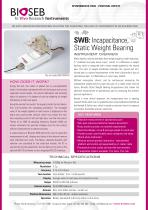
In Vivo Research Instruments SPONTANEOUS PAIN - POSTURAL DEFICIT AN EASY AND NON PAIN-INDUCING SOLUTION FOR ASSESSING THE LEVEL OF DISCOMFORT IN AN INJURED PAW SWB: Incapacitance, Static Weight BearingINSTRUMENT OVERVIEW While healthy, animals distribute their weight equally on both hind paws. A "unilateral hind paw tissue injury" results in a difference in weight bearing, which is measured with a lower weight applied by the injured paw. The ratio of weight distribution between the injured and non-injured paw is a natural measurement of the level of discomfort, thus of spontaneous pain, in inflammatory or nerve injury models. During the test, the rodent is placed into an size-adjustable holder. Comfortably maintained while his hind paws rest on two separated sensor plates, the animal habituates and naturally adjust its posture to its degree of pain by adapting its weight distribution on both rear paws. Using the remote foot-switch, the operator starts the test handsfree, and launches the averaging calculation. The averaged value of the weight applied on each sensor is displayed on the brand new touch-screen console, which now shows the realtime weighing curve for left and right paw, over the test period. Thanks to its 1000 Hz sampling frequency, Bioseb's SWB can assess extremely fast postural changes over the test period, without compromising its precise accuracy. A unique feature of Bioseb's SWB allows the user to repeat the measurement at will, displays and stores in the internal memory each individual test result. The Mean, standard deviation and variation are calculated by the statistical module. No PC is required during the experiment, but the data can be sent to the optional BIO-CIS software via the integrated RS-232 interface. Without nociceptive stimuli, and by continuously measuring the independant weight borne by each rear paw of a rodent under minimal stress, Bioseb's Static Weight Bearing Incapacitance Test allows the objective measurement of spontaneous pain by assessing the animal's postural equilibrium. Beside a more ethical approach, the Incapacitance test is opening research fields which are not available when using traditional methods as the Randall & Selitto test, which is based on external stimuli to measure nociceptive thresholds and pain sensitivity. • Objective measurement of spontaneous pain • Non pain-inducing method to measure discomfort • Easy, fast & accurate: no restraint requirements • Real-time display: curve & average weight for each paw • Tactile screen: user-friendly menu navigation and setup • Stand-alone instrument • Minimal animal-operator interaction : instrumented platform and control unit separated by a 1-meter cable • Footswitch to tare scales and start the test remotely • 2 adujstable holders available: 1 for mice, 1 for rats Measuring range Resolution Accuracy Test duration Display Output User-defined : from 1 to 99 seconds Average value for each paw and respective curves Phone: North America +1 727 521 1808 - Europe & other Areas +33 442 344 360 - Email: [email protected] WWW.BIOSEB.COM
Open the catalog to page 1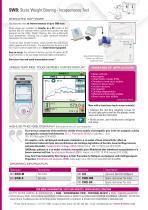
DEDICATED SOFTWARE The Instrument has an internal memory of up to 2000 tests. Those values are available for transfer to a PC thanks to the optional BIO-CIS software which collects and transfers the data acquired via the Static Weight Bearing Test into a Microsoft Excel spreadsheet, allowing you to apply advanced statistical calculations for your research. To use our Data Transfer function, simply connect the USB/RS232 cable supplied with the device : this operation can be done at the end of your batch of experiment, as a stand-alone equipment. Easy to set up, this software interface uses the...
Open the catalog to page 2All Bioseb catalogs and technical brochures
 DWB
DWB2 Pages
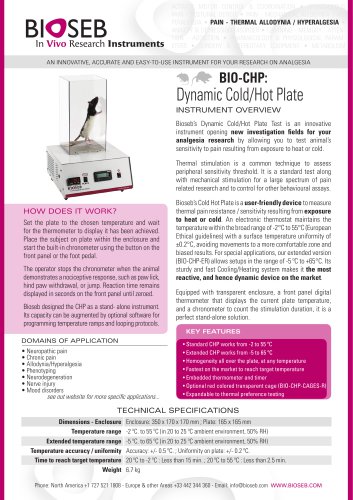 BIO-CH
2 Pages
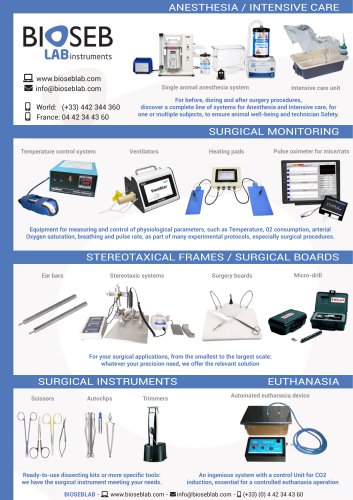 BiosebLab Catalogue
2 Pages
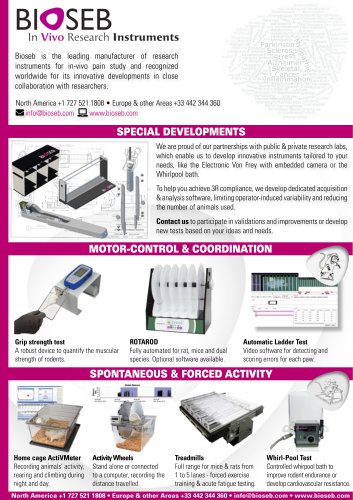 Bioseb Catalogue
4 Pages
Archived catalogs
 Infrared thermometer
2 Pages
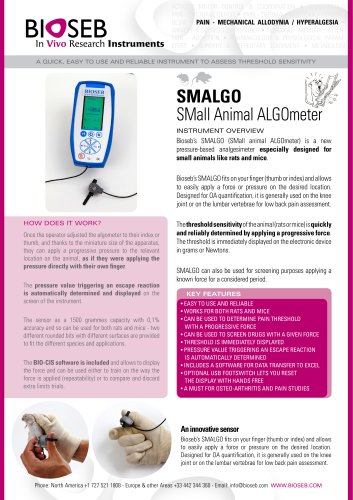 SMALGO
2 Pages
 BIO-VETALGO
2 Pages
 BIO-GS3
2 Pages
 ACTIVWHEEL
2 Pages
 OF3D
OF3D2 Pages
 Rotarod
2 Pages
 KWB
KWB2 Pages


- Anatomy model
- Training anatomy model
- Training phantom
- Bioseb analysis software
- Thermometer
- SpO2 monitor
- Surgical anatomy model
- Visualization software
- Digital thermometer
- Control software
- Reporting software
- Windows software
- Laboratory software
- Surgical phantom
- Monitoring software
- Infrared thermometer
- Electronic ventilator
- Acquisition software
- Design software
- Traceability software