
- Catalogs
- BIOSENCY SAS
- ATS2023

ATS2023
ATS2023
Catalog excerpts
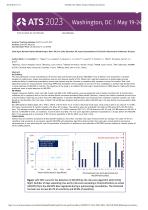
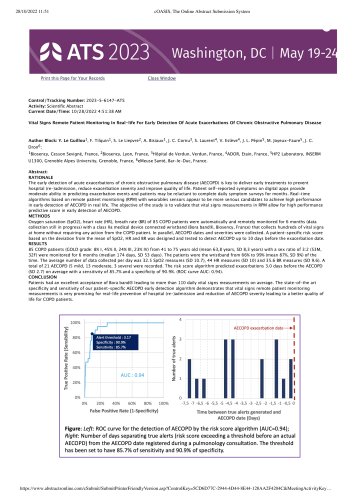
cOASIS, The Online Abstract Submission System Activity: Scientific Abstract Vital Signs Remote Patient Monitoring In Real-life For Early Detection Of Acute Exacerbations Of Chronic Obstructive Pulmonary Disease 1Biosency, Cesson Sevigne, France,2Biosency, Lyon, France,3Hopital de Verdun, Verdun, France,4ADOR, Etain, France,SHP2 Laboratory, INSERM U1300, Grenoble Alpes University, Grenoble, France?eMeuse Sante, Bar-le-Duc, France. The early detection of acute exacerbations of chronic obstructive pulmonary disease (AECOPD) is key to deliver early treatments to prevent hospital (re-)admission, reduce exacerbation severity and improve quality of life. Patient self-reported symptoms on digital apps provide moderate ability in predicting exacerbation events and patients may be reluctant to complete daily symptom surveys for months. Real-time algorithms based on remote patient monitoring (RPM) with wearables sensors appear to be more serious candidates to achieve high performance in early detection of AECOPD in real life. The objective of the study is to validate that vital signs measurements in RPM allow for high performance predictive score in early detection of AECOPD. Oxygen saturation (Sp02), heart rate (HR), breath rate (BR) of 85 COPD patients were automatically and remotely monitored for 6 months (data collection still in progress) with a class lla medical device connected wristband (Bora band®, Biosency, France) that collects hundreds of vital signs at home without requiring any action from the COPD patient. In parallel, AECOPD dates and severities were collected. A patient-specific risk score based on the deviation from the mean of Sp02, HR and BR was designed and tested to detect AECOPD up to 10 days before the exacerbation date. RESULTS 85 COPD patients (GOLD grade: 8% I, 45% II, 24% III, 23% IV) from 41 to 75 years old (mean 63,8 years, SD 8,3 years) with a sex ratio of 3:2 (53M, 32F) were monitored for 6 months (median 174 days, SD 53 days). The patients wore the wristband from 66% to 99% (mean 87%, SD 9%) of the time. The average number of data collected per day was 32.5 Sp02 measures (SD 10.7), 44 HR measures (SD 10) and 35.6 BR measures (SD 9.6). A total of 21 AECOPD (5 mild, 13 moderate, 3 severe) were recorded. The risk score algorithm predicted exacerbations 3.0 days before the AECOPD (SD 2.7) on average with a sensitivity of 85.7% and a specificity of 90.9%. (ROC curve AUC: 0.94). Patients had an excellent acceptance of Bora band® leading to more than 110 daily vital signs measurements on average. The state-of-the art specificity and sensitivity of our patient-specific AECOPD early detection algorithm demonstrates that vital signs remote patient monitoring measurements is very promising for real-life prevention of hospital (re-)admission and reduction of AECOPD severity leading to a better quality of life for COPD patients. Figure: Left: ROC curve for the detection of AECOPD by the risk score algorithm (AUC=0.94); Right: Number of days separating true alerts (risk score exceeding a threshold before an actual AECOPD) from the AECOPD date registered during a pulmonology consultation. The threshold has been set to have 85.7% of sensitivity and 90.9% of specificity.
Open the catalog to page 1
- Vitals monitor
- Pulse oximetry vital signs monitor
- Heart rate vital signs monitoring device
- Continuous vital signs monitor
- Vital signs monitor with touchscreen
- Wearable vital signs monitor
- Vital signs monitor with integrated battery
- Home care vital signs monitor
- Computer-based vital signs monitor
- Remote vital signs monitor
- Modular vital signs monitor
- Smartphone-based vital signs monitor
- COPD vital signs monitor