
- Catalogs
- Biosurfit, SA
- spinit® BC Quick Guide

spinit® BC Quick Guide

spinit® BC Quick Guide
Catalog excerpts

Quick Reference Guide IMPORTANT! • Read the entire spinit® BC Quick Guide before testing patient samples or controls. • See the spinit® user Manual for more information about the operation of the Instrument and Disc. • Confirm the spinit® instrument you are using is a spinit® CRP/BC (label on the front.) • See the spinit® BC Instructions for use for more information about the BC assay. • Use spinit® BC control materials to confirm that the instrument and test kit are working properly. 1. GETTING STARTED: spinit® instrument Take time to familiarize yourself with the spinit® instrument and the test kit. 1. ON button. 2. Connect the power supply unit 3. USB Ports 4. Ethernet cable 5. Touchscreen 6. Instrument tray 7. USB barcode reader Training videos are available on the spinit® instrument. Refer to the videos at any time to become familiarized with the spinit® system. spinit® disc spinit® strip Sample collection device used exclusively with spinit® tests. Information Codes INFO CODE General failure of the spinit® BC discs. spinit® instrument auto-focus function was performed formed but focus quality is compromised. Sample processing is compromised likely due to incomplete lysis of erythrocytes and/or poor staining of leucocytes. Collect a new sample and repeat the test, using a new spinit® BC disc as per Instructions for Use. If available, test a new spinit® BC disc from an alternative lot. If the problem persists, please contact your local supplier. Low and/or compromised counts of leucocytes. Collect a new sample and repeat the test, using a new spinit® BC disc as per Instructions for Use. Take particular attention to minimize time between sample loading and disc insertion on spinit®. If the problem persists please contact your local supplier. Collect a new sample and repeat the test, using a new spinit® BC disc as per Instructions for Use. If the problem persists, please contact your local supplier.
Open the catalog to page 1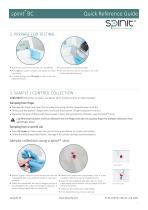
Quick Reference Guide • Switch the instrument on and wait for it to stabilize; • Scan barcode from the pouch label; • Press Start for patient samples and follow on-screen • Remove disc from pouch and place it on a flat instructions; • If control testing, press QC mode on main screen and surface with label facing up; follow instructions. 3. SAMPLE / CONTROL COLLECTION Important! Remember to always use gloves when testing controls or blood samples. Sampling from finger • Massage the finger and clean the sampling area using alcohol. Allow the area to air dry. • Firmly prick the patient´s finger...
Open the catalog to page 2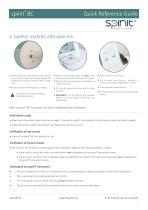
Quick Reference Guide 4. SAMPLE LOADING AND ANALYSIS • Immediately insert the strip all the way into the • Once you have the disc ready, click Next on the disc and fold it back until it breaks, leaving the loaded part of the strip inside the disc’s sample well; screen and wait for the instrument tray to open; Place the disc on instrument tray and follow on screen instructions; • Discard the strip's handling area accordingly. • The tray will automatically close and the assay will start; Test analysis must start immediately after loading the disc. • Important! Do not close the tray manually. •...
Open the catalog to page 3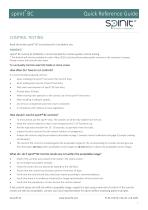
Quick Reference Guide CONTROL TESTING Read the entire spinit® BC Instructions for Use before use. Important! spinit® BC control kit (910201) is recommended for routine quality control testing. * The final kit will only be available for sale in May-2020, but biosurfit provides quality controls at the customer's request. Please contact the biosurfit sales team. To run Quality Controls select QC Mode in Home screen. How often do I have to run controls? It is recommended analysing controls: • when installing the spinit® instrument for the first time; when testing each new lot of spinit® test discs;...
Open the catalog to page 4All Biosurfit, SA catalogs and technical brochures
 biosurfit_CDMO
2 Pages
 spinit® HbA1c Quick Guide
2 Pages
 spinit® CRP Quick Guide
4 Pages
- Solvent reagent
- Blood detection kit
- Serum detection kit
- Plasma detection kit
- Blood rapid screening test
- Protein reagent
- Rapid whole blood test
- Whole blood detection kit
- Clinical detection kit
- Quality control reagent
- POC analyzer
- Hematology test kit
- POC blood analyzer
- Protein POC analyzer
- POC analyzer with touchscreen
- Portable POC analyzer
- Immunoassay POC analyzer
- Whole blood POC analyzer
- CRP assay kit