
- Catalogs
- The Brewer Company
- Cart Series

Cart Series

1 / 2 PagesView full catalog
Cart Series
Product catalog summary
Overview of Utility Carts
Utility carts are versatile transport devices designed to facilitate the movement of goods, tools, or equipment in various settings such as warehouses, hospitals, offices, and industrial environments.
Specifications
- Materials: Typically constructed from steel, aluminum, or durable plastics to ensure strength and longevity.
- Load Capacity: Varies widely depending on design, commonly ranging from 100 to 1000 pounds.
- Dimensions: Sizes differ based on intended use, with common platform sizes around 24x36 inches.
- Wheels: Equipped with swivel or fixed casters, often with locking mechanisms for stability.
Procedures for Use
- Ensure load is evenly distributed to prevent tipping.
- Do not exceed the maximum load capacity specified by the manufacturer.
- Use locking brakes when stationary to avoid unintended movement.
- Inspect wheels and frame regularly for wear and damage.
Standards and Norms
- Compliance with OSHA guidelines for safe material handling.
- Adherence to ANSI standards for industrial carts.
- Use of non-marking wheels in sensitive environments to prevent floor damage.
Recommendations and Best Practices
- Select carts with ergonomic handles to reduce operator strain.
- Choose materials resistant to corrosion for use in wet or chemical environments.
- Regular maintenance schedules to prolong cart lifespan and ensure safety.
- Training for users on proper loading and maneuvering techniques.
Summary of Key Parameters
| Parameter | Typical Range | Notes |
|---|---|---|
| Load Capacity | 100 - 1000 lbs | Depends on cart design and materials |
| Platform Size | 24" x 36" (common) | Varies by application |
| Wheel Type | Swivel or Fixed Casters | Locking mechanisms recommended |
| Material | Steel, Aluminum, Plastic | Chosen based on durability and environment |
See more
Catalog excerpts
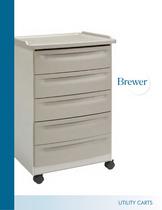
UTILITY CARTS
Open the catalog to page 1All The Brewer Company catalogs and technical brochures
 Brewer DENTAL SEATING
16 Pages
 Specialty Seating
4 Pages
 Clinical & Exam Room Solutions
28 Pages
 FLEX ™ Access Exam Table
2 Pages
 135 Series Saddle Seats
2 Pages
 Clinical Support Products
5 Pages
 Brewer Dental Catalog
9 Pages
 Industrial Seating Catalog
4 Pages
 Brewer Basic Exam Table
2 Pages
 Optical Seating Catalog
8 Pages
 135DSS Saddle Stool Brochure
3 Pages
 Medical Product Catalog
20 Pages
 Stationary Arm Supports
2 Pages
 DynaCore
4 Pages
 Ergonomic Seating
2 Pages
 Step Stools
2 Pages
 Instrument Stands
2 Pages
 IV Poles
2 Pages
 Infusion Pump Stands
2 Pages
 Hamper Stands
2 Pages
 Lighting
4 Pages
 Side Chairs
2 Pages
 Medical Seating
4 Pages
 Basic Exam Table
2 Pages
 Access High-Low Exam Table
4 Pages


Archived catalogs
 Dental Seating Catalog
12 Pages
Related Searches
- Examination couch
- Healthcare facility stool
- Infusion stand
- IV pole on castors
- Stool with backrest
- 4-hook infusion stand
- Ergonomic stool
- Dental stool
- Saddle seat stool
- Overbed table on castors
- Height-adjustable overbed table
- Doctor's office stool
- 2-hook infusion stand
- Office chair
- Telescopic IV pole
- Surgical bowl stand
- Office chair on casters
- Stainless steel surgical basin stand
- Trolley-mounted surgical basin stand
- Treatment table with storage unit
*Prices are pre-tax. They exclude delivery charges and customs duties and do not include additional charges for installation or activation options. Prices are indicative only and may vary by country, with changes to the cost of raw materials and exchange rates.
About MedicalExpo
MedicalExpo is a marketplace that offers B2B players a complete experience, from product sourcing to purchase. MedicalExpo is an entity of VirtualExpo Group.
Are you a buyer?
Are you a supplier?