
- Catalogs
- Bruker Daltonics Inc.
- MLKL Activation and Oligomerisation analysis using cross-linking LC-MS and Native Mass Spectrometry


MLKL Activation and Oligomerisation analysis using cross-linking LC-MS and Native Mass Spectrometry

MLKL Activation and Oligomerisation analysis using cross-linking LC-MS and Native Mass Spectrometry
The document discusses the importance of epitope mapping in therapeutic antibodies, focusing on hydrogen exchange mass spectrometry (HX-MS) as a technique to study protein structure and interactions. HX-MS provides insights into solvent accessibility and conformational changes during antigen binding, requiring precise sample preparation and high-resolution data interpretation.
Methods
The study utilized a fully automated robotic setup for HX-MS experiments, involving a liquid handling robot, UHPLC system, and UHR-QTOF mass spectrometer. The model system used was E. coli Hsp90 (HtpG), which undergoes conformational changes upon ATP binding. The experiment included multiple labeling time points and control samples, with data analysis performed using specialized software.
Results
The MS/MS experiments identified 179 peptides, with 47 selected for analysis, covering 95% of the sequence. ATP binding caused significant conformational changes, particularly in the N-terminal ATP binding domain, with high reproducibility observed. An EX1 exchange mechanism was noted, indicating two protein populations due to ATP hydrolysis.
Conclusion
The automated setup provided precise timing and high sensitivity, improving data quality and reproducibility compared to manual systems. The system's advantages were demonstrated using the model system, showing comparable results to previous studies but with enhanced quality.
Catalog excerpts
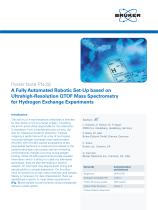
LXJ Poster Note PN-28 A Fully Automated Robotic Set-Up based on Ultrahigh-Resolution QTOF Mass Spectrometry for Hydrogen Exchange Experiments Introduction The activity of most therapeutic antibodies is directed by their ability to link to a target antigen. Localizing the amino acids (AAs) responsible for this interaction is mandatory from a mechanistic point of view, but also for intellectual property protection. Epitope mapping is performed with an array of techniques, including hydrogen exchange mass spectrometry (HX-MS). With HX-MS solvent accessibility of the polypeptide backbone is measured and related to the proteins secondary structureas well as monitoring conformational changes occurring during antigen binding. While HX-MS experiments provide valuable information which is difficult to obtain by alternative techniques, they are also demanding in several aspects. On one hand they require exact timing and reproducibility in sample preparation. On the other hand full sensitivity at high mass resolution and isotopic fidelity is necessary for data interpretation. Here we established a system to meet these requirements (Fig. 1) and studied its performance using a biologically relevant model system. Authors J2S J. Wiesner, N. Hentze, M. P. Mayer ZMBH Uni. Heidelberg, Heidelberg, Germany E. Belau, W. Jabs Bruker Daltonik GmbH, Bremen, Germany C. Evans Bruker Ltd., Coventry, UK G. Tremintin Bruker Daltonics Inc., Fremont, CA, USA Keywords Instrumentation and Software Biopharma UHR-QTOF Hydrogen Exchange (HX) maXis II Protein Structure studies HDX system Higher Order Structure impact II Protein-Protein Interactions
Open the catalog to page 1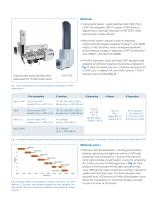
Methods • Instrumental Setup: Liquid handling robot (HDX PAL3, LEAP Technologies), UHPLC-system (1290 Infinity II, Agilent) and a ultra-high resolution (UHR) QTOF mass spectrometer (maXis, Bruker). • Benchmark system used as model for detecting conformational changes caused by binding: E. coli Hsp90 (HtpG), a 140 kDa dimer, which undergoes significant conformational changes in response to ATP binding [Graf et al. EMBO J. 28, 602-613 (2009)]. Sophisticated liquid handling robot specialized for HX-MS experiments • HX-MS Experiment: HtpG and HtpG+ATP samples were prepared at 5 different labeling...
Open the catalog to page 2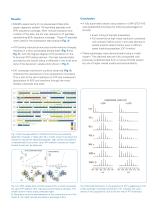
• S/MS experiments of non-deuterated HtpG after M pepsin digestion yielded 179 identified peptides with 97% sequence coverage. After manual evaluation and curation of the data, the list was reduced to 47 peptides representing 95% sequence coverage. These 47 peptides were used for the subsequent data analysis (Fig. 4). • fully automated robotic setup based on UHR-QTOF MS A was established providing the following advantages for HX-MS: • TP binding induced pronounced conformational changes, A resulting in a slow exchanging tensed state (Fig. 4 and Fig. 5), with the highest degree of HX protection...
Open the catalog to page 3
Bruker Daltonik GmbH Bremen · Germany Phone +49 (0)421-2205-0 [email protected] - www.bruker.com to change specifications without notice. © Bruker Daltonics 02-2016, PN-28, 1842877 Bruker Daltonics is continually improving its products and reserves the right For research use only. Not for use in diagnostic procedures.
Open the catalog to page 4All Bruker Daltonics Inc. catalogs and technical brochures
 Life Science Mass Spectrometry
20 Pages
 MASS SPECTROMETRY
20 Pages
 neofleX™
12 Pages
 timsOmniTM
20 Pages
Archived catalogs
 micrOTOF-Q III
6 Pages
 Toxtyper
6 Pages
 impact HD
12 Pages
 Radiation Backpack Sentry
4 Pages
 Product Overview
20 Pages
 The new autoflex speed
10 Pages
 solarix XR
12 Pages
 SIGIS II
2 Pages
 VeroTect
4 Pages
 µRAID
µRAID4 Pages
 SVG 2 and Probes
6 Pages
 MM2
MM26 Pages
 RAID M100
6 Pages
 RAID S2
6 Pages
 RAID XP
4 Pages
 pTD
pTD2 Pages
 RAID AFM
4 Pages
 DE-tector
6 Pages
 ImagePrep
4 Pages
 micrOTOF II
8 Pages
 impact II
12 Pages
 EVOQ
EVOQ6 Pages
 maxis II
12 Pages
 ProteinScape
8 Pages
 Bruker ToxScreener
6 Pages
 MALDI Biotyper CA System
12 Pages
 MALDI Biotyper Clinical IVD
6 Pages
 MBT Mycobacteria Library
4 Pages
 PesticideScreener 2.0
8 Pages
 rapifleX™ MALDI Tissuetyper™
8 Pages
 MALDI Imaging
16 Pages
 MBT Pharma
8 Pages
 MBT Disposable Targets US
2 Pages
 MBT BTS US
2 Pages
 MBT Sepsityper
6 Pages
 MBT Consumables RUO
4 Pages
 MBT SMART IVD
4 Pages
 MBT Pilot RUO
4 Pages
 MBT Galaxy RUO
4 Pages
 Quant Proteomics
8 Pages
 timsTOF Pro
6 Pages
 TargetScreener
6 Pages
 timsTOF™
8 Pages
 TASQ Software
4 Pages
 BioPharma Compass® 2.0
8 Pages
 Metabolomics
8 Pages
 spotOn™
4 Pages
 Product Overview
16 Pages
 Toxtyper
8 Pages
 CMC-assist
2 Pages
 IntelliSlidesTM
2 Pages
 MALDI Biotyper® CA System
12 Pages
 Label-Free Molecular Imaging
12 Pages
 EVOQ - 2014
6 Pages


- BRUKER analysis software
- Visualization software
- Control software
- Reporting software
- BRUKER laboratory software
- Monitoring software
- Acquisition software
- BRUKER benchtop spectrometer
- Simulation software
- Chromatography system
- Test software
- Import software
- Server-based software
- Real-time software
- Data analysis software
- Research software
- Interpretation software
- Compact spectrometer