
- Catalogs
- Bruker Daltonics Inc.
- Native MS Solutions scimaX MRMS: Perfectly designed for Native MS


Native MS Solutions scimaX MRMS: Perfectly designed for Native MS

Native MS Solutions scimaX MRMS: Perfectly designed for Native MS
- Ion Path: Optimized for native MS with a balanced pressure gradient, allowing transmission of intact complexes into the ParaCell for extreme resolution analysis.
- Standard Features: Includes 2xR ParaCell Detector, various dissociation techniques (nECD, SORI-CID, EID, ETD), Analytical Quadrupole CASI, Dual Stage Ion Funnel, and Dual ESI/MALDI Ion Source.
- Proprietary Technology: The ParaCell detector with patented magnetron control technology offers superior trapping capacity for high m/z, highly charged ions.
- Structural Biology: Essential for analyzing large proteins and complexes without breaking intra-molecular bonds, ensuring proteins are desolvated and charge does not overwhelm the detector.
- Drug Discovery: Used in fragment-based drug discovery (FBDD) to identify interactions between compounds and protein targets, as demonstrated in malaria drug target studies.
- Broadband Extreme Resolution: Detects molecules at 200 m/z with 20 million resolution and ppb mass accuracy.
- Extreme Sensitivity: Capable of observing protein concentrations from 100 µM to 10 nM.
- Flexibility: Interfaces with multiple ion sources and excels in various applications beyond native MS, such as MALDI Imaging and metabolomics.
- Professor Joe Loo highlights the impact of native MS and top-down proteomics in structural biology and medicine.
- Professor Ronald Quinn emphasizes the effectiveness of MRMS in retaining weak non-covalent complexes and screening compound pools.
Catalog excerpts

Native MS Solutions • scimaX MRMS: Perfectly designed for Native MS Mass Spectrometry Innovation with Integrity
Open the catalog to page 1
scimaX Ion Path – Perfectly Balanced for Native MS The critical requirement for native MS is an optimal pressure gradient between the electrospray source and the mass analyzer. The ion path on the scimaX MRMS (magnetic resonance mass spectrometry) enables the transmission of intact biomolecular complexes into the ParaCell, allowing for extreme resolution analysis. Now fragile fragment-protein, protein-substrate, multi-protein biomolecular complexes, membrane proteins with nanodiscs, mAbs, and native protein top-down analysis can all be analyzed on a standard (unmodified) scimaX. Standard features...
Open the catalog to page 2
Native MS of Protein Complexes (15T MRMS) 20* (D) Successful analysis of large proteins and their complexes requires three key conditions to be met. First, the proteins must be transmitted and detected without breaking intramolecular bonds. Secondly, the protein must be sufficiently desolvated to allow observation of the free protein ions. Finally, the extraordinary amount of charge on the molecules must not overwhelm the detector leading to space charge or coalescence issues. The scimaX and ParaCell technologies were designed with these goals in mind and are proven in labs worldwide for native...
Open the catalog to page 3
Native MS Applications for Fragment Based Drug Discovery MRMS takes on the challenge of discovering new drugs for Malaria Malaria causing, crescent shaped Plasmodium falciparum gametocyte in blood smear Advancing the frontiers of Fragment-Based Drug Design (FBDD), Professor Ron Quinn and co-workers of the Griffith Institute for Drug Discovery, analyzed a specially curated natural products fragment library of over 600 unique compounds against 62 separate potential malaria drug protein targets.[1] Using MRMS, 79 fragments were identified interacting with 31 proteins and later shown to have in vitro...
Open the catalog to page 4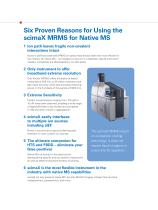
The scimaX MRMS is built on conduction cooling technology. It does not require liquid cryogens or a vent line for operation. Six Proven Reasons for Using the scimaX MRMS for Native MS 1 Ion path leaves fragile non-covalent interactions intact Bruker's perfectly balanced MRMS ion optics have always been the most efficient in the industry for native MS - no changes to vacuum or a separate, special instrument needed. Complexes are desolvated but not disrupted. 2 Only instrument to offer broadband extreme resolution Only Bruker MRMS offers the ability to detect molecules at 200 m/z at 20 million...
Open the catalog to page 5
Proven MS technology for routine analysis of native protein complexes Wongkongkathep P Han JY, Choi TS, Yin S, Kim HI, Loo JA. (2018) Native Top-Down Mass Spectrometry and Ion , Mobility MS for Characterizing the Cobalt and Manganese Metal Binding of α-Synuclein Protein, Journal of the American Society for Mass Spectrometry, 10.1007/s13361-018-2002-2, 29 (9), 1870–1880 Vu H, Pedro L, Mak T, McCormick B, Rowley J, Liu M, Quinn RJ (2018) Fragment-Based Screening of a Natural Product Library against 62 Potential Malaria Drug Targets Employing Native Mass Spectrometry, ACS Infectious Diseases, 0.1021/acsinfecdis.7b00197...
Open the catalog to page 6All Bruker Daltonics Inc. catalogs and technical brochures
 Life Science Mass Spectrometry
20 Pages
 MASS SPECTROMETRY
20 Pages
 neofleX™
12 Pages
 timsOmniTM
20 Pages
Archived catalogs
 micrOTOF-Q III
6 Pages
 Toxtyper
6 Pages
 impact HD
12 Pages
 Radiation Backpack Sentry
4 Pages
 Product Overview
20 Pages
 The new autoflex speed
10 Pages
 solarix XR
12 Pages
 SIGIS II
2 Pages
 VeroTect
4 Pages
 µRAID
µRAID4 Pages
 SVG 2 and Probes
6 Pages
 MM2
MM26 Pages
 RAID M100
6 Pages
 RAID S2
6 Pages
 RAID XP
4 Pages
 pTD
pTD2 Pages
 RAID AFM
4 Pages
 DE-tector
6 Pages
 ImagePrep
4 Pages
 micrOTOF II
8 Pages
 impact II
12 Pages
 EVOQ
EVOQ6 Pages
 maxis II
12 Pages
 ProteinScape
8 Pages
 Bruker ToxScreener
6 Pages
 MALDI Biotyper CA System
12 Pages
 MALDI Biotyper Clinical IVD
6 Pages
 MBT Mycobacteria Library
4 Pages
 PesticideScreener 2.0
8 Pages
 rapifleX™ MALDI Tissuetyper™
8 Pages
 MALDI Imaging
16 Pages
 MBT Pharma
8 Pages
 MBT Disposable Targets US
2 Pages
 MBT BTS US
2 Pages
 MBT Sepsityper
6 Pages
 MBT Consumables RUO
4 Pages
 MBT SMART IVD
4 Pages
 MBT Pilot RUO
4 Pages
 MBT Galaxy RUO
4 Pages
 Quant Proteomics
8 Pages
 timsTOF Pro
6 Pages
 TargetScreener
6 Pages
 timsTOF™
8 Pages
 TASQ Software
4 Pages
 BioPharma Compass® 2.0
8 Pages
 Metabolomics
8 Pages
 spotOn™
4 Pages
 Product Overview
16 Pages
 Toxtyper
8 Pages
 CMC-assist
2 Pages
 IntelliSlidesTM
2 Pages
 MALDI Biotyper® CA System
12 Pages
 Label-Free Molecular Imaging
12 Pages
 EVOQ - 2014
6 Pages


- BRUKER analysis software
- Visualization software
- Control software
- Reporting software
- BRUKER laboratory software
- BRUKER spectrometer
- Monitoring software
- Acquisition software
- BRUKER benchtop spectrometer
- Simulation software
- Chromatography system
- Import software
- Test software
- Server-based software
- Real-time software
- Data analysis software
- Research software
- Compact spectrometer
- Interpretation software
- BRUKER mass spectrometer