
- Catalogs
- Bruker Daltonics Inc.
- RAID AFM


RAID AFM

RAID AFM
The RAID-AFM (NC version) is a sophisticated monitoring system designed for the detection of chemical and nuclear threats, specifically tailored for the protection of critical infrastructure. It is developed by Bruker Daltonics and integrates advanced technologies to ensure safety and security in various facilities.
Key Features
- Non-radioactive XPITM Photo Ionization source, eliminating the need for special user licenses.
- Embedded web-interface for global sensor interrogation without additional software.
- Optional integrated doserate meter for gamma radiation measurement.
- High-speed reversible voltage source for concurrent detection of chemical and nuclear threats.
- Ion mobility spectrometer tube with excellent analytical reproducibility.
- Automatic overload control to protect sensors.
Applications
- Long-term monitoring of chemical agents and nuclear radiation in critical infrastructure.
- Early warning tool for civil and industrial applications.
- Integration into air-conditioning and fire safety systems.
- Control of workplace pollutants.
- Operable as a stand-alone instrument or networked for remote monitoring.
Technical Specifications
- Dimensions: 560 mm x 160 mm x 600 mm (LxWxH), 860 mm with radiation probe.
- Weight: 21 kg.
- Power: 100 – 230 V AC, 150 W; Optional: 18 – 32 V DC.
- Data interfaces: Ethernet.
- Temperature range: -5 °C to +60 °C (Storage), 0 °C to +60 °C (Operation).
- Humidity: Suitable for any atmospheric humidity.
- Drying filter lifetime: Approx. 9000 hours of operation.
- MTBF: > 1000 hours; MTTR: < 10 minutes (Operator Level), < 45 minutes (Direct Support).
- Training: Approx. 2 hours required to operate.
Detection Performance
- Detects compounds with proton or electron affinity in ppb and ppm concentration ranges.
- Standard compounds include sulfur dioxide, hydrogen cyanide, chlorine, and volatile chlorinated hydrocarbons.
- CWA detection includes GA, GB, GD, VX, HD, HN, L.
- Optional gamma-probe with a measuring range of 150 µSv/h – 200 μSv/h and energy range of 40 keV – 1.3 MeV.
Contact Information
Bruker Detection has offices in Germany, the United Kingdom, and the USA, providing contact details for sales and support.
Catalog excerpts

RAID AFM NC-version Automated Facility Monitor for Nuclear and Chemical Detection Innovation with Integrity Safety & Security
Open the catalog to page 1
Critical Infrastructure Protection (CIP) Many countries have or are working towards a strategy for the protection of their critical infrastructure. Critical infrastructure includes but is not limited to airports, power plants, banking and finance centers, water supply systems, governmental institutions, transportation, National Health Service. These facilities, services and institutions require an appropriate level of protection. Incidents directed at Critical Infrastructure such as a terrorist attack or a natural disaster, could have a major impact on the civil population, health and safety,...
Open the catalog to page 2
Protection areas ■ Early warning tool for civil and industrial applications ■ Long term monitoring of ambient air of areas and facilities for the presence of hazardous compounds and nuclear ■ Integration into air-conditioning and fire safety systems ■ Control of working place pollutants ■ Either operation as stand-alone XPI™ Photo Ionization source: |~1~| Non radioactive ionisation source Remote webserver monitorin EVENTS SETTINGS Visualization of instrument status ■ Control of instrument operation ■ Instrument configuration setting ■ Recordable event reader pocket computer with web-browser Operation...
Open the catalog to page 3
Technical Specifications Base Unit Drying filter lifetime Approx. 9000 hrs of operation Size 560 mm x 160 mm x 600 mm (LxWxH) 860 mm (Height with radiation probe) < 10 minutes (Operator Level) < 45 minutes (Direct Support) Power requirement 100 – 230 V AC, 150 W, Optional: 18 – 32 V DC Training required to operate the instrument Approx. 2 hrs Data interfaces Ethernet C-Detection performance Compounds with proton or electron affinity, detection limits in the ppb and ppm concentration range TIC’s: Standard compounds: sulfur dioxid, hydrogen cyanide, chlorine, volatile chlorinated hydrocarbons CWA:...
Open the catalog to page 4All Bruker Daltonics Inc. catalogs and technical brochures
 Life Science Mass Spectrometry
20 Pages
 MASS SPECTROMETRY
20 Pages
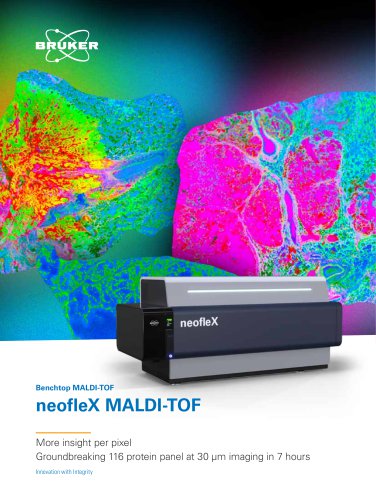 neofleX™
12 Pages
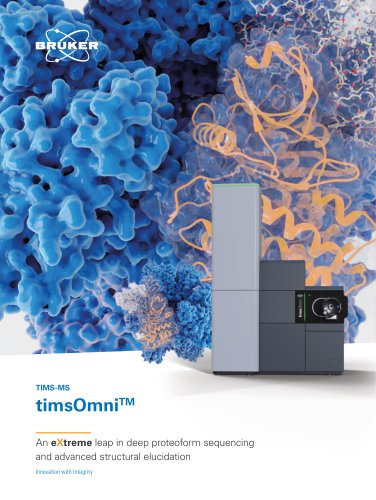 timsOmniTM
20 Pages
Archived catalogs
 micrOTOF-Q III
6 Pages
 Toxtyper
6 Pages
 impact HD
12 Pages
 Radiation Backpack Sentry
4 Pages
 Product Overview
20 Pages
 The new autoflex speed
10 Pages
 solarix XR
12 Pages
 SIGIS II
2 Pages
 VeroTect
4 Pages
 µRAID
µRAID4 Pages
 SVG 2 and Probes
6 Pages
 MM2
MM26 Pages
 RAID M100
6 Pages
 RAID S2
6 Pages
 RAID XP
4 Pages
 pTD
pTD2 Pages
 DE-tector
6 Pages
 ImagePrep
4 Pages
 micrOTOF II
8 Pages
 impact II
12 Pages
 EVOQ
EVOQ6 Pages
 maxis II
12 Pages
 ProteinScape
8 Pages
 Bruker ToxScreener
6 Pages
 MALDI Biotyper CA System
12 Pages
 MALDI Biotyper Clinical IVD
6 Pages
 MBT Mycobacteria Library
4 Pages
 PesticideScreener 2.0
8 Pages
 rapifleX™ MALDI Tissuetyper™
8 Pages
 MALDI Imaging
16 Pages
 MBT Pharma
8 Pages
 MBT Disposable Targets US
2 Pages
 MBT BTS US
2 Pages
 MBT Sepsityper
6 Pages
 MBT Consumables RUO
4 Pages
 MBT SMART IVD
4 Pages
 MBT Pilot RUO
4 Pages
 MBT Galaxy RUO
4 Pages
 Quant Proteomics
8 Pages
 timsTOF Pro
6 Pages
 TargetScreener
6 Pages
 timsTOF™
8 Pages
 TASQ Software
4 Pages
 BioPharma Compass® 2.0
8 Pages
 Metabolomics
8 Pages
 spotOn™
4 Pages
 Product Overview
16 Pages
 Toxtyper
8 Pages
 CMC-assist
2 Pages
 IntelliSlidesTM
2 Pages
 MALDI Biotyper® CA System
12 Pages
 Label-Free Molecular Imaging
12 Pages
 EVOQ - 2014
6 Pages


- BRUKER analysis software
- Visualization software
- Control software
- Reporting software
- BRUKER laboratory software
- Monitoring software
- Acquisition software
- BRUKER benchtop spectrometer
- Simulation software
- Chromatography system
- Import software
- Test software
- Server-based software
- Real-time software
- Data analysis software
- Research software
- Interpretation software
- Compact spectrometer
- BRUKER mass spectrometer