
- Catalogs
- Bruker Daltonics Inc.
- TargetScreener


TargetScreener

TargetScreener
Catalog excerpts

• A Comprehensive Screening Solution for Forensic Toxicology Innovation with Integri
Open the catalog to page 1
TargetScreener Get the Complete Picture Forensic laboratories are frequently required to perform comprehensive screening of complex samples to identify drugs and other toxicants. This is a very challenging task due to the enormous number of analytes covered, their wide range of concentration and the complexity of sample matrices tested. Within the field of forensic toxicology, there is high requirement for analytical certainty in the accuracy and completeness of the results, so as to ensure that they will stand up to scrutiny in a court of law. In recent years, owing to the high level of specificity...
Open the catalog to page 2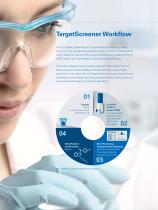
TargetScreener Workflow Prior to analysis, depending on the analytical requirements, blood serum or urine samples are prepared using LLE, SPE or protein precipitation. These are injected onto a reverse phase binary gradient UHPLCQTOF system for fragmentation, detection and confirmation. The Bruker TargetScreener employs a powerful and specific form of data acquisition called broadband CID (bbCID). This mode of data acquisition when used with the TargetScreener accurate mass forensic database and associated data mining software brings the full power of exact mass screening to the forensic laboratory....
Open the catalog to page 3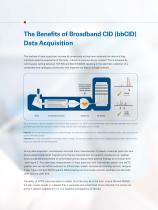
The Benefits of Broadband CID (bbCID) Data Acquisition This method of data acquisition ensures all compounds eluting have molecular ion data and fragmentation spectra acquired all of the time – hence no compounds are missed! This is achieved by continuously cycling between TOF-MS and bbCID MS/MS resulting in the seamless collection of a comprehensive catalogue of precursor and fragment ion data in a single analysis. Collision cell rapidly alternates between low and elevated collision energies Q1 allows all ions to pass Collision cell TOF-MS Detection bbCID MS/MS Confirmation Fig.2: Schematic...
Open the catalog to page 4
b) bbCID spectra, Qualifier Ions circled in green Fig.3: a) Chromatographic overlay of bbCID qualifier (QI) ion traces Fig.4: Broadband CID (bbCID) data acquisition differentiating two isomeric synthetic cannabinoids, JWH-122 and JWH-019. Their unique bbCID qualifier ions (highlighted in the green boxes) are used for unambiguous identification.
Open the catalog to page 5
TargetScreener Applications Kit The TargetScreener applications kit incorporates a forensic toxicology accurate mass database detailing the exact mass of molecular ions, adducts, fragment ions as well as retention times that have been collected using an optimized UHPLC gradient to maximize confidence in identification. This highly curated database is key to enabling accurate and sensitive detection and identification of relevant compounds. Also included within the applications kit are the analytical and guard columns, a test mix and all the necessary chromatographic and mass spectrometric parameters...
Open the catalog to page 6All Bruker Daltonics Inc. catalogs and technical brochures
 Life Science Mass Spectrometry
20 Pages
 MASS SPECTROMETRY
20 Pages
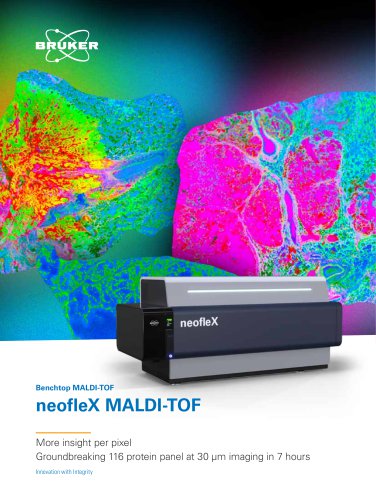 neofleX™
12 Pages
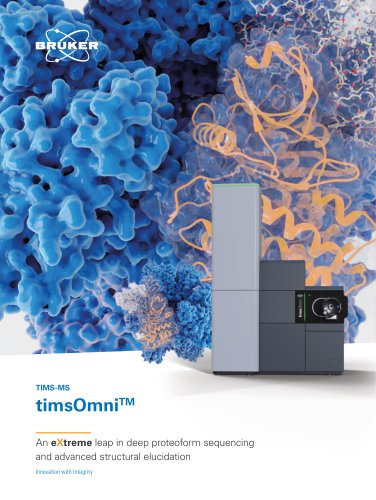 timsOmniTM
20 Pages
Archived catalogs
 micrOTOF-Q III
6 Pages
 Toxtyper
6 Pages
 impact HD
12 Pages
 Radiation Backpack Sentry
4 Pages
 Product Overview
20 Pages
 The new autoflex speed
10 Pages
 solarix XR
12 Pages
 SIGIS II
2 Pages
 VeroTect
4 Pages
 µRAID
µRAID4 Pages
 SVG 2 and Probes
6 Pages
 MM2
MM26 Pages
 RAID M100
6 Pages
 RAID S2
6 Pages
 RAID XP
4 Pages
 pTD
pTD2 Pages
 RAID AFM
4 Pages
 DE-tector
6 Pages
 ImagePrep
4 Pages
 micrOTOF II
8 Pages
 impact II
12 Pages
 EVOQ
EVOQ6 Pages
 maxis II
12 Pages
 ProteinScape
8 Pages
 Bruker ToxScreener
6 Pages
 MALDI Biotyper CA System
12 Pages
 MALDI Biotyper Clinical IVD
6 Pages
 MBT Mycobacteria Library
4 Pages
 PesticideScreener 2.0
8 Pages
 rapifleX™ MALDI Tissuetyper™
8 Pages
 MALDI Imaging
16 Pages
 MBT Pharma
8 Pages
 MBT Disposable Targets US
2 Pages
 MBT BTS US
2 Pages
 MBT Sepsityper
6 Pages
 MBT Consumables RUO
4 Pages
 MBT SMART IVD
4 Pages
 MBT Pilot RUO
4 Pages
 MBT Galaxy RUO
4 Pages
 Quant Proteomics
8 Pages
 timsTOF Pro
6 Pages
 timsTOF™
8 Pages
 TASQ Software
4 Pages
 BioPharma Compass® 2.0
8 Pages
 Metabolomics
8 Pages
 spotOn™
4 Pages
 Product Overview
16 Pages
 Toxtyper
8 Pages
 CMC-assist
2 Pages
 IntelliSlidesTM
2 Pages
 MALDI Biotyper® CA System
12 Pages
 Label-Free Molecular Imaging
12 Pages
 EVOQ - 2014
6 Pages


- BRUKER analysis software
- Visualization software
- Control software
- Reporting software
- BRUKER laboratory software
- BRUKER spectrometer
- Monitoring software
- Acquisition software
- BRUKER benchtop spectrometer
- Simulation software
- Chromatography system
- Import software
- Test software
- Server-based software
- Real-time software
- Data analysis software
- Research software
- Compact spectrometer
- Interpretation software
- BRUKER mass spectrometer