
- Catalogs
- Bruker Daltonics Inc.
- timsOmniTM


timsOmniTM
timsOmniTM
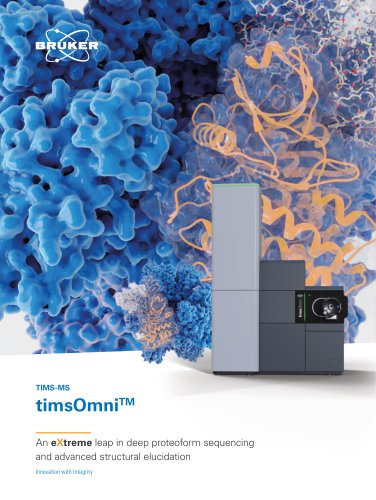
The timsOmniTM is a cutting-edge mass spectrometry instrument designed to enhance proteoform sequencing and structural elucidation. It offers high sensitivity and precision for analyzing proteoform diversity and identifying potential mutagenic impurities.
- Top-Down Mass Spectrometry: Employs electron-based fragmentation and complementary dissociation techniques for detailed molecular profiling.
- OmniScape™ Software: Delivers biology-relevant insights with exceptional depth and accuracy.
- Electron-Based Fragmentation: Features omni-directional MSn eXd with ion enrichment for improved sensitivity.
- Advanced Structural Elucidation: TIMS separation reveals conformational heterogeneity and structure, optimizing precursor utilization.
- Electron Capture Dissociation (ECD): Preserves labile post-translational modifications.
- Collision Induced Dissociation (CID): Produces b/y fragments with limited sequence coverage.
- Combination of ECD and CID: Enhances protein sequence coverage through formation of a/x, b/y, and c/z ions.
- Charge DDA (cDDA): Enables on-the-fly charge-state deconvolution during LC-MS analysis, targeting coeluting proteoforms and reducing chimeric spectra.
- Dynamic Precursor Accumulation: Optimizes ion fill times for enhanced signal-to-noise MSn spectra.
- Antibody Sequencing: Provides comprehensive ion sequence ladders for de novo sequencing and profiling of human plasma antibody repertoires.
- Biotherapeutics Monitoring: Facilitates time-resolved monitoring of in vivo biotransformation products to improve biotherapeutic efficacy.
- Histone Modifications: Offers high amino acid sequence coverage and accurate localization of post-translational modifications in histones.
The timsOmni system supports multimodal fragmentation (EID, ECD, CID, and ECD/CID) for complete sequence coverage and precise localization of post-translational modifications. Electron-based fragmentation methods achieve 70-80% coverage, while CID yields around 40%.
Combining native and top-down mass spectrometry with MSn and ion enrichment provides detailed structural insights into protein complexes, crucial for understanding protein assembly in health and disease, impacting drug development.
High-resolution glycan characterization is vital for biopharmaceutical development, emphasizing the preservation of glycan linkages during fragmentation for detailed glycosylation site mapping.
Essential for understanding biological processes and developing therapeutics, the timsOmni system's MSn eXd capabilities enable precise sequencing and characterization of oligonucleotide-based therapeutics.
Detailed structural elucidation is crucial in pharmaceutical development for assessing impurity toxicity. The timsOmni system provides advanced workflows, eliminating the need for impurity standards and accelerating drug development.
Enhances top-down sequence analysis by calculating theoretical isotopic distributions and selecting optimal sets to explain mass spectra, enabling high-confidence identification of monoisotopic masses.
The timsOmni system offers excellent sensitivity for bottom-up proteomics, allowing analysis of low input samples with high precision, supporting ultra-high sensitivity for both bottom-up and top-down proteomics.
The timsOmni system represents a significant advancement in proteoform sequencing and structural elucidation, offering versatile capabilities for a wide range of biomolecular analyses, positioning it as a powerful tool for research and development in various scientific fields.
Catalog excerpts
timsOmniTM An eXtreme leap in deep proteoform sequencing and advanced structural elucidation Innovation with Integrity
Open the catalog to page 1
An eXtreme leap for electron-based fragmentation techniques Welcome to the timsOmniTM , a transformative instrument poised to revolutionize mass spectrometry in systems biology. Designed to push the boundaries of scientific discovery, the timsOmni achieves extraordinary sensitivity, advances deep proteoform sequencing and delivers unprecedented precision in structural elucidation. Discovering the intricacies of proteoform diversity and gaining new insights into the functional plasticity of proteins is now within reach. The timsOmni further enables detailed structural elucidation of potential...
Open the catalog to page 2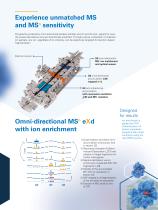
Experience unmatched MS and MSn sensitivity Powered by proprietary omni-directional lossless transfer and ion enrichment, signals for even the lowest-abundance ions are dramatically amplified. Through precise modulation of selected ion packets, any ion, regardless of its intensity, can be selectively targeted for electron-based fragmentation. Electron source Q8 omni-directional MSn ion enrichment and optical access Q5 omni-directional accumulation with trapped eXd Q2 omni-directional accumulation with resonance excitation CID and MSn isolation R Omni-directional MSn eXd with ion enrichment 1...
Open the catalog to page 3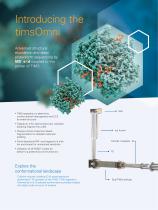
Advanced structural elucidation and deep proteoform sequencing by MSneXd coupled to the power of TIMS. • TIMS separation to determine conformational heterogeneity and CCS to reveal structure • Trapped eXd for optimal precursor utilization boosting fragment ion yield • Precise control of electron-based fragmentation for detailed molecular profiling • Omni-directional MSnand trapped eXd with ion enrichment for unmatched sensitivity Transfer multipole •— • Utilization of all PASEF modes for bottom-up proteomics and multiomics Explore theconformational landscape Collision induced unfolding (CIU)...
Open the catalog to page 4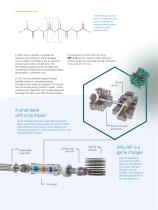
Nomenclature for the primary fragment ions types observed for peptides and proteins in tandem mass spectrometry. In ECD, when a protein or peptide ion captures a free electron, bond cleavage occurs rapidly and locally at the N–Cα bond, producing primarily c/z fragments. This non-ergodic process preserves labile post translational modifications like phosphorylation, glycosylation, sulfonation, etc. Combinations of ECD and CID using MSn eXd can be used to further enhance protein sequence coverage through formation of a/x, b/y and c/z ions. In CID, ions are gradually heated through multiple collisions,...
Open the catalog to page 5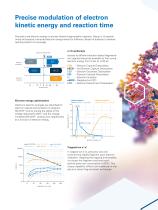
Precise modulation of electron kinetic energy and reaction time Precisely tune electron energy to access diverse fragmentation regimes. Adjust eXd d reaction times and explore uncharted electron energy levels for different classes of analytes to achieve optimal product ion coverage. eXd Landscape electron ionization Access to different electron-based fragmentation regimes becomes available by fine tuning electron energy from 0.1eV to >100 eV niECD electron capture Electron energy optimization – Electron Capture Dissociation – hot Electron Capture Dissociation – Electron Excitation Dissociation...
Open the catalog to page 6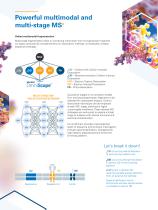
Powerful multimodal and multi-stage MSn Online multimodal fragmentation Multimodal fragmentation relies on combining information from first-generation fragment ion types, produced by complementary ion dissociation methods, to drastically increase sequence coverage. MULTI-STAGE MSn ION ACTIVATION NETWORK MS2 CID – Collision-cell Collision Induced C Dissociation CID – Resonant-excitation Collision Induced R Dissociation ECD – Electron Capture Dissociation EID – Electron Induced Dissociation PD – Photo-dissociation Successive stages of ion activation enable first- and second-generation fragments...
Open the catalog to page 7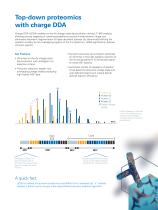
Charge DDA (cDDA) enables on-the-fly charge-state deconvolution during LC-MS analysis, allowing precise targeting of coeluting proteoforms across a wide dynamic range and eliminates redundant fragmentation of highly abundant species. By dynamically shifting the isolation window to non-overlapping regions of the m/z spectrum, cDDA significantly reduces chimeric spectra. • Ultra-fast on-the-fly charge-state deconvolution with intelligent m/z selection criteria. • Precursor selection targets nonoverlapping charge states producing high fidelity MS2 data. • Dynamic precursor accumulation optimizes...
Open the catalog to page 8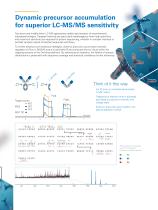
Dynamic precursor accumulation for superior LC-MS/MS sensitivity Top-down and middle-down LC-MS approaches enable rapid analysis of recombinantly expressed biologics. Targeted methods are particularly advantageous when high specificity and maximum sensitivity are required for protein sequencing, whether in complex matrices or purified samples typical of biopharmaceutical workflows. To further advance such analytical strategies, dynamic precursor accumulation actively regulates ion flow in MS/MS scans to optimally fill and compress the ion cloud within the trapping sections of the Omnitrap platform....
Open the catalog to page 9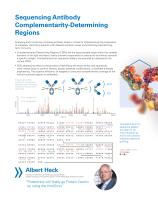
Sequencing Antibody Complementarity-Determining Regions Analyzing and monitoring circulating antibody levels is critical for characterizing the progression of a disease, identifying patients with delayed symptom onset and predicting potential longterm immunity. • Complementarity-Determining Regions (CDRs) are the hypervariable loops within the variable domains of the light and heavy chains primarily responsible for selectivity and affinity towards a specific antigen. Comprehensive ion sequence ladders are essential to characterize the unique CDRs. Protein centric ECD analysis of a therapeutic...
Open the catalog to page 10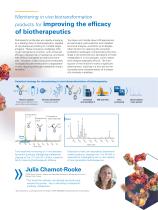
Monitoring in vivo biotransformation improving the efficacy of biotherapeutics products for Multispecific antibodies are rapidly emerging as a leading class of biotherapeutics, capable of simultaneously binding to multiple target antigens. These innovative modalities offer novel mechanisms of action, with enhanced efficacy, reduced risk of resistance, and fewer side effects compared to traditional therapies. However, unlike monoclonal antibodies, multispecifics are more prone to degradation in vivo, requiring thorough metabolite characterization. Top-down and middle-down MS approaches are particularly...
Open the catalog to page 11All Bruker Daltonics Inc. catalogs and technical brochures
 Life Science Mass Spectrometry
20 Pages
 MASS SPECTROMETRY
20 Pages
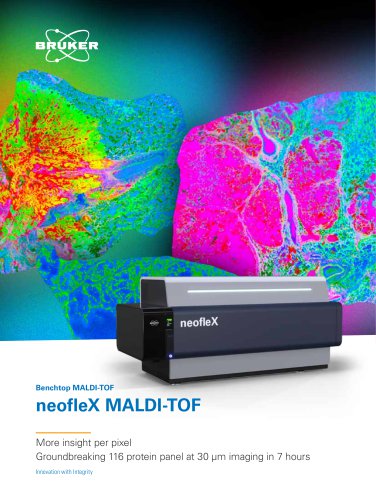 neofleX™
12 Pages
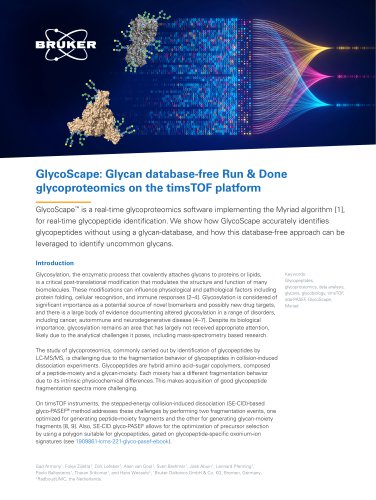
Archived catalogs
 micrOTOF-Q III
6 Pages
 Toxtyper
6 Pages
 impact HD
12 Pages
 Radiation Backpack Sentry
4 Pages
 Product Overview
20 Pages
 The new autoflex speed
10 Pages
 solarix XR
12 Pages
 SIGIS II
2 Pages
 VeroTect
4 Pages
 µRAID
µRAID4 Pages
 SVG 2 and Probes
6 Pages
 MM2
MM26 Pages
 RAID M100
6 Pages
 RAID S2
6 Pages
 RAID XP
4 Pages
 pTD
pTD2 Pages
 RAID AFM
4 Pages
 DE-tector
6 Pages
 ImagePrep
4 Pages
 micrOTOF II
8 Pages
 impact II
12 Pages
 EVOQ
EVOQ6 Pages
 maxis II
12 Pages
 ProteinScape
8 Pages
 Bruker ToxScreener
6 Pages
 MALDI Biotyper CA System
12 Pages
 MALDI Biotyper Clinical IVD
6 Pages
 MBT Mycobacteria Library
4 Pages
 PesticideScreener 2.0
8 Pages
 rapifleX™ MALDI Tissuetyper™
8 Pages
 MALDI Imaging
16 Pages
 MBT Pharma
8 Pages
 MBT Disposable Targets US
2 Pages
 MBT BTS US
2 Pages
 MBT Sepsityper
6 Pages
 MBT Consumables RUO
4 Pages
 MBT SMART IVD
4 Pages
 MBT Pilot RUO
4 Pages
 MBT Galaxy RUO
4 Pages
 Quant Proteomics
8 Pages
 timsTOF Pro
6 Pages
 TargetScreener
6 Pages
 timsTOF™
8 Pages
 TASQ Software
4 Pages
 BioPharma Compass® 2.0
8 Pages
 Metabolomics
8 Pages
 spotOn™
4 Pages
 Product Overview
16 Pages
 Toxtyper
8 Pages
 CMC-assist
2 Pages
 IntelliSlidesTM
2 Pages
 MALDI Biotyper® CA System
12 Pages
 Label-Free Molecular Imaging
12 Pages
 EVOQ - 2014
6 Pages


- BRUKER analysis software
- Visualization software
- Control software
- Reporting software
- BRUKER laboratory software
- BRUKER spectrometer
- Monitoring software
- Acquisition software
- BRUKER benchtop spectrometer
- Simulation software
- Chromatography system
- Import software
- Test software
- Server-based software
- Real-time software
- Data analysis software
- Research software
- Interpretation software
- Compact spectrometer
- BRUKER mass spectrometer